Expedition notes — the treasures of the glaciers of North and South II.
16 August 2018
The polar scientist Marie Šabacká is the leader of the 2018 Neuron Expedition. With her team she set off to study glaciers not only in the north but, above all, to obtain samples from tropical glaciers in Africa. Those remain in the background of scientists' interest, even though they are rarer than their northern counterparts — because of global warming they are disappearing far faster, and with them valuable information about ecology and climate. This expedition is of worldwide significance — it will be the first to compare samples from polar and tropical glaciers and to place them in a global context.
The polar scientist Marie Šabacká is the leader of the 2018 Neuron Expedition. With her team she set off to study glaciers not only in the north but, above all, to obtain samples from tropical glaciers in Africa. Those remain in the background of scientists' interest, even though they are rarer than their northern counterparts — because of global warming they are disappearing far faster, and with them valuable information about ecology and climate. This expedition is of worldwide significance — it will be the first to compare samples from polar and tropical glaciers and to place them in a global context.
Encounters with polar bears, thick clothing even in the middle of summer, frost, cold and endless polar days... but also wild nature and research that will contribute to explaining global change. We will now show you what the everyday "routine" of Marie Šabacká's team looks like.
A continuation of part I of Marie Šabacká's travel notes...
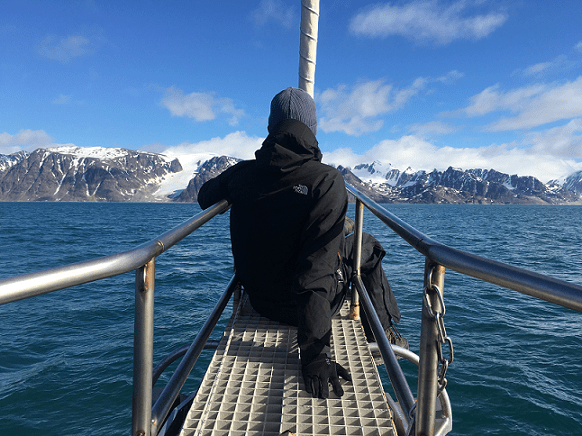
Twice we tried to sail through the Hinlopenstretet channel to reach localities in the southern part of Nordaustlandet, but we never managed it. A strong headwind was blowing and the sea was too rough; there was also a risk that we would not get back even if we managed to sail through. We also could not afford too much delay, because we would have jeopardised the Belgian scientific expedition that was sailing on the Clione after us. During the voyage all the members of the expedition took turns on watch at the helm, which meant keeping or, where necessary, changing course, watching out for ice floes and animals (walruses) and waking the other members of the crew if the cargo shifted on deck and had to be secured again.
Only in one channel did we have to manoeuvre between ice floes; everywhere else we met open sea, even at the northernmost tip of Svalbard, just below the 81st parallel north. Open sea this far north and in practically all the fjords and bays we travelled to is a rarity and a phenomenon only of the last few years.
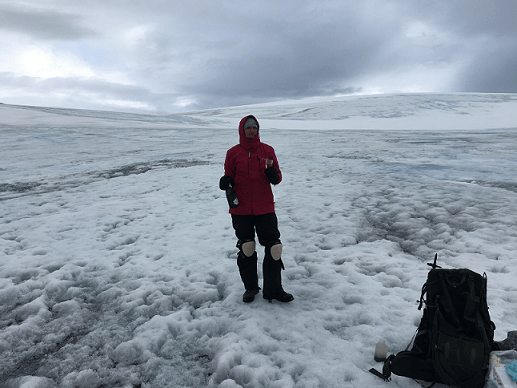
Altogether the voyage lasted 13 days (because of worsening weather we returned a day early) and we landed a total of 7 times. After landing we usually faced a walk of several kilometres to the glacier, where we sometimes had to wade across rivers. Wellingtons often were not enough and usually there was nothing for it but to strip down to our underwear. The temperature of glacial streams is around zero, so it was certainly nothing pleasant. For our scientific research it was important to collect samples and measurements from higher elevations, as far up as it was possible to get from a safety and logistical point of view, so a climb of several kilometres across the glacier awaited us too.
On land we spent long hours and often worked deep into the night, which during the polar day is not such a problem. On the shore we always left a safety box containing everything needed for emergency camping, in case we could not get back to the Clione. Fortunately that did not happen. On the last glacier, after the last sample, we opened champagne — or rather prosecco, because we cannot afford champagne ☺.
When will you set off for Africa, where exactly and for how long?
We leave at the beginning of June for five weeks for the Rwenzori region, which lies on the border of Uganda and Congo. We are heading for the Ugandan part. The Rwenzori, where Africa's third highest mountain, Mount Stanley, is located and the only place in Africa apart from Kilimanjaro and Mount Kenya where there are still glaciers. Kilimanjaro and Kenya are extinct volcanoes in the middle of plains, whereas the Rwenzori is a classic mountain range. First we have to get to the glaciers, which means a climb of several days from 1,600 metres above sea level to 4,500 metres above sea level, where we will stay for some time. Local guides and porters from the Bakonjo tribe will help us carry the scientific material up.
What will you be trying to demonstrate there, or rather what is your aim?
Tropical glaciers are fundamentally very different from glaciers found at higher latitudes (in the temperate zone and the polar regions). That is because in the tropics the climate is governed by monsoons, so instead of the classic four seasons there is an alternation of dry season and rainy season, but the average daily temperature does not change much over the year. On the contrary, there are marked differences between day and night. From a biological point of view that is extremely interesting, because life on these glaciers is not limited to a summer season and can develop continuously. We assume the communities should be richer than elsewhere in the world.
The main scientific aim is to create a comprehensive picture of the ecology of the Ugandan tropical glaciers, above all of the taxonomic and metabolic diversity of the microorganisms that inhabit them. We want to establish whether tropical glaciers are merely the southernmost outposts of extensive polar ecosystems or whether they host entirely unique communities. To do that, however, it is necessary to compare them with the communities found on temperate and polar glaciers.
During the climb to the glacier we will take soil samples in order to obtain an altitudinal gradient from 1,600 m above sea level to 5,000 m above sea level. On the glacier itself we will take samples of ice, snow, sediments and meltwater. In addition we will carry out experiments that will help us find out, for instance, whether pollution of the glacier by dust from the burning of rainforests has any impact on glacial communities. To measure the current total size of the Rwenzori glaciers and their coverage by microbial communities we will use drones.
Scientists pay almost no attention to tropical glaciers, even though they have marked peculiarities and are the fastest disappearing biotopes on the planet. Their retreat often has a strong socioeconomic impact on the local inhabitants. That is why, besides its scientific aims, our expedition also has a popularising character. Two members of the expedition will be the leading Czech filmmakers Rudolf Havlík and Václav Tlapák. Together with them we will make a documentary film not only about our scientific work and about the glaciers but also about the lives of the people of the Bakonjo tribe, who live in the foothills, and how they are coping with the loss of the glaciers around them.