What we took away from the Critical Thinking conference
30 July 2018
For the umpteenth time we became a partner of the Krimyš (Critical Thinking) conference. The event is organised by the GrowJOB institute. Why critical thinking of all things? In an age of manipulation and fabricated reports (hoaxes, fake news), critical thinking is one of the most important subjects for the future of society. According to the Future Jobs report published by the World Economic Forum, critical thinking will also be one of the most essential skills on the labour market in 2020. This year again the programme was full of interesting speakers and experts, and we bring you a short report with the most interesting observations.
For the umpteenth time we became a partner of the Krimyš (Critical Thinking) conference. The event is organised by the GrowJOB institute. Why critical thinking of all things? In an age of manipulation and fabricated reports (hoaxes, fake news), critical thinking is one of the most important subjects for the future of society. According to the Future Jobs report published by the World Economic Forum, critical thinking will also be one of the most essential skills on the labour market in 2020. This year again the programme was full of interesting speakers and experts, and we bring you a short report with the most interesting observations.
The Krimyš conference (an abbreviation of the Czech for critical thinking) took place on Thursday 26 July at the Lucerna cinema in Prague. A hall filled to the last seat suggested that the programme of lectures would be very interesting. The whole evening was guided by Lukáš Hána, founder of the conference and an expert on critical thinking.
The conference was opened by Petr Ludwig, founder of the GrowJOB Institute, with his contribution on how critical thinking could become a field in which the Czech Republic excels. Just as Estonia became famous for e-government, our country could set the trend in teaching critical thinking. He stressed that critical thinking should nowadays start to be built into curricula, so that from a young age people have a tool with which to assess the truthfulness of information.
Andrea Procházková, a journalist at Respekt and a student at the faculty of law, showed with real examples how different periodicals approach the presentation of identical information. The differences between approaches to journalism are really large, both on the Czech market and internationally. Readers should therefore always verify a given piece of information from several relevant sources.
The next speaker, Martin Rota, a well-known YouTuber, showed us how his videos come about — videos that critically and wittily take apart current pseudo-scientific topics, hoaxes and mystifications. What works on viewers and how difficult it is to shoot content that holds a viewer's attention in today's overloaded age.
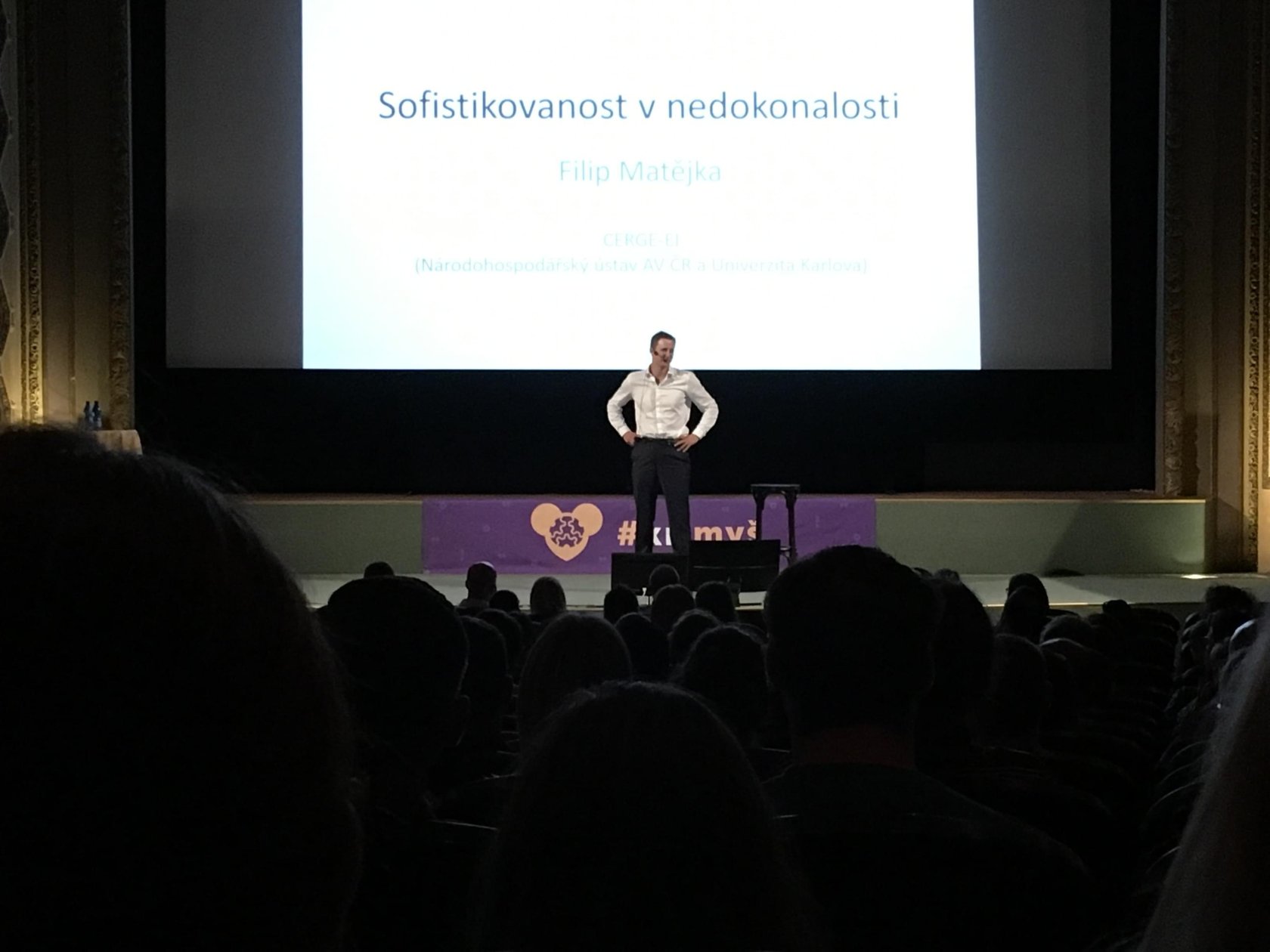
A contribution entitled "Sophistication in imperfection" was delivered by Filip Matějka, an economist from CERGE-EI and a 2016 Neuron Award laureate. The theory of rational inattention reveals something of how we are able to process and evaluate information. Classic economic models assumed that a person always has the information they need and that on the basis of it they can decide correctly. But that does not work in real life. Filip showed with examples that the level of inattention can change depending on the quantity of information provided and available, and how these mechanisms operate when applying for a job or looking for a flat to rent, for instance.
Bjoern Lomborg, president of the Copenhagen Consensus Center, was confirmed in the programme at the last minute. His lecture "How can nations spend smarter?" raised many questions in the audience. In brief it is about rationalising and optimising financial flows (whether humanitarian aid, development cooperation or, say, the standard flows of the state budget) according to their "added value". On the basis of a cost-benefit analysis, the effect of this money could be many times greater. Rather than focusing on a large number of small projects, it is effective to concentrate on a few promising projects in which the money invested brings many times greater value.
Vojtěch Buk, co-author of a book on fake news and founder of the project zvolsi.info, supplied the audience with many practical examples of fake news and with observations gained from teaching critical thinking at primary and secondary schools.
The conference was closed by Lukáš Hána, a lecturer in critical thinking, who presented a technique with which we can train critical thinking. The technique consists of three easy steps:
1) challenge
2) consider
3) conclude
How to do it? Information and "facts" that seem suspicious to us should be analysed with these three steps. First try to attack (challenge) the hypothesis, then look for alternative explanations or variants of the hypothesis, and finally assess these steps — whether the alternative explanations do or do not fit the hypothesis — and draw your own conclusion from it.
All the contributions will be available as recordings on the conference website.
NEWS & CURRENT AFFAIRS
Unexpected discoveries, happy accidents,
hard work and dreams come true.