"Expedition notes: the treasures of the glaciers of North and South — part I."
1 August 2019
The polar scientist Marie Šabacká is the leader of the 2018 Neuron Expedition. With her team she set off to study glaciers not only in the north but, above all, to obtain samples from tropical glaciers in Africa. Those remain in the background of scientists' interest, even though they are rarer than their northern counterparts — because of global warming they are disappearing far faster, and with them valuable information about ecology and climate. This expedition is of worldwide significance — it will be the first to compare samples from polar and tropical glaciers and to place them in a global context.
Marie Šabacká recently returned from the first part of the expedition — research into the glaciers of Svalbard. "The expedition to the northern part of Svalbard went very successfully. We obtained a large quantity of samples and measurements, which we are currently processing." As she says herself, she is roughly halfway through her mission. The team is now preparing for the main part of the expedition, to the tropical glaciers in Africa. Although they had to postpone their departure by a few months compared with the plan because of the serious illness of one member of the team, she says: "Our expedition to the tropical glaciers in Uganda is largely prepared. We leave in June."
There is much to look forward to.
What results did the first phase in Svalbard bring? Are you satisfied with how it went?
I am very satisfied with how it went. And we got to most of the localities we needed. We managed to obtain samples and measurements from distant glaciers, from 80° north, which is as far north as we are realistically able to get. With that we will have a completed transect from almost the pole to the equator. At present we have sorted through the samples and counted the microscopic animals — tardigrades and rotifers. From most of the samples we have isolated DNA and are preparing them for genome sequencing. We will have the final data during the spring.
Was there anything that surprised you during the research?
We encountered a relatively large number of polar bears: one male and two females with cubs. Altogether we saw six bears during this voyage. The presence of bears prevented us several times from landing at a given locality and we had to move a little further on.
The male we saw on the island of Phippsøya was unfortunately shot a few days later by a group of German tourists. They did not notice the bear before landing, because it was probably hidden behind a fold in the terrain. The bear attacked one of the guides who had landed first to check that the shore was safe. Unfortunately they had no choice but to shoot the aggressive bear. This news appeared in media all over the world and our newspapers picked it up too. Any shooting or injuring of a bear in Svalbard must be reported and is investigated by the governor's office. If it is proved that there was some failure on the part of those who shot (for instance if they did not observe safety rules or did not have the prescribed safety equipment with them), they receive a fine or even face expulsion, restriction of their activities or a ban on entering Svalbard. The results of the investigation into this case have not yet been published.
From a scientific point of view it was key for us to obtain samples and measurements from the large glaciers of the northern part of Svalbard. These ice caps are mini versions of the Greenland and Antarctic ice sheets. We study cryoconites, small holes on the surface of glaciers. They are little mini pools where rich microbial life exists. We found that on the tops of these ice caps the cryoconites are large and very well developed. That is because the conditions, though more extreme, are more stable here. The organisms that interest us thus have, perhaps paradoxically, better conditions for life and development here than on glaciers further south, because their environment is stable and they are not so often flushed out by meltwater.
What were the research conditions like?
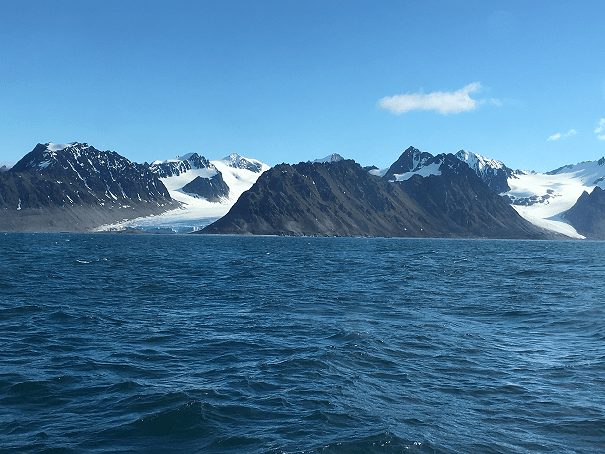
The north-eastern part of Svalbard, where we went, is much colder than the western part, where most scientists and tourists go. That is because the east is not washed by the warm (up to +8 °C) West Spitsbergen Current, an offshoot of the Gulf Stream we know better, but on the contrary by the cold (−1.7 to +2 °C) East Spitsbergen Current, which flows here from Siberia via the North Pole. Even water at such a low temperature did not stop us swimming on one beautiful sunny day.
While at sea and in the lowlands temperatures were just above zero, on the tops of the glaciers, where we spent most of our time, it was freezing. Combined with a strong wind and often poor visibility, the conditions were truly wintry. Being wrapped up in the middle of July in two down jackets, ski goggles and mittens the size of my head is unusual even for experienced Arctic polar scientists.
Not only because of the bears but also because of the weather we had to keep our programme flexible and adapt to conditions. While sailing north we had good weather and our yacht Clione could keep up a speed of 6 knots (nautical miles per hour). During the expedition and on the way back it was a little worse.
How did the voyage of the ship Clione turn out? What is it like to swim beneath glaciers and which drink is best chilled in a glacial hollow? You will find out in the second part of Marie Šabacká's travel notes.