"Expedition notes: the journey after ayahuasca — part II."
2 May 2019
In May 2019 a fundamental breakthrough occurred in Dr Tomáš Páleníček's Neuron Expedition in search of ayahuasca. After three years of painstaking work, the indigenous inhabitants of the Amazon agreed to cooperate — for the very first time in history — with Western scientists on a research project. This wonderful success means that the Neuron Expedition team can continue its unique research into ayahuasca. Using mobile EEG devices the team wants to record the brain activity of Indian volunteers taking ayahuasca during traditional rituals. The aim is to understand how it works and how ayahuasca might one day be used in treating depression.
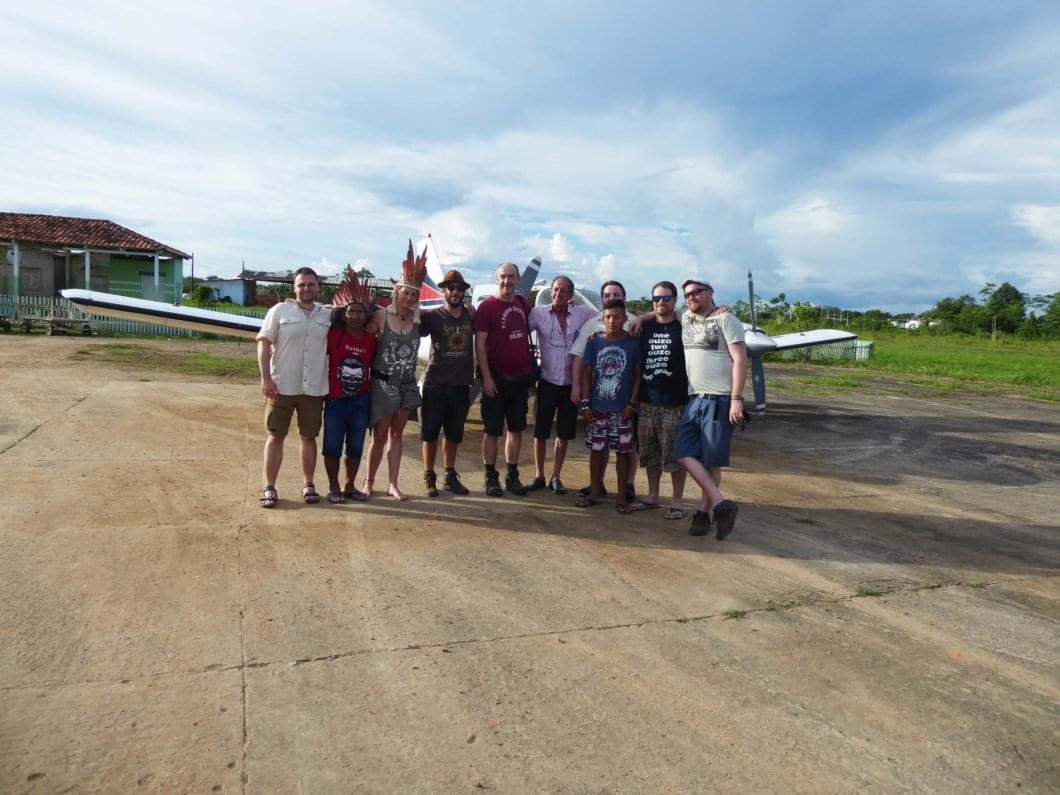
In May 2019 a fundamental breakthrough occurred in Dr Tomáš Páleníček's Neuron Expedition in search of ayahuasca. After three years of painstaking work, the indigenous inhabitants of the Amazon agreed to cooperate — for the very first time in history — with Western scientists on a research project. This wonderful success means that the Neuron Expedition team can continue its unique research into ayahuasca. Using mobile EEG devices the team wants to record the brain activity of Indian volunteers taking ayahuasca during traditional rituals. The aim is to understand how it works and how ayahuasca might one day be used in treating depression.
"We have established important and warm relationships; they (the Indians) want to support us and cooperate on the research. I believe this is the first time ever that Western neuroscientists have gained such a level of cooperation. We also managed to test the equipment, whose use in this extreme environment may bring certain limitations," says the expedition leader Tomáš Páleníček.
How did the latest visit to the Huni Kui tribe go? Read more in the note from the expedition:
After arriving in Brazil in May, we headed for the small town of Santa Rosa do Purus. It lies in the very heart of the Amazon rainforest in the state of Acre. 80 % of the inhabitants there belong to the Huni Kui tribe.
We were greatly honoured when the local leader Naxima decided to organise two ceremonies with Nixi Pae (the Huni Kui name for ayahuasca) in our honour, in the presence of his family and a respected old "pajé" (shaman). Everything took place entirely naturally and we were enthralled — not only could we observe the ritual, but its participants agreed to fill in psychometric scales describing the subjective nature of their experiences. The pilot data were in the world!
A great challenge for us, however, remained the extreme conditions of the local environment. The high humidity and temperature troubled not only us humans but especially the equipment — during an attempt to record EEG during a Nixi Pae ceremony the device stopped working. It overheated. And so badly that it was unusable for further measurements. Fortunately our colleague Frank had two devices in reserve, so our ability to make EEG recordings was not significantly limited.
After fulfilling days in Santa Rosa we moved on to Peru, to the Mayantuyacu centre, which lies in the jungle near the town of Pucallpa. The centre lies in a beautiful spot on the bank of the Shanay-Timpishka, a river with almost boiling water at a temperature of around 90 °C. The place was founded and is led by maestro (shaman) Juan Flores of the Ashaninka tribe. The famous anthropologist and ayahuasca researcher Jeremy Narby also took part in its development. Maestro Juan shared with us his knowledge of the plants they use to treat various illnesses and allowed us to present our plan to him, including a practical demonstration of the EEG equipment.
The ayahuasca ceremony was prepared for the second evening. This time the EEG equipment was successfully tested and the EEG of the expedition leader Tomáš Páleníček was recorded throughout the ritual. Maestro Juan also agreed to cooperate and to involve the centre in the research.
Two weeks after our return from the journey to the Amazon, our collaborator Eduardo Schenberg presented the project and the preliminary results at the fourth great assembly of the whole Huni Kui tribe. It was organised by the umbrella organisation FEPHAC in the city of Rio Branco. It was the largest gathering of the Huni Kui tribe ever organised! More than 300 representatives from all 104 Huni Kui aldeias came together. Several political subjects were discussed; for us the most important thing was that the assembly unanimously approved cooperation on our study. For the first time in history a whole indigenous tribe gave the green light to scientific cooperation — and with our team at that! What an honour!
Despite this wonderful success, a long road still lies ahead of us. We have to resolve the technical problems of recording EEG and the questions concerning the analysis of the data collected. Although the study has been ethically approved by the Czech ethics board, it still needs the consent of Brazilian and Peruvian local authorities.
What lies ahead?
The main part of the expedition is planned for the beginning of 2020. "The study should above all answer whether the traditional environment can bring long-term positive effects on mood and well-being. At the same time we are interested in the neurobiological biomarkers of these changes, so that we can measure them we are taking mobile EEG devices with us. Secondly, we believe that ritual psychedelic experiences can induce a connection between people. When we record EEG during a ceremony, we will also assess the connection between the brains of the individual participants including the shaman. We will use precisely synchronised EEG caps, which will allow us to investigate these manifestations. We also think that experiences with ayahuasca may change interpersonal relationships in the long term, increase social responsibility and support the ability to connect with others, or even influence our relationship to ourselves and to nature," says Tomáš Páleníček.
More also here: http://psyresfoundation.eu/expedice-neuron-doktori-na-tripu/
Tomáš Páleníček
He has worked at the National Institute of Mental Health (NUDZ, formerly the Prague Psychiatric Centre) since 2001, when he began preclinical research into the neurobiology of schizophrenia in pharmacological models of psychosis. Very soon he extended his field of activity to research into the neurobiology of the effects of psychedelics (LSD, psilocin, 2C-B, mescaline and so on) and entactogens (the drug Ecstasy, or MDMA) and of new synthetic drugs. Alongside the research activities carried out during his postgraduate studies he completed clinical training in psychiatry and obtained a specialist qualification in electroencephalography (EEG). He defended his PhD in 2009 and obtained his specialisation in psychiatry in 2012. He has now extended his research activities to human experiments as well. He takes part in projects with ketamine as a model of psychosis and also in studying its antidepressant effects. He is the principal investigator of the first project in the Czech Republic aimed at researching the acute effects of cannabis in healthy volunteers and of the first project in the Czech Republic in which the psychedelic psilocybin is administered to human volunteers as a model of psychosis. The main direction he pursues within this research is the functional connectivity of the brain, studied by means of EEG. In clinical practice he currently works in outpatient care.