Czech Egyptologists have found a rare tomb, with Neuron's support!
6 April 2019
"The king's wife, his beloved Setibhor"
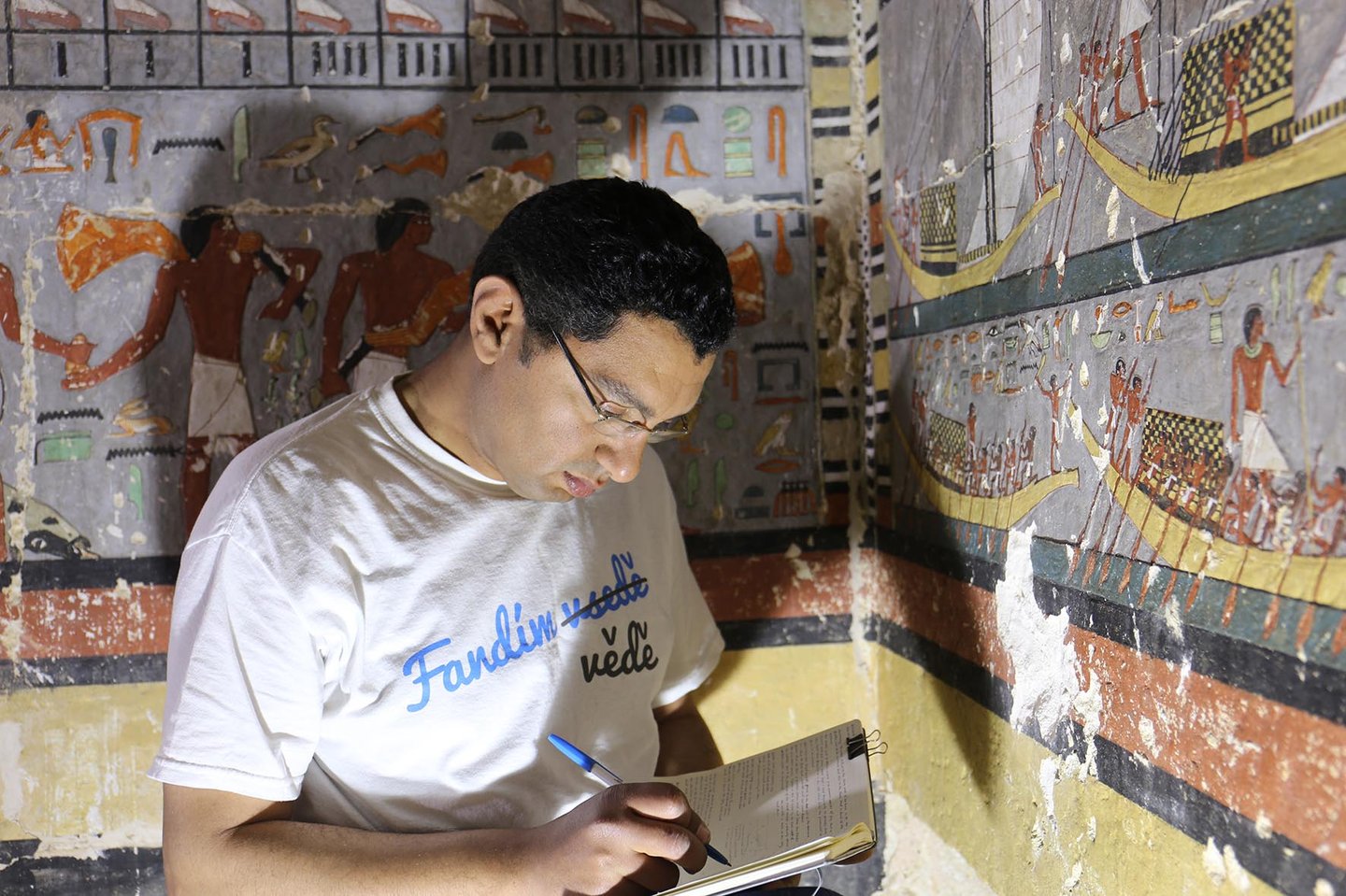
Czech Egyptologists led by Mohamed Megahed have scored another bullseye in Egypt. They have discovered the unique tomb of the dignitary Khuy, who lived at the end of the 5th Dynasty in the twilight of the Old Kingdom. The tomb was uncovered during research and documentation work in the area of South Saqqara. Neuron supported the research with a Neuron Impuls grant and we are delighted that we could once again be there for a discovery of world significance!
"This unexpected find was made possible in part by the support of the Neuron Endowment Fund. A large part of the consolidation work and the restoration interventions needed to protect this exceptional tomb was carried out thanks to the Neuron Impuls grant," says Mohamed Megahed, holder of a 2017 Neuron Impuls, of the discovery.
"The Egyptian expedition led by a member of the Czech Institute of Egyptology of the Faculty of Arts of Charles University and holder of a Neuron grant for young scientists, Dr Mohamed Megahed, crowned months of effort with two world discoveries in the pyramid field at South Saqqara. It managed to investigate the pyramid complex of Queen Setibhor, the largest of its kind from the 3rd millennium BC. Alongside that it also discovered the tomb of the dignitary Khuy with unique and practically undamaged decoration of the burial chamber. Both complexes date from the 24th century BC and contribute in a fundamental way to our knowledge of that period and of the gradual decline of the famous age of the pyramid builders," says Miroslav Bárta, director of the Czech Institute of Egyptology, of the success.
"The king's wife, his beloved Setibhor"
The discovery of Khuy's tomb highlights the significance of the reign of King Djedkare and of the late 5th Dynasty. In his mortuary complex the expedition also managed to discover evidence of a hitherto unknown queen from the end of the 5th Dynasty. The name and titles of Queen Setibhor were found on a column in the southern part of her pyramid complex. Experts had been trying for decades to answer the question of who owned this unusual monument, which adjoins the pyramid complex of the 5th Dynasty king Djedkare.
The queen's name and her titles are carved on a red granite column located in the newly uncovered entrance to her pyramid complex. The hieroglyphic inscription, executed in sunk relief and bounded by a rectangular frame, contains several of the queen's titles, including the most important: "the king's wife, his beloved Setibhor".
The red granite column, along with dozens of limestone blocks and smaller fragments bearing the remains of relief decoration from the queen's monument, was uncovered by the experts during documentation work in the northern part of Djedkare's pyramid complex, from where the complex of his queen was entered.
The pyramid complex of Queen Setibhor was among the first to be built at South Saqqara at the end of the 5th Egyptian Dynasty. It is at the same time the largest pyramid complex belonging to a queen from the whole of the Old Kingdom. What is more, her mortuary temple included architectural elements and features that were at the time reserved for rulers alone. The great size of Queen Setibhor's pyramid complex and her title of king's wife suggest that it may have been she who helped her husband, King Djedkare, to the Egyptian throne at the end of the 5th Dynasty. Djedkare then apparently sought to honour his queen by building for her a great monument with many unusual features, including the newly found red granite palm column — such columns had until now been known only from the complexes of rulers, not of queens, of the Old Kingdom.
What does the tomb look like inside?
The above-ground part of the tomb contains an offering room that was once decorated with reliefs. Only the lower edge of these survives today, as a result of the activities of later stone thieves who recycled the blocks of fine white limestone from this structure for their own buildings. In the northern wall of the tomb an entrance opens into the underground spaces, whose plan is evidently inspired by the substructures of the royal pyramids of the 5th Dynasty. A descending corridor led underground, from which one entered a vestibule and, through a short passage in its southern wall, a decorated antechamber. The decoration of the northern and southern sides of the antechamber shows the owner seated at an offering table, while the eastern wall was covered by a list of offerings and the western wall bore the motif of a palace façade.
Two entrances in the western wall of the antechamber led into the burial chamber itself, which was undecorated. It seems that almost its entire area was originally filled by a limestone sarcophagus, completely destroyed by ancient thieves. Nevertheless the experts discovered here parts of Khuy's body bearing clear signs of mummification. An entrance in the southern wall of the antechamber allowed access to a small room that served as a store. In the fill that almost completely filled it, only small remains of objects from the burial equipment were found. Take a look at what the tomb looks like here!
How will the research continue?
Archaeological work in the pyramid complexes of King Djedkare and Queen Setibhor and in the adjoining cemetery will continue, and the experts hope they will manage to discover further evidence about the end of the 5th and the beginning of the 6th Dynasty of Egyptian kings. It was a time when the royal ideology and religious ideas were being transformed, a time when, under Djedkare's successor Unas, the Pyramid Texts first appeared on the walls of the inner chambers of the pyramids, and when the building of what are called sun temples, which every king of the 5th Dynasty up to the accession of Djedkare had constructed, came to an end.