Mathematics and hope: Neuron laureates describe how they look for truth
There is no doing without mathematics. Not even today! In the English-speaking world 14 March is written the other way round, as 3.14, which led to it becoming Pi Day (π). That is, the day of probably the most famous mathematical constant. In 2019 UNESCO also chose it as the International Day of Mathematics, which has a theme every year — this year's is "Mathematics and Hope".
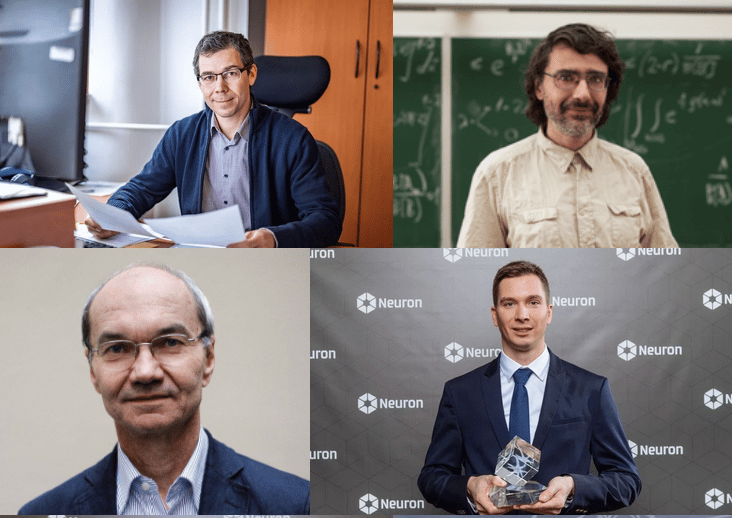
There is no doing without mathematics. Not even today! In the English-speaking world 14 March is written the other way round, as 3.14, which led to it becoming Pi Day (π). That is, the day of probably the most famous mathematical constant. In 2019 UNESCO also chose it as the International Day of Mathematics, which has a theme every year — this year's is "Mathematics and Hope".
"With this theme the organisation celebrates mathematics as a universal language that inspires understanding, cooperation and optimism in addressing humanity's shared challenges," the Union of Czech Mathematicians and Physicists said. That is also why we asked selected holders of Neuron Awards in mathematics to tell us where they see the strength and the hope of their beloved discipline.
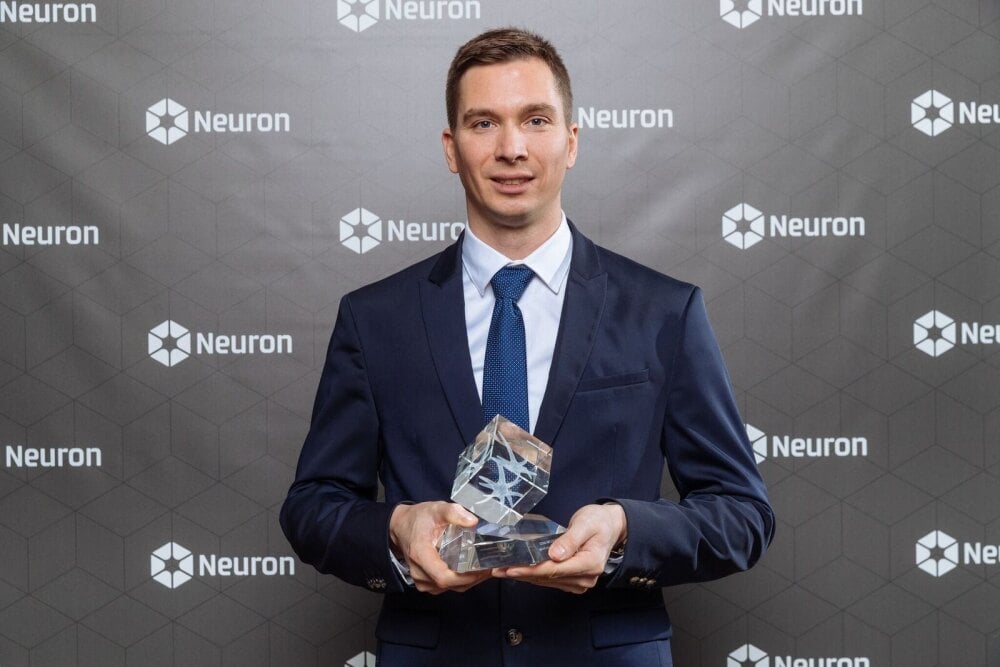
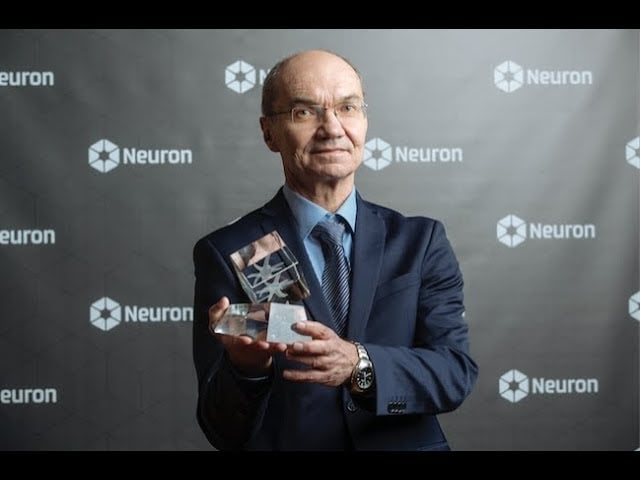
According to the laureates we approached, the strength of mathematics lies "in its concern with the search for truth" (Tomáš Vejchodský), or "in its impartiality and objectivity" (Benjamin Vejnar), or in the fact that it "formulates problems precisely and provides unambiguous answers" (Pavel Pudlák). It is also strong because "results achieved in it have no 'expiry date' — they remain valid for ever" (Jan Volec). Women mathematicians honoured by Neuron — Lenka Slavíková, for instance — recently revealed that one of their career role models was the Iranian mathematician Maryam Mirzakhani, the first woman ever to win the Fields Medal (2014), the highest honour in the field.
Now read the full answers of leading Czech mathematicians connected with the Neuron Foundation: they talk both about hope in mathematics and about their current work.
1) Where do you see the main strength and hope of mathematics?
2) What are you working on in mathematics at the moment — and do you expect promising results?
Pavel Pudlák
Neuron Award for contribution to world science 2017
(Institute of Mathematics of the Czech Academy of Sciences)
- The strength of mathematics lies in the fact that it makes it possible to formulate problems precisely and provides unambiguous answers. That also gives me hope that mathematicians will be needed even when artificial intelligence (AI) is better at solving mathematical problems. They will be needed to set the problems for artificial intelligence and then explain how the results can be used.
- At present I am working on a new edition of a book about the logical foundations of mathematics and computational complexity. I also devote some time to working on problems, especially in proof complexity. This line of research is connected with very hard problems such as the question of whether P=NP. I do not believe I will manage to solve such a problem, but I hope my results will help bring a solution closer.
Tomáš Vejchodský
Neuron Impulse 2016
(Institute of Mathematics of the Czech Academy of Sciences)
- Certainly in its intense concern with the search for truth. Mathematics is a beautiful world in which all people of good will agree on which statements are true and which are not. It is an abstract world of ideal objects, and yet it repeatedly turns out that mathematical truths have surprisingly deep and practical consequences for our real world. The giant of Czech mathematics Professor Jaroslav Kurzweil said: "In mathematics — unlike in politics — what was true before remains true today."
- Together with colleagues at the Institute of Mathematics of the Czech Academy of Sciences we are developing numerical software for solving large-scale problems from engineering practice, for instance modelling fluid flow or the elastic deformation of bodies. We address the challenge of how to implement these methods efficiently on the largest supercomputers with a fairly unique combination of the domain decomposition method, which allows a large problem to be divided into many smaller parts solved simultaneously, and an adaptive algorithm that can automatically refine the computation where it is most needed. In order to be able to use these approaches for geometrically complicated domains too, we focus on so-called embedded boundary methods. These make it possible to capture the complicated shape of a body numerically without having to copy it precisely with the computational mesh. At the moment I am analysing these methods theoretically, which allows us to set up large computations correctly so that they are stable, reliable and as efficient as possible.
Benjamin Vejnar
Neuron Award for promising young scientists 2018
(Faculty of Mathematics and Physics, Charles University)
- I see the main strength of mathematics in its impartiality and objectivity. These are qualities that are increasingly rare today. How much hope does mathematics give? Probably not much. It is fun, and "those who play don't get into mischief". That applies not only to children but above all to adults.
- At the moment I am at a conference in the USA and am looking forward to colleagues' talks and to reactions to my work in planar topology.
Jan Volec
Neuron Award for promising young scientists 2024
(Faculty of Information Technology, Czech Technical University)
- A great advantage of mathematics is that results achieved in it have no "expiry date" — they remain valid for ever.
- My group and I are currently working on applying graph limits and flag algebras to open problems in combinatorics.
Robert Šámal
Neuron Award for promising young scientists 2017
(Faculty of Mathematics and Physics, Charles University)
- In mathematics everyone agrees on what we know and how we know it. That is a welcome change from most other areas of human activity, and it will grow in importance with the quantity of cheap AI-generated content.
- I study the properties of random drawings of graphs on surfaces. I hope this area will prove as fruitful as the study of random graphs has been over the past few decades.
Jan Hladký
Neuron Award for promising young scientists 2021
(Institute of Computer Science of the Czech Academy of Sciences)
- Mathematics alone will not save the world. As a prototype of rational thinking, though, it cultivates qualities such as patience and honesty towards data, which are immensely valuable in today's world.
- In recent years I have worked on graphons and inhomogeneous random graphs, that is, mathematical models describing very large networks. These tools make it possible to study their limiting behaviour and general structural properties. A great many new questions keep arising in this area and I believe some of them will lead to interesting results.
Vladimir Lotoreichik
Neuron Award for promising young scientists 2019
(Nuclear Physics Institute of the Czech Academy of Sciences)
- For me personally the main strength of mathematics lies in the fact that universal truth exists in this science. If a theorem is proved, anyone can check the proof and satisfy themselves that it is correct.
- At present I am working on several conjectures concerning the optimisation of the eigenvalues of differential operators with respect to the shape of the domain.
Jan Kynčl
Neuron Award for promising young scientists 2022
(Faculty of Mathematics and Physics, Charles University)
- I see the main strength of mathematics in its ability to give simple explanations for complicated phenomena. Specifically, mathematics could for instance help us explain why and how deep learning works, or model the behaviour of future artificial intelligence systems, and thereby contribute to more responsible development and to the design of suitable regulatory measures.
- At present several students and I are refining the topics of their bachelor's theses; some already have their first interesting results and others are close to them, so hopes are gradually being fulfilled.