The know-how of internships: Neuron alumni value the experience they gained
An enormous experience, broadened horizons and a unique cross-cultural encounter. That is how the young scientists who travelled to a science-oriented country thanks to the Neuron Foundation described their internships in Israel. The meeting with the alumni was unusually topical. Particularly powerful emotionally were the live online contributions from the current intern Ludmila Hamplová, who works on socially and religiously conditioned attitudes to vaccination. Broadcasting live from Jerusalem, she described what it is like to do research in difficult conditions, where she even found the remains of a rocket while out running…
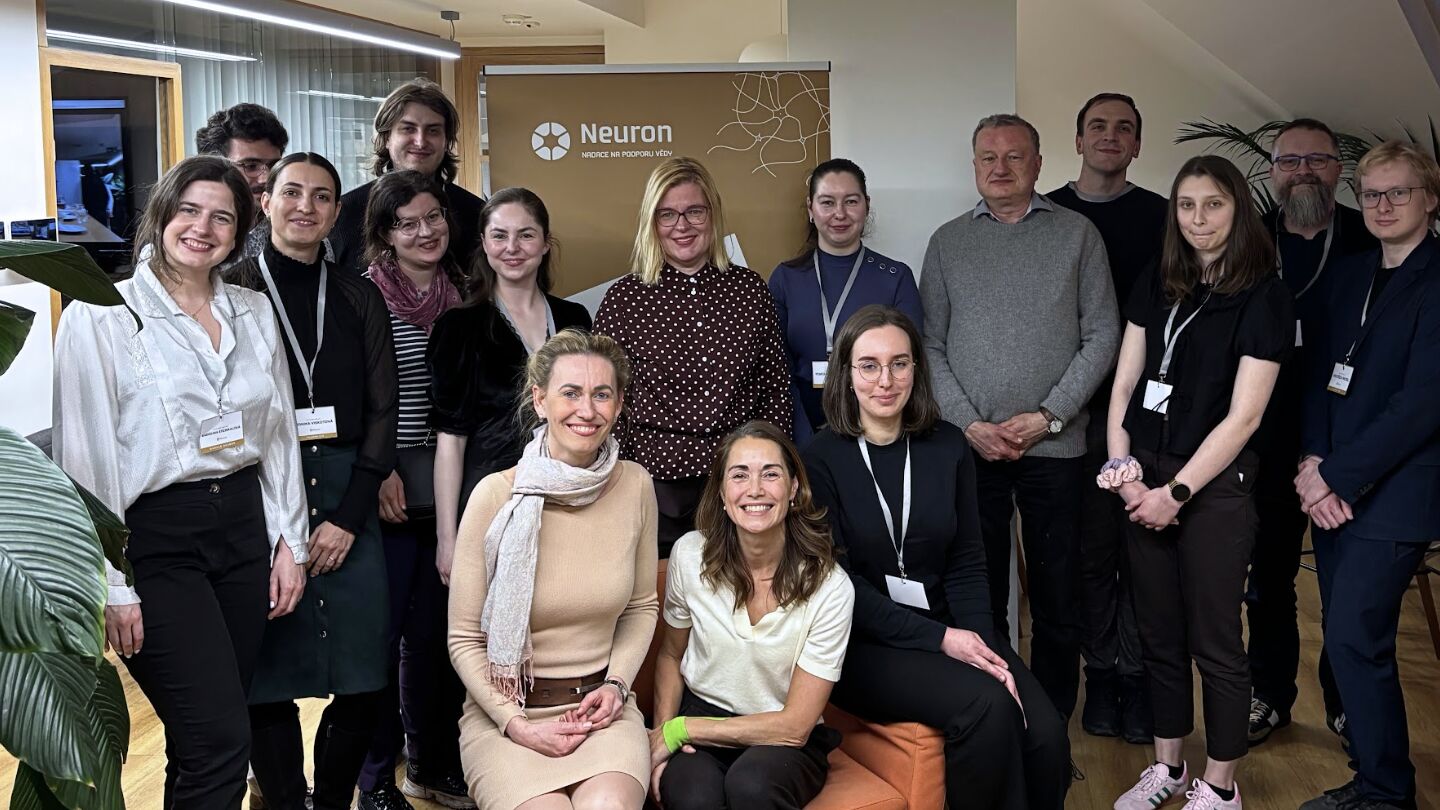
The meeting with six alumni of Neuron internships from 2023 and 2025, along with new candidates, was led at the foundation's offices by its director Monika Řasa Vondráková. "The first year of our internships was a trial, but it was an immediate success. We even went on to invite selected Israelis to the Czech Republic. In science and elsewhere it is important to have an excellent idea, but then someone has to carry it out. Neuron took that on and managed to make it all happen, even though there is a great deal of work behind it and it is not always easy," the co-founder of the Neuron Foundation said in welcoming all the guests, among whom were two exceptional professors connected with the Institute of Organic Chemistry and Biochemistry of the Czech Academy of Sciences: Professor Martin Fusek, the Czech guru of transferring research into business, and Jan Konvalinka, the IOCB's director.
"I think there are three essential places to go for scientific knowledge. The west coast of the USA, the east coast of the USA and Israel, and perhaps the United Kingdom. But the absolutely key idea is that young people should go and see somewhere it is done differently," Martin Fusek said at the start, recalling that people in Israel "have to fight constantly for their survival". Throughout the evening, practical advice on the stay (and even translations from Hebrew on participants' photos) was added by the experienced Linda Štucbartová, the internships' mentor, who had also prepared a "guidebook" for the interns.
Israeli science through the eyes of six young scientists
In a compelling section, the young "Neuronists" talked about their experiences, their work and their research. The first to speak was the astrophysicist Monika Viskotová of Masaryk University about her placement at the elite Weizmann Institute, where she worked on the signals of massive black holes and also on preparations for the first Czech space telescope. "My supervisor and I are still in touch, we call each other and the bond we formed continues," the doctoral student highlighted among the benefits.
The next speaker, who studied at Tel Aviv University in 2023, was the chemist Vojtěch Musil, a graduate of the University of Chemistry and Technology in Prague. "I managed to combine my hobbies: chemistry and 3D printing," said the postdoc, amusing the audience; he works on polymer technologies and the possible 3D printing of the future. He is currently working at TU Wien. In this connection the director Monika Vondráková recalled that one of the Neuron Foundation's patrons is Josef Průša, a well-known champion of 3D printers: "Maybe you will think something up together," Monika smiled.
Eliška Trampotová works on molecular biology; in 2023 she was in Jan Mašek's group and also in Tel Aviv in the laboratory of Professor David Sprinzak. "He is an enormous name in our field; it seemed almost unthinkable to me that I would be working with him. We brought the expertise of both our labs together," said the now IOCB Prague researcher in praise of the experience, which thus connected Czech and Israeli know-how. "I was impressed by their directness and spontaneity," she noted. Knowing the basics of Hebrew is an advantage: "It makes the whole stay more pleasant."
Remarkable is the research of Tomáš Knapp, a doctoral student at the Faculty of Law of Charles University who also works with the Faculty of Mathematics and Physics. As a member of Jakub Drápal's ERC team at the law faculty, he analyses an enormous quantity of court judgments from Central and Eastern Europe, making use of AI and large language models (LLMs). At the university in Jerusalem he experienced the beginnings of the fighting, but the cooperation continues online. "We are sitting on an awful lot of data; in Moldova we have whole judgments. We told ourselves we would look at how it all works in practice," he said. He also values the human aspect of the internship. "I discovered a great many forms of humanity and gained many contacts, which were superb, and I am grateful to Neuron for it," Knapp says of his stay at the Hebrew University.
The archaeologist Tereza Holasová, who went from Palacký University to Tel Aviv, also found plenty of positives. She works on palace architecture in the Levant. "I liked how they try to open up the world of science to the public and awaken people's interest in history and research," she recalled. Like the other interns on the Israeli CI3 programme, she mentions the difficult security situation in the country and also the traumatic experiences of colleagues who have direct experience of war. She also managed to get to know a start-up project in Israeli agriculture that may point to an interesting route towards non-destructive archaeological research. The mission opened her eyes.
The last "Neuronist" to speak in person was Jan Šnábl, who in 2023 worked in the north of Israel on food-related topics — for instance enriching foods such as bread with insect proteins. He amused the audience with recollections of transporting a sample of beetles, but also recalled the country's persistently precarious security situation, having personally experienced an evacuation.
Safety first, science forward
That is exactly what our intern Lída Hamplová is dealing with now; she was broadcasting live from Israel, from Jerusalem. As part of her bachelor's thesis at the University of Hradec Králové she is interested in culturally conditioned aspects of vaccination — among Orthodox Jews, Arabs and Palestinians. She is at the Hebrew University. "War broke out; nobody here claims it is an adventure that we will one day look back on with a smile. No. It is serious. It affects absolutely everyone," Lída said of the attacks by dozens of Hezbollah and Iranian rockets. She even found fresh shrapnel when she went out for a run.
"Mental health care is not a taboo in Israel," she pointed out, visibly moved. Professionally she is also interested in public health, which in fact includes care for the mind. "If you have a vision in Israel and are willing to work on it, you get the chance," she says appreciatively of the practical approach. "This country is harsh, even cruel, but it can give you space if you know how to ask for it. I am incredibly grateful to Neuron for having this experience. El Al is not flying yet, but I will get home somehow," she told everyone present, among whom were Barbara Eignerová and Dušan Brinzanik of IOCB Tech along with other interns: Janis Bojko, Barbora Dopitová and Aneta Perglerová.
Linda Štucbartová, the mentor, offered plenty of practical observations to past and future participants in the programme, mentioning Israelis' mental resilience and their relationship to applied research and business. "Everyone there is on WhatsApp. And you know I am always available to you — we have been messaging each other," she reminded them that Neuron interns have continuous support.
The pleasant evening ended with discussions in a relaxed spirit. Networking, sharing experiences and impressions. "If nothing else in my career had worked out, initiating these internships was really worth it," Professor Martin Fusek said, making the audience laugh.
And his IOCB colleague Jan Konvalinka recalled in closing that at an early stage of a career, while still an undergraduate, say, it does not entirely make sense to head off to a below-average university in the USA (at the cost of putting yourself or your family in debt for seven or eight years), but that it is worth looking for a good institution in Europe or Israel. And yes, if possible, then head off to top universities around the world at a later stage!
The interns themselves mentioned that they had received a decent grounding in their fields in the Czech Republic. But it is at doctoral or postdoc level in top laboratories that success is decided. And that is what Neuron supports — thanks in part to long-term cooperation with and support from the IOCB of the Czech Academy of Sciences and IOCB Tech.