Filip Matějka: The moment will come when it is mainly we who need help from others
Filip Matějka is a behavioural economist who uses economic theory to explain the behaviour of people and of the state. You asked him about the topics that interest you in connection with the further development of the economy and of "post-pandemic" society.
Filip Matějka is a behavioural economist who uses economic theory to explain the behaviour of people and of the state. You asked him about the topics that interest you in connection with the further development of the economy and of "post-pandemic" society.
Which topics do you think behavioural economics should now start studying more?
Behavioural governments, and the interaction of markets and volunteers during a period of acute crisis. All at once we can see very clearly what a government cannot manage in a short time, however much it might want to. On the other hand, volunteers and individual businesses are working near miracles. We know that over the longer term people are somewhat more selfish and that markets and prices determine our behaviour almost decisively, but in an exceptional situation we behave differently, for better and for worse.
Will people's buying behaviour change radically in the coming months in response to the current crisis? Will emotions play an even greater role in people's purchasing decisions because of society's "latent panic"?
The greatest influence will be enormous uncertainty. Especially in the decisions of businesses, but of employees too. Companies will not invest or hire, because they do not know whether the epidemic will come back; employees at large plants do not want to go to work because they are afraid of infection. The task of politicians in the coming months will be to reduce that uncertainty as far as possible.
We have to increase testing capacity tenfold, but also to make clear what economic support measures we would use in future. This time it was a bit chaotic because of the speed, and nothing much better was possible, but we can prepare in advance.
Could less globalisation of the economy and society be a kind of solution? Are we facing a return to "self-sufficiency" and our own vegetable gardens?
It would not be a good solution, but it is quite possible that our world will move somewhat in that direction. Vegetable gardens are fine, but limited international cooperation would be a disaster. I don't like the fact that when problems came, every country, ours included, very quickly forgot about helping others. We are giving no thought at all to how to help Italy. The moment will come when it is mainly we who need help from others. On the other hand, we have to learn to coordinate domestic businesses. A lot of them were able to switch production astonishingly quickly, but the state cannot fully use that for society's needs.
Does China offer us inspiration for further ways of dealing with the crisis? What should China have done differently, and will it cope with the consequences better than European states?
I follow China very little, I cannot advise them, and I also believe almost nothing they say about their own situation.
How can foreign banks be prevented from continuing to charge interest and sending the profits abroad? Is that even a possible solution and can the state resort to it?
It doesn't strike me as a big problem. Or rather, governments always want to attract foreign investment while at the same time objecting to dividends flowing abroad. Those two things do not go together. Anyone who wants to invest does so only in order to get it back over time with interest. It is true, though, that sectors with low competition generate larger profits and should be taxed and regulated more. The government's current plan for a National Development Fund, to which banks contribute somewhat "voluntarily", is a strange and non-transparent solution.
Should people change their investment portfolios and start preparing for harder times?
Our family bought a global equity index at the beginning of March — not exactly great timing. But nobody should claim to be good at timing. It doesn't stress me. It is important to have some cash reserve in case something changes quickly, but otherwise let us all simply diversify risk, buy a lot of different assets and invest for the long term.
---
Missed the chance to ask Filip with us? Don't despair. On Tuesday 21 April from 9:00 you have another opportunity on ► Home Office TV
Interested in economics and society? Read our interview with Filip Matějka Looking for economic laws for real people, in which he outlines, for instance, his favourite theory of rational inattention. You can also take inspiration from the video from our conference Science as the fuel of modern business, in which Filip Matějka explains the limits of our decision-making.
RUNNING NOW – Ask the scientists: artificial intelligence expert Tomáš Mikolov
Is the current situation in the world an opportunity to speed up the digitalisation of industry and involve artificial intelligence more? How can artificial intelligence help in the fight against the pandemic, and how is it already helping?
Ask the artificial intelligence expert and Neuron Award laureate Tomáš Mikolov anything you want to know about artificial intelligence, computers or the current crisis on our Facebook.
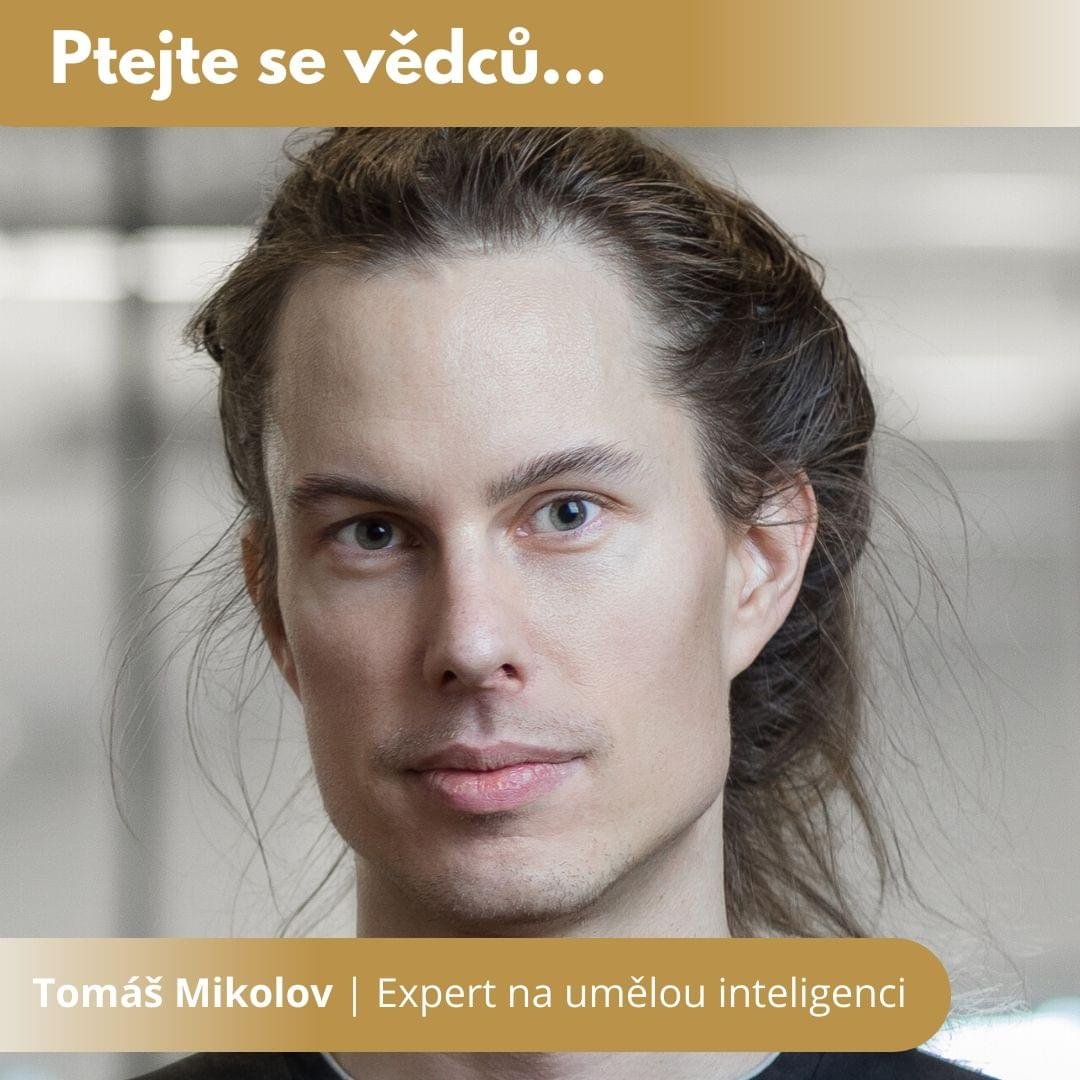
Ask Tomáš Mikolov — click on the photo