The Neuron Expeditions will study the asexuality of basilisks and the longevity of sharks
24 March 2022
Czech scientists and researchers will study the longevity of the Greenland shark off Greenland and, in Honduras, will focus on the asexuality of basilisks. That is the decision of the Neuron expedition council after meeting the finalists for the Neuron Expedition 2022 grant.
"This year we received twenty interesting applications for the Neuron Expedition, proposing journeys to every corner of the world. To the equator, to southern Africa, to the Amazon or Central Asia, whether to study the local flora and fauna, to uncover historically important sites or to follow in the footsteps of legendary Czech travellers," says Petr Horký, chair of the Neuron Foundation's expedition council. "The decision was difficult, but in the end we chose two expeditions that convinced us most by their focus and their planned contribution. It was impossible to pick the better of the two, and so the Neuron Expedition has two winning teams. One will head for Greenland, the other thousands of kilometres further south to Honduras," he adds.
The chair of the Neuron Foundation's board, Monika Vondráková, adds: "The record number of applications delights us and shows that Neuron is heading in the right direction with its support for Czech science in the field. Thanks to our patrons' contributions this will be the first time ever that two new research teams set off into the world with the expedition flag, and I congratulate them. What is more, at the beginning of March the Neuron Expedition Dzamba Ya Lobi returned from Congo, and next month Marie Šabacká sets off for Uganda to study tropical glaciers. 2022 will be the year of the Neuron Expeditions."
In search of the longevity of the Greenland shark
The subject of the first expedition is the Greenland shark, which so far has remained on the margins of world science — its DNA probably contains a molecular-genetic trick that allows it to escape the processes of ageing and to prevent tumour growth.
The research team will therefore set out for the shark's refuge in the waters between Iceland and Greenland, where it will take tissue for genomic and transcriptomic analysis, take swabs from the surface of its body and collect water samples from the site where it occurs. The data obtained will be unique worldwide and will contribute to understanding the molecular-genetic basis of the Greenland shark's longevity. The findings will also be useful for the general theory of ageing in vertebrates, humans included, and may serve to find new ways of successfully influencing the processes of ageing and tumour growth.
The expedition will bring together the Institute of Biophysics of the Czech Academy of Sciences, the Faculty of Science of the University of Ostrava and marine ecologists from the Marine & Freshwater Research Institute in Hafnarfjörður. Led by Prof. Václav Brázda, a respected specialist in molecular biology, the expedition will set out for the Irminger Sea and the Denmark Strait in the summer of 2022.
In search of the asexual basilisk
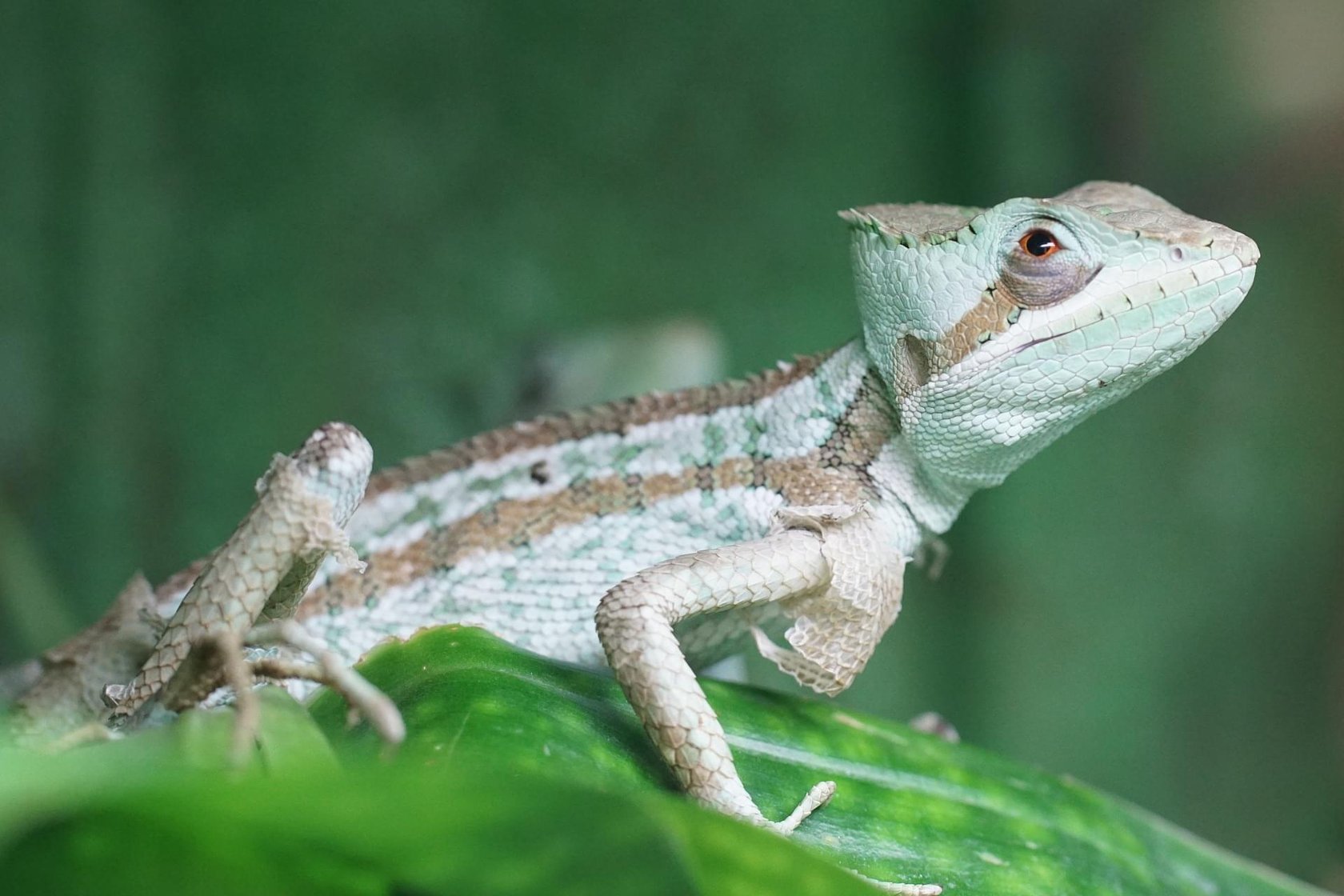
Is the basilisk Laemanctus julioi asexual in the wild? What is the origin of the asexual lineage kept in Europe? Is the asexual lineage an interspecific hybrid like other asexual reptiles? And how many genetic clones make up any wild asexual populations? These are the questions the second Neuron Expedition 2022, heading for Honduras, will try to answer.
The expedition will combine field observation of basilisks with catching them safely to collect external parasites and a faecal sample to determine their diet, while a blood sample will be taken from the tail vein for genetic analysis. The project may lead to the discovery of a new asexual lineage of reptiles, of which only twelve are known today, and in a group in which asexuality may have arisen independently of hybridisation. That would completely transform ideas about the origin of asexuality in vertebrates and our understanding of the evolution of sex. Besides these general questions, the project will help map the distribution of individual basilisk species and assess the degree of threat to two newly recognised Honduran species, Laemanctus julioi and Laemanctus waltersi, about which almost no data have been published so far.
The Neuron Expedition 2022 to Central America will be led by Prof. Lukáš Kratochvíl, an evolutionary biologist and zoologist and an expert on the evolution of sex-determination systems and sex chromosomes. The head of the Department of Ecology of the Faculty of Science of Charles University has in his team representatives of the Czech Academy of Sciences, the Pilsen Zoological and Botanical Garden and the Faculty of Science of Palacký University in Olomouc, and is also counting on researchers from Honduras and Panama.