I got a fish onto the cover of Science, says Zuzana Musilová
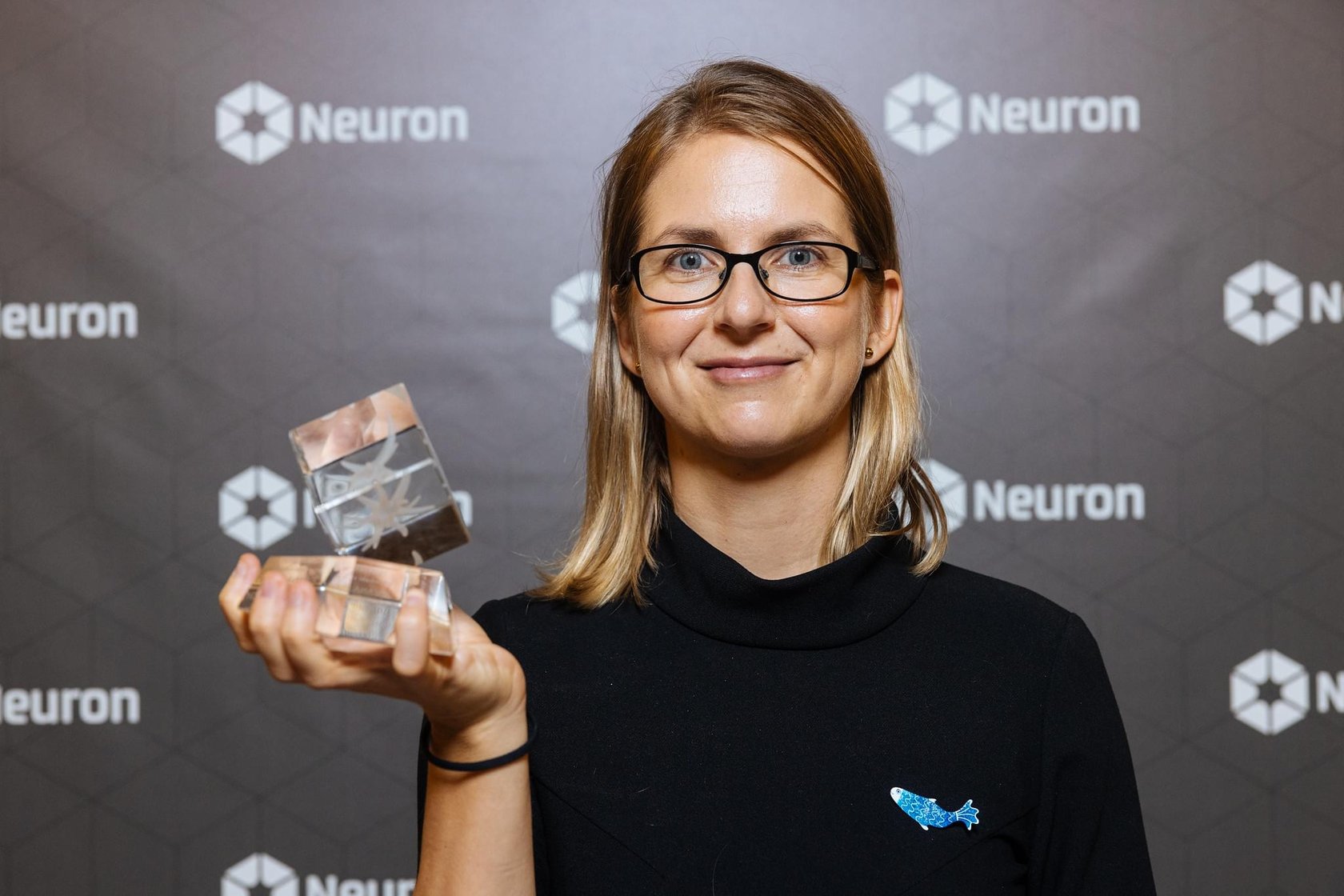
The laureate of the Neuron Award 2021 for promising young scientists in biology received the award for her research into the evolutionary processes of fish and her study of their adaptations from innovative angles.
How do fish respond to their environment? That is the main subject of the research of Zuzana Musilová, who does not confine herself to studying mechanisms but works on the evolutionary processes that lead to various adaptations. She has revealed that fish vision can be modulated by changes in DNA, including gene duplication. Her research is gaining international recognition and she publishes in leading journals such as Science and PNAS, while in the Czech Republic she has founded her own research group devoted to the evolution of fish senses.
Zuzana Musilová combines deep scientific commitment with experience from numerous expeditions and research placements around the world. That allows her to study the life of fish and the development of our world from innovative and interdisciplinary angles.
How would I explain what I do as clearly as possible in seven short sentences?
With my colleagues and students I study the evolution of fish and in particular the adaptation of their vision to different environments. We use modern methods of molecular genetics, that is, we sequence fish genomes and sets of RNA (transcriptomes) in the eye. From the number and sequence of certain genes we are able to infer (in short) which colours a fish is able to see, for instance. In some environments, such as the deep oceans, conditions are so extreme that, besides the bizarre shapes of the fish and their telescopic or mirror eyes, we are uncovering incredible things at the molecular level too. Such as fish probably capable of astonishingly detailed discrimination between many shades of blue-green, thanks to a unique retinal anatomy and the use of rods (instead of cones), which incidentally is unique among vertebrates. To give an idea — we humans have three different cone proteins (red, green and blue) in order to see our colour range. The record-holder in the deep sea has 38, so it is genuinely hard to imagine how it sees its world.
What do I enjoy at least as much as my work?
I am lucky that my hobby (keeping aquarium fish) has become something of my job, so sometimes the two are hard to separate. I feel wonderful under water and I relish being in a tropical lake or river with nothing but a mask and snorkel, watching fish undisturbed in their own world for a while.
What was the greatest obstacle I have overcome in life?
Fortunately I have not run into any outright obstacles in my professional life. What certainly shaped me was going abroad for a postdoctoral placement. That kind of experience is absolutely essential for a scientist's development. Otherwise the last obstacle (though in fact one not overcome) was probably last year's despair over the cancelled expedition in search of deep-sea fish. A week before departure I stood there with my rucksack packed, deciding whether to run for the last train to Dresden, because the borders were closing that evening. Then for a while I even weighed up the possibility of crossing the Šumava mountains illegally. In any case it was a truly awful feeling and I hope I never experience it again.
In the end, three days later, our German collaborators cancelled the expedition entirely with no replacement date. We believe we will get another chance in three years, which is the usual cycle of the research vessel, but it does make you realise that life is not endless.
Talent, temperament, hard work, luck, something else — what determines success?
All of it together, and none of it can be missing in science. And of course motivation and curiosity as well; they are the most important driving force of discovery.
What do I consider the greatest success I have achieved?
Getting a fish onto the cover of Science! That is of course something of an exaggeration, because I had nothing to do with the image itself. But I was delighted that we managed to publish a partly zoological story about the evolution of fish vision in the depths of the sea in such a journal. And personally, more than the journal's name, I value the course of the research itself, when my colleagues and I gathered data and analyses from various fields, often well beyond my expertise, and the story then crystallised for us like assembling a jigsaw.
What would I change in the world if I had the power?
On a global scale, certainly the accessibility of education for all children in the world. Only through education can people then understand connections and make decisions about their own lives. And sometimes even change the world. On a domestic scale, probably that Václav Havel had not died so soon.
What is the greatest challenge facing my field and science in general?
In evolutionary research it is certainly the further linking of different fields — if we are studying a particular adaptation in animals, for instance, we often combine field observation with the morphology and genetic basis of that adaptation. At present there is an effort to add the most modern molecular approaches, for example at the level of the function of individual cell types, thanks to which we can then better understand the mechanism by which these adaptations work. Otherwise, science in general will, I think, soon be troubled by predatory journals and also by rising fees in standard journals.
THANK YOU TO THE PATRONS AND PARTNERS OF THE NEURON FOUNDATION AND THE NEURON AWARDS