Ekonom: We want to show young people that science is cool, says the director of Neuron
2 July 2026
Interest in science among young people is falling, so we want to show them that it is actually cool and that being curious is great, says the head of the Neuron Foundation, Monika Řasa Vondráková. In an interview for the weekly Ekonom she talked about how society's view of science has changed in recent years and how difficult it is to connect two seemingly distant worlds — that of scientists and that of businesspeople. "The Neuron Foundation has sixteen main patrons today," she explains to the business magazine.
Interest in science among young people is falling, so we want to show them that it is actually cool and that being curious is great, says the head of the Neuron Foundation Monika Řasa Vondráková. In an interview for the weekly Ekonom she talked about how society's view of science has changed in recent years and how difficult it is to connect two seemingly distant worlds — that of scientists and that of businesspeople. "The Neuron Foundation has sixteen main patrons today," she explains to the business magazine.
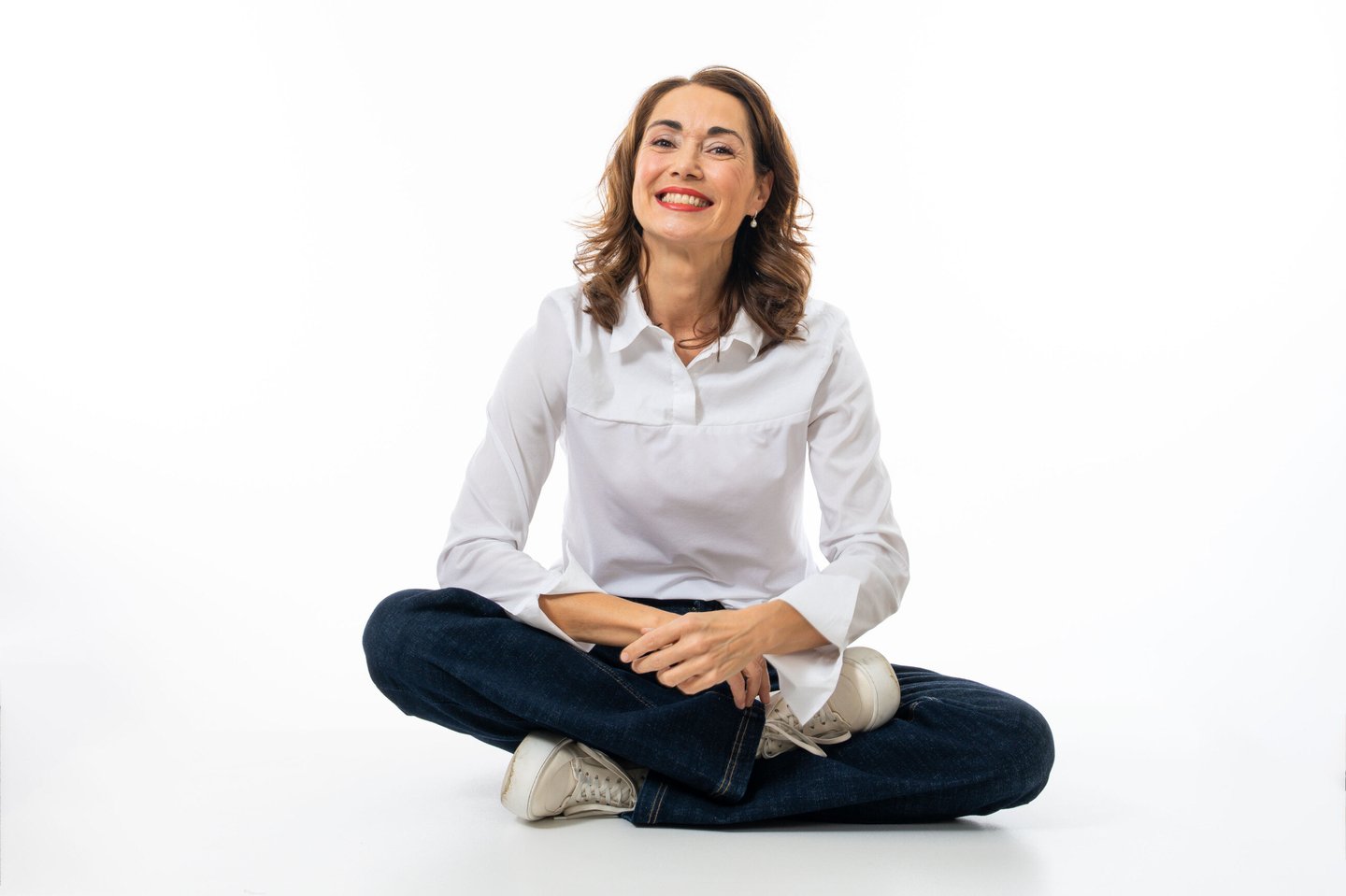
"A lot of young people think science is only for swots, for straight-A students, and that it is complicated. We want to show them that science is cool and that being curious is great. In the young scientists we have supported we see one thing in common: they thought about something and then went and took the first step…"
Looking back at those sixteen years of the endowment fund and the Neuron Foundation, do you feel that Czech society's view of scientists has changed in that time?
Definitely. I feel that in recent years the popularisation of science and of scientists themselves has been growing at a tremendous rate. Enormous credit for that goes to the media, which are not afraid to show science and do superb interviews with scientists. That is immensely important. When I think back to our beginnings, it was almost unbelievable how hard it was to find journalists who understood science and wanted to cover it. In newsrooms the subject was tossed around like a hot potato.
Today the situation is completely different. And scientists' approach has changed too. I remember one scientist coming to present his project to us and standing with his back to the audience during the presentation. Presentation skills were certainly not a given at the time. That has moved on markedly as well; scientists today understand far better that being able to present their work clearly is part of its impact.
The Neuron Foundation connects science with business — have these two worlds learned to talk to each other yet?
It is definitely getting better. When Neuron was starting out, the world of science and the world of business did not really understand each other. I remember that when I went to see the investor Ondřej Fryc back then, he told me straight out that he tended to close the door on scientists. They came to him asking for large sums of money, but did not want to say much about the research itself and were promising him only some small percentage of any return.
Interest in the business potential of science was not very strong among students then either. I remember that we had Barbara Paldus here in the Czech Republic, the daughter of Professor Josef Paldus, the mathematician and chemist to whom we presented a Neuron Award. He lived in Canada for a long time. Barbara herself successfully patented several of her discoveries and is a successful international businesswoman who studied at Stanford. We invited her to the Prague University of Economics and Business at a time when she was on the cover of Forbes. I thought students would come to see a successful international entrepreneur with Czech roots. About twenty students came, and some of them spent the lecture looking at their phones instead. That was when I realised that as a society we still cannot adequately imagine how enormous the business potential in science is.
There is a certain barrier on the scientists' side too; if you mention the Prague University of Economics and Business among them, they often say it is not a proper university, just "some economics school". These two communities simply were not ready for each other. And that is exactly where the Neuron Foundation matters, because it connects successful businesspeople with successful scientists.
So is the attitude of wealthy Czechs to supporting science changing? Are they more willing to invest in it?
Yes, it is changing, partly because the so-called big players simply have more money. We were at an event, for instance, where the researcher Stanislav Fořt spoke; he works intensively on artificial intelligence. We got on well there, and afterwards one of the founders of Avast, Eduard Kučera, came up and said straight away that he had found it terribly interesting and would like to invest in some project connected with AI. As for the activity and willingness of wealthy Czechs to invest in science, of course it depends very much on the particular scientific field. Medicine is the most financially demanding, as the story of Petr Kellner also shows; he put an enormous amount of money into developing a vaccine against prostate cancer, and in the end the result did not come.
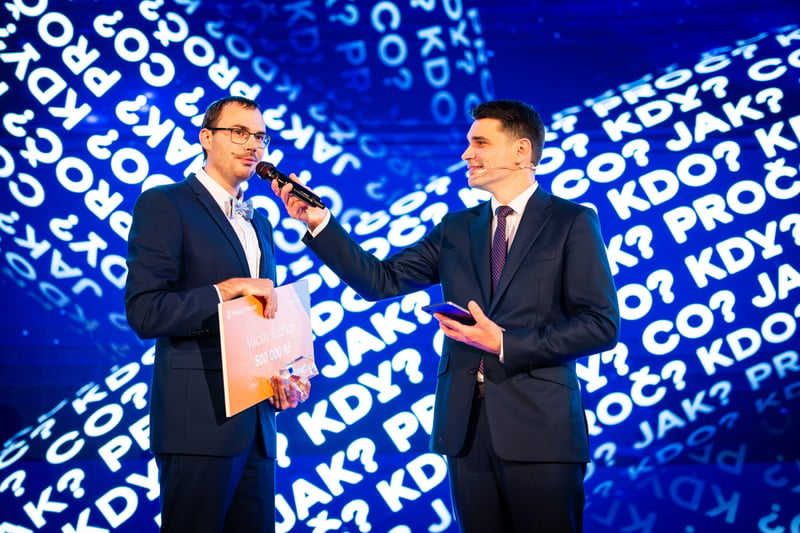
It is simply always an enormous risk. In any case, though, we can see that Czech businesspeople are interested in science. I was hugely pleased, for example, by the connection between the Beat Games co-founder Jaroslav Beck and the scientist Tomáš Mikolov. Tomáš Mikolov did leave academic science because he did not get grants and was not sufficiently supported, but Jarda Beck saw enormous business potential in him, joined forces with him, and now they are partners in a start-up together. A lovely moment also came at the Neuron Foundation awards ceremony, where we had Erin Carson, an absolutely wonderful world-class mathematician, and right there at our event one of the successful Czech businesspeople offered her a job on his project.
You recently launched the campaign Start with Why, which is meant to draw young people to science. How do you want to attract them?
We launched the campaign because we saw that interest in science is falling and that we have to focus attention on the younger generation, so that in future we have anyone at all to give our awards to. That is why the Start with Why campaign came about, through which we want to draw young people to science. A lot of them think science is only for swots, for straight-A students, and that it is terribly complicated. We want to show them that science is cool and that being curious is great. In the young scientists we have supported we see one thing in common: they thought about something and then went and took that first step. A lot of people have ideas in their heads but never carry them out. And yet that first step is often quite simple.
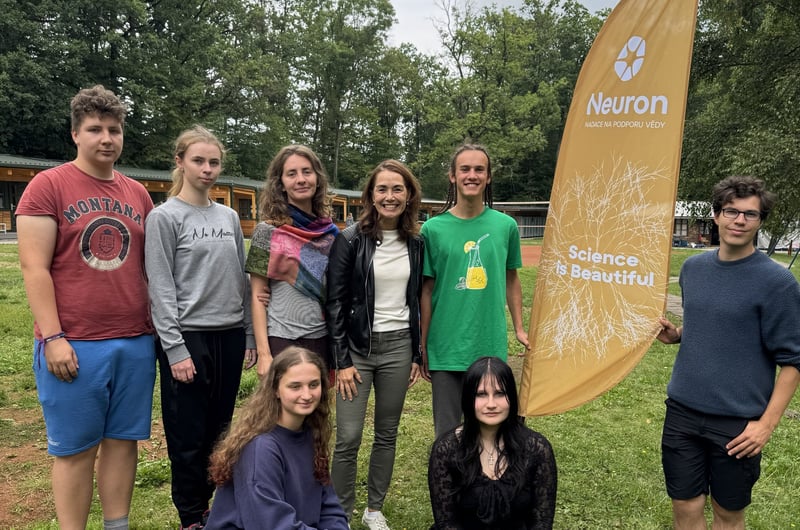
The campaign has four ambassadors who managed it. Take Václav Knapp: at secondary school he was interested in AI and the human brain. He found out that a professor at Berkeley worked on it. So he simply wrote him an email. The professor replied: "Come over, then." But he was still at secondary school and moreover had no money for the trip and the stay. He came to Neuron, we supported him financially, he went, and thanks to that the wide world of science opened up to him. To round the whole thing off, and with future patrons in mind too, this year we are running a unique camp for the first time. We have joined forces with the initiative Můžeš podnikat, founded by my husband, the founder of ABRA Software, Jaroslav Řasa. We want to bring together a group of young scientists and a group of young people from business and let them work together on a project which they will present to us at the end of the camp.
What is the biggest problem facing the current emerging generation of potential young scientists?
I see two main problems. The first is the incredible flood of information. The present age overwhelms young people and forces them to skim the surface. But science and genuine curiosity are about choosing one thing and going into it uncompromisingly deeply.
The second fundamental problem, and also the reason why the number of scientists in the Czech Republic is falling overall, is the situation of doctoral students. They struggle with inadequate sources of funding, they often have to raise the money for their projects themselves, and that really is not easy. Unfortunately, the Czech Republic is not generous enough in this respect where science is concerned.
Where abroad should we look for an example in this regard?
Countries such as Sweden, Israel, the United Kingdom and Singapore see science as one of their highest priorities. They understand that if they have clever, educated and courageous people, they can push the boundaries of the possible with them. That is why they cherish their talents, create good conditions for them and systematically support their scientific projects.
How many patrons does the Neuron Foundation currently have and what finances do you work with?
The Neuron Foundation has sixteen main patrons today. Financially we have it set up so that partnership with the foundation starts at 250,000 crowns a year, and patron status from half a million crowns upwards. Our founders support the foundation each year with one million crowns.
We also greatly appreciate that Marek Dospiva recently promised us a further increase in his support. Another enormous step forward for us was the transformation of the original endowment fund into a foundation, thanks to which we can build up an endowment. A key role in that was also played by the gift of 100 million crowns from the founder of Jablotron, Dalibor Dědek. The returns on these funds now partly cover our operating costs. Thanks to that, the funds from patrons and partners can go primarily where they make the most sense: to supporting Czech science and scientific talent.
Interview by Petr Kain, published in the print edition of Ekonom on 25 June 2026, pp. 44–46, online at Ekonom.cz