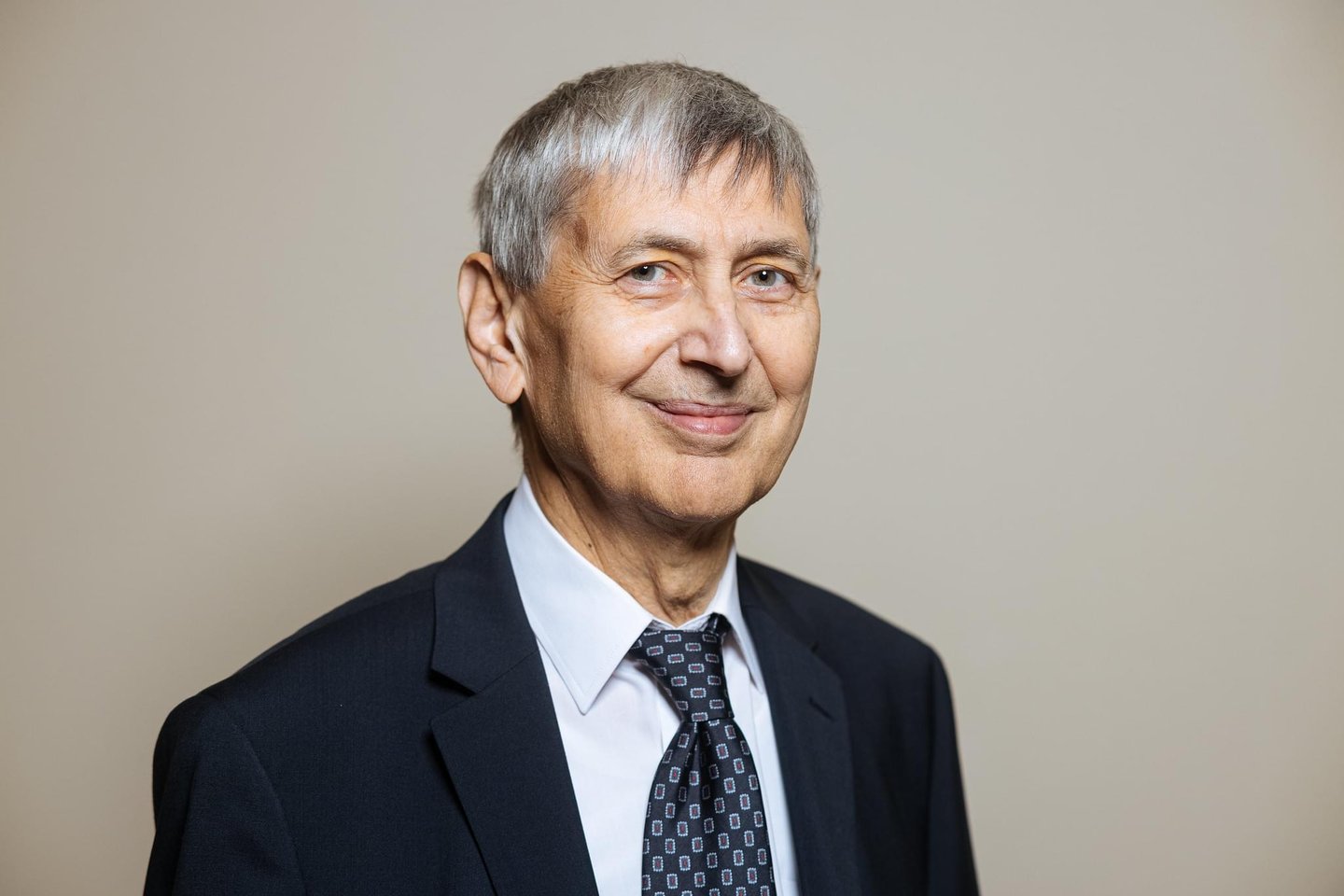
A life in puzzles. That is the story of the mathematician David Preiss
David Preiss is a laureate of the 2021 Neuron Award for lifelong contribution to science in the field of mathematics as a leading expert in geometric measure theory — roughly speaking, a theory that studies the interaction between geometry and the measurement of size (of areas, for instance) in Euclidean and in very general spaces. It is an indispensable part of modern mathematical analysis, whose techniques and results are used especially in the calculus of variations and, through it, also influence the solution of partial differential equations, probability theory and problems in numerical mathematics. And David Preiss is a genuine leader in this field — he published an important part of his results as early as 1987 in an article for the Annals of Mathematics and to this day is one of the few Czech authors there; for his research he won an ERC Advanced Grant intended for internationally recognised experts, a rarity in the domestic setting. David Preiss's work has been honoured with, for instance, the Pólya Prize of the London Mathematical Society and the Ostrowski Prize; he is himself an honorary member of the Learned Society of the Czech Republic and an elected Fellow of the Royal Society.
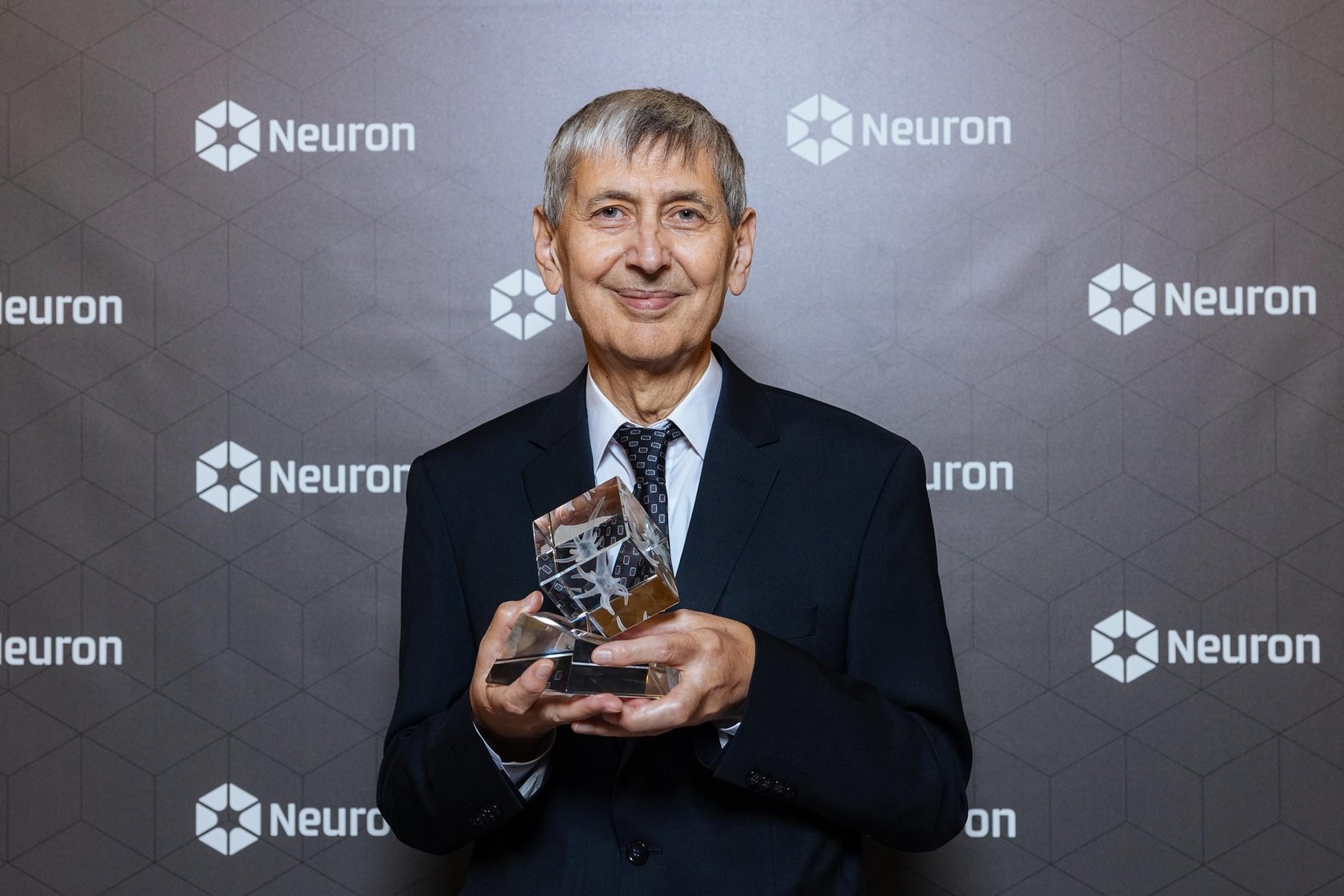
David Preiss is a laureate of the 2021 Neuron Award for lifelong contribution to science in the field of mathematics as a leading expert in geometric measure theory — roughly speaking, a theory that studies the interaction between geometry and the measurement of size (of areas, for instance) in Euclidean and in very general spaces. It is an indispensable part of modern mathematical analysis, whose techniques and results are used especially in the calculus of variations and, through it, also influence the solution of partial differential equations, probability theory and problems in numerical mathematics. And David Preiss is a genuine leader in this field — he published an important part of his results as early as 1987 in an article for the Annals of Mathematics and to this day is one of the few Czech authors there; for his research he won an ERC Advanced Grant intended for internationally recognised experts, a rarity in the domestic setting. David Preiss's work has been honoured with, for instance, the Pólya Prize of the London Mathematical Society and the Ostrowski Prize; he is himself an honorary member of the Learned Society of the Czech Republic and an elected Fellow of the Royal Society.
A life in puzzles
To meet at the right time a challenge that matches the person's nature or talent — that is how David Preiss, one of the best-known mathematicians, sees the key to success. An internationally recognised professor, currently working at the University of Warwick in England, a man of whom the head of the mathematics institute there, Colin Sparrow, speaks as "a brilliant mathematician who has solved many important problems."
Understanding a mathematician's work tends to be difficult, but let us try. David Preiss moves in the area of what is called pure mathematics; he works on analysis and studies functions on the set of real numbers in detail. "Mathematics investigates a range of objects that arise from the abstract generalisation of real objects," David Preiss explains.
Writing Greek letters
For the layperson it will have to be enough to imagine that David Preiss has spent his whole life solving puzzles. "When my daughter was little she once helped me copy out some mathematical theorems, and at that time she had the impression that my work consisted of writing Greek letters," Professor Preiss recounts as he considers how to describe his focus as comprehensibly as possible. "Once I was travelling by train and sitting opposite two schoolchildren. I was writing my usual formulas on paper and they asked: is that some kind of puzzle? — Well, I've been working on it for quite a while, I answered. — How long? they wanted to know. — Twenty years, I said truthfully. And after that they just stared in horror. Yes," Professor Preiss nods, "all my life I have been pondering strange puzzles that not many people understand. And that is precisely what fascinates me about it — that we cannot answer them." The euphoria that occasionally comes after a successful solution is apparently never very great. "Because I realise how much we still do not know and never will know. So the joy comes, but it lasts only a short while."
As a child David Preiss was certainly not buried in formulas; he fell for mathematics only later. "Only once at primary school did I solve something, rather against the teacher's will, but otherwise I was not all that interested in mathematics," he recalls. "The first turning point came in the ninth grade, when I won the mathematics olympiad. But even then chemistry still interested me more." Real "falling in love" came only at secondary school. "It happened thanks to my mathematics teacher Rybák, who, unlike the other teachers, fascinated me by how he took everything with complete calm. The others pushed the approach: you have to learn it, you simply must, must, must. But not him. Of those who were not interested in mathematics he required chiefly that they not disturb the lesson, and otherwise he did not push it. This approach of his caught my attention. Professor Rybák was so important in my life that when he was dying in hospital I went to thank him for how much he had influenced me."
I can't just run away
David Preiss mentions two more people who accompanied him on the path to mathematical success: his classmate Luděk Zajíček and associate professor Zdeněk Frolík of the Faculty of Mathematics and Physics of Charles University. "He organised winter schools to which he invited significant people from abroad. At that time, for most of the seventies and eighties, that was our only contact with the outside world."
However much Professor Preiss holds prestigious posts abroad today, he stayed in Czechoslovakia until the revolution. "After the excellent mathematician Heinrich Wolfgang von Weizsäcker, nephew of the later German president, invited me to Germany at the beginning of the eighties, I could travel out now and then. It would probably have been possible somehow to leave, but I did not want to. I had the feeling that one cannot just run away."
Immediately after 1989 he got a post in England — he applied for it during the revolution, when it was clear that the world was opening up. "I said to myself that I already knew everyone here and that there is something to be said for change." He thought the same way when he was offered a post at the University of Warwick, which is famous for having attracted a number of excellent mathematicians when it was founded with a clear prospect for life: here you will chiefly be able to sit and think.
Doing good mathematics
Because pure mathematics, imprecisely understood as the opposite of applied, is mathematics as such. One can think only about it, and not about what that thinking will one day be good for.
Thanks to excelling in his field, in 2012 David Preiss won a five-year Advanced Fellowship from the European Research Council, the aim of which was to develop new methods in the area of analysis. And just a year before that, in 2011, David Preiss together with two other colleagues so impressed an international jury made up of representatives of several universities that they received the prestigious Ostrowski Prize.
Martin Markl, who is the guarantor for mathematics at the Neuron Endowment Fund, said of David Preiss: "As a colleague I admired him, because he could do calculations at the playground while minding the children, and on top of that manage to smoke forty cigarettes a day." — "Yes, that's true," David Preiss laughs. "I was able to do several things at once, including solving two mathematical problems at the same time. Or to think about something while listening to a lecture. I was really very fast and I could not understand how anyone could be so slow." Now, he says, it does not work so well any more, because every brain ages, even a mathematical one. "In the past it was enough for someone to say half a sentence and I already knew what they wanted to say. Gradually I fell into step with the others; today I am slower than my students. But that does not mean I ever considered myself better. They were one way, I was another — and all together we did good mathematics."
Shakespeare, music and walks
Ask anyone about David Preiss — and besides his professional merits most people will mention one striking quality of his: an almost unusual modesty. "And that goes for his personal needs too," notes associate professor Jaroslav Tišer of the Faculty of Electrical Engineering of the Czech Technical University. "Whenever interesting mathematics or an interesting problem turned up somewhere, comfort always went aside. Even extremely uncomfortable accommodation at conferences, very common before 1989, became irrelevant if the content of the given gathering was mathematically up to standard. And his professional bearing is just as modest: he never makes anything of himself. Not in debate with students, nor in work with colleagues."
Indeed, at the very beginning of this text David Preiss raised a warning:
"I am a little at a loss about what I would say about David Preiss outside mathematics, because mathematics is — apart from his family, of course — essentially the only thing he devotes himself to," associate professor Tišer reflects, but he does recall something: "I remember one non-mathematical interest that David pursued for a time. It was Shakespeare's plays. He attended performances by various theatre companies and compared how the individual conceptions and interpretations differed from one another. At that time David really had a great overview of Shakespeare's plays and of their productions."
Which David Preiss immediately confirms as he talks about how the coronavirus pandemic marked his work and his life: "I used to go to the theatre a lot, but then that ended. Now I like listening to music, especially by Viktor Kalabis; I like him. I gave music preference even over long walks in nature. And perhaps that is not only because of the circumstances but also because of age."
He does not complain about the pandemic as such either: "Yes, I am old school, I like going to the library and leafing through journals, which I miss now. But otherwise it is incredible how many seminars and lectures there suddenly are and how much one learns. All you have to do is open the computer and switch on zoom. In this way I have been virtually in Taiwan, in America… It is fast and convenient, though of course it has one disadvantage too: because of the internet I have less time for my own work."
And what does David Preiss consider the greatest success he has achieved? Anyone who has read the preceding lines about his character attentively will not really be surprised by the answer: "The mathematical results of those whose work I have influenced."
WATCH THE RECORDING OF THE 2021 NEURON AWARDS GALA EVENING
WATCH THE RECORDING OF THE DEBATE WITH THE 2021 NEURON AWARD LAUREATES
WE THANK THE PATRONS AND PARTNERS OF THE NEURON ENDOWMENT FUND AND THE NEURON AWARDS