"Cancer under the microscope: 5 revelations that will surprise you"
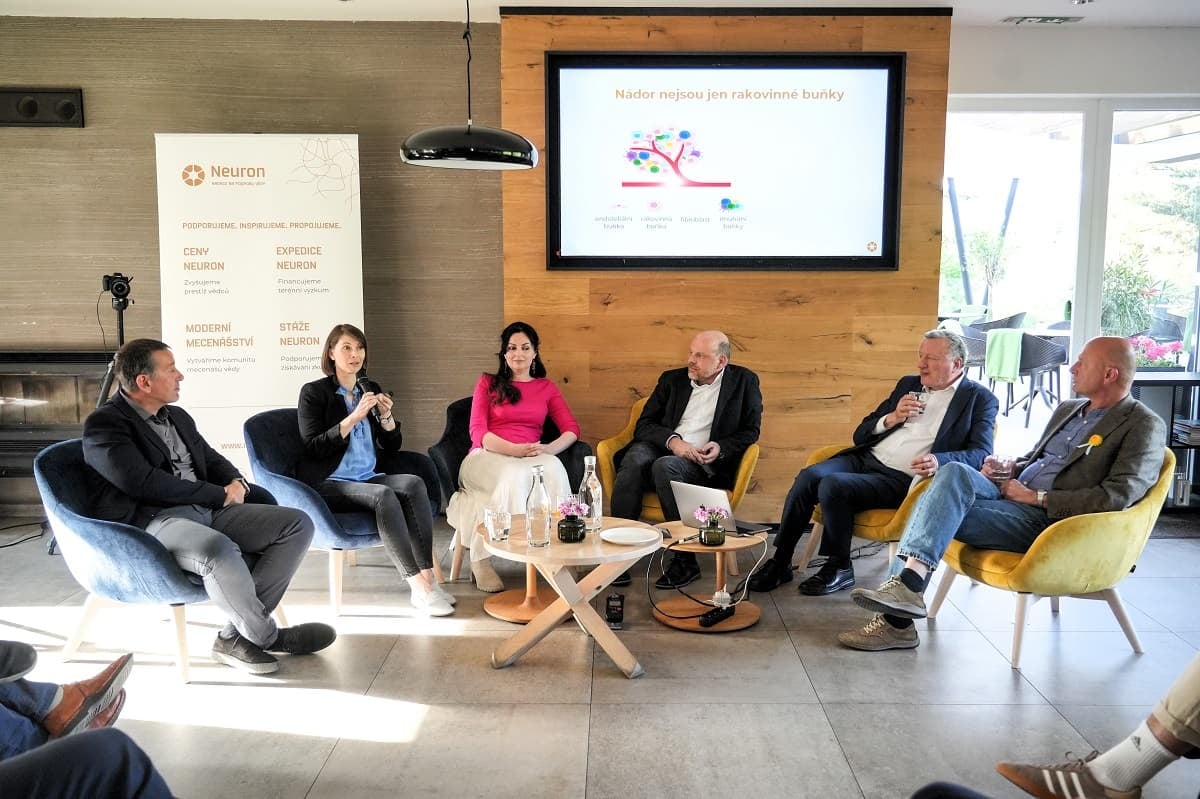
The Neuron Club, held symbolically on World Cancer Day, demolished established myths and offered a look behind the scenes of top-level research. The debate was moderated by Professor Jan Konvalinka and leading Czech scientists took to the stage in turn — Professor Ondřej Slabý, Professor Radek Špíšek, Dr Kateřina Rohlenová, Dr Zuzana Kečkešová and Dr Pavel Majer. Each of them brought unexpected connections and discoveries that change the rules of the game. What were the most interesting things said?
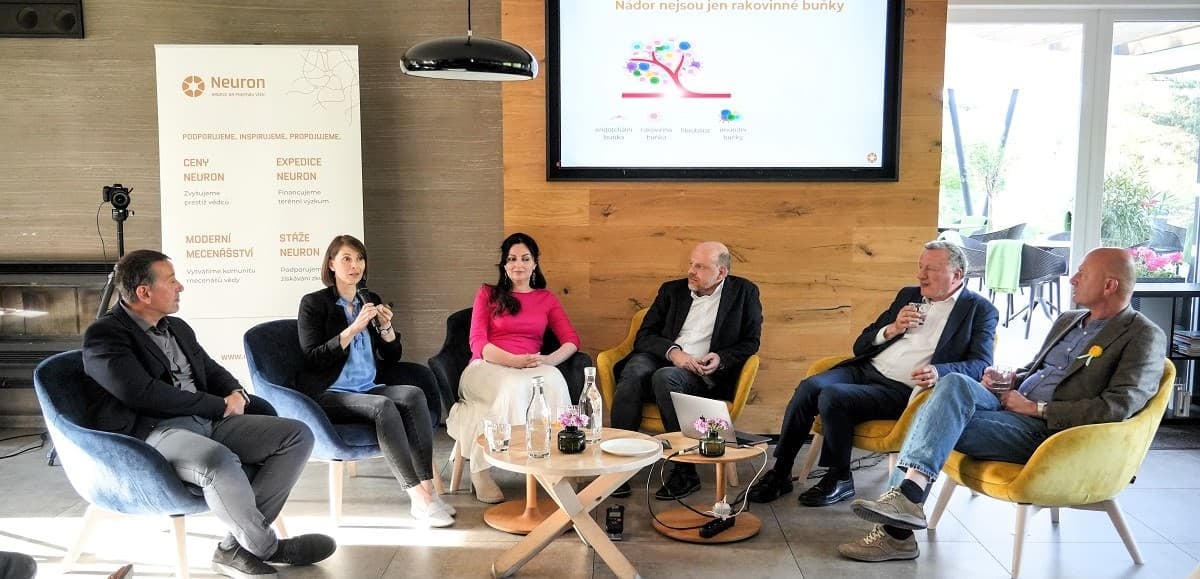
A recording of the whole Neuron Club can be found at the end of the article.
1. "Cancer" does not exist. It is hundreds of diseases.
"From a scientific or medical point of view the word cancer has no content. There are hundreds of different tumour diseases. Every tumour is unique, like snowflakes," explained Professor Ondřej Slabý of Masaryk University.
Incidentally, in Czech the correct word ought to be "krabovina" — Hippocrates named the disease after a tumour that resembled the body of a crab, not a crayfish.
2. Immunity: an invisible shield against tumours
"A patient lived for 16 years with a dormant metastatic melanoma with no clinical symptoms. After her death her kidneys were transplanted into other patients. In the recipients, whose immune system was suppressed to prevent rejection of the organ, the tumour suddenly exploded…," Professor Radek Špíšek of the company Sotio said, describing a historic case.
Tumours are brilliant at camouflaging themselves — they surround themselves with a shield of cells that silence the immune defence. The breakthrough came with checkpoint inhibitors — drugs that break through this shield. Thanks to them, even patients with previously hopeless tumours survive today.
3. Tumours are not only tumour cells. They are a corrupted organ.
"We can see a tumour as a corrupted organ. A tumour does not grow in a vacuum but in a patient, and it is made up not only of tumour cells but also of normal cells that the tumour has tamed to work in its favour," pointed out Dr Kateřina Rohlenová of the Institute of Biotechnology of the Czech Academy of Sciences.
Her team has revealed that some drugs can paradoxically create an environment that helps the surviving tumour cells to grow even faster. "If you destroy the bees but leave the hive standing, they will soon be back. With a tumour it works in a similar way."
4. Why do some parts of the body resist tumours?
Dr Zuzana Kečkešová of the IOCB of the Czech Academy of Sciences discovered the protein LactB in tissues resistant to the emergence of tumours. This protein is able to set off a suicide programme in tumour cells and prevent them from growing. That is why it is often functionally damaged in tumours.
Kečkešová has developed substances that prevent tumour cells from disabling LactB. The results of tests in mice with human tumours were astonishing — the tumours shrank dramatically or disappeared entirely. She is currently founding a spin-off company with the support of world authorities.
5. Clever chemistry that knows where to strike
Dr Pavel Majer of the IOCB of the Czech Academy of Sciences has developed a "prodrug" that is activated only in the tumour and remains inactive in healthy tissue, so that the anti-tumour treatment has no toxic effect on normal organs.
"The mice that were treated with our prodrug lived happily ever after, whereas the untreated ones died of the tumour and those on classic therapy died of the toxicity of the treatment," he summed up the results. More than 58 million dollars has already been invested in the project.
What does it mean to defeat cancer?
Victory over advanced cancer, or better, over metastatic tumour disease, need not always mean wiping it out completely. Modern oncology is heading towards turning a fatal illness into a chronic condition that can be kept under control for a long time, in much the way that has been achieved with HIV infection and AIDS. In the future a diagnosis of an advanced tumour could be similar to diabetes or high blood pressure — something you do have to learn to live with, but which will not stop you reaching a great age and dying in the end of something completely different.
Professor Jan Konvalinka offered a surprising perspective on "victory" in the fight with cancer: "The much-loved Czech actor Jiří Bartoška died recently. I read somewhere that he 'lost his battle with cancer'. I think he won it, because 11 years after the diagnosis he lived a rich life, he acted in films and in the theatre, he was treated and he died surrounded by his family at the age of 78. That is a victory, my friends."
The debate was a reminder that despite advances in treatment, prevention remains the best strategy. The Neuron Club also showed that Czech research in this field is at world level — and sometimes even a step ahead.