The naturalist Václav Gvoždík has discovered a forgotten crocodile
15 September 2016
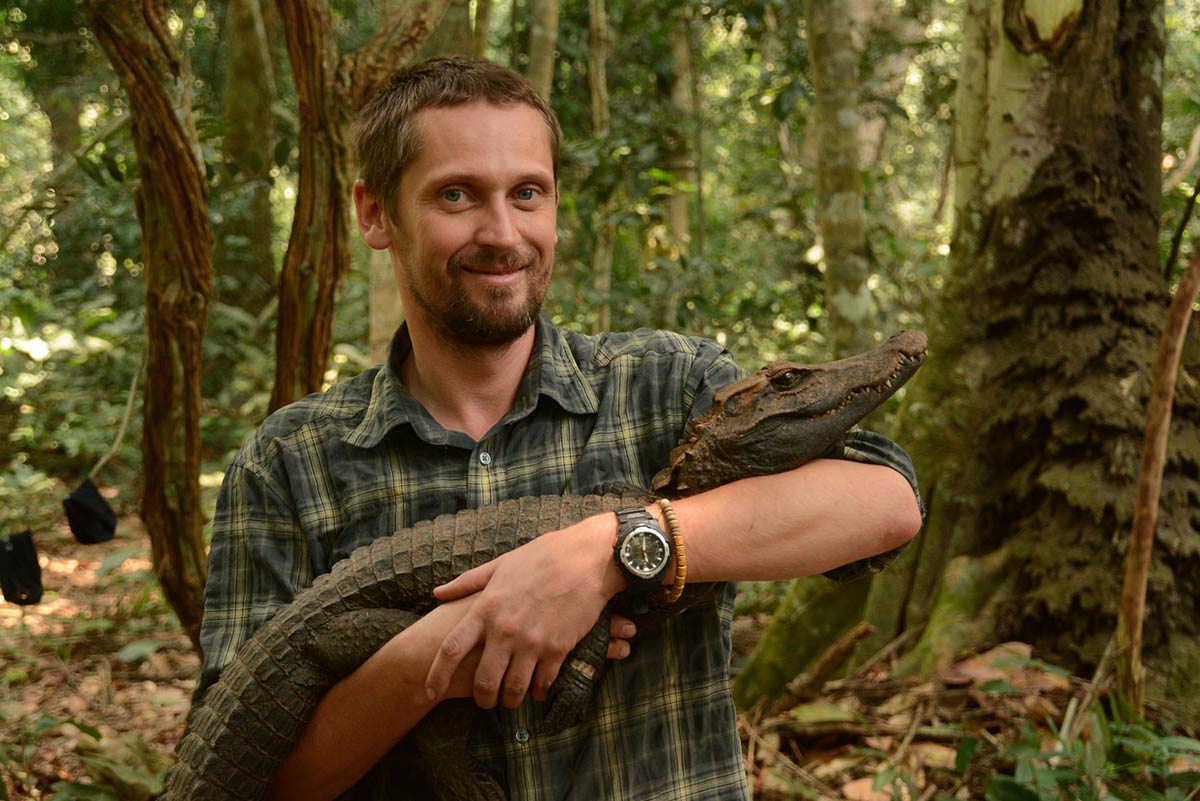
The Congo dwarf crocodile — so far only an unofficial name for a crocodile that history forgot. Or did it?
At the beginning of 2017 the biologist Václav Gvoždík returned with his team from a Neuron Expedition to the rainforests of Congo. The aim of the trip was to obtain genetic samples of a dwarf crocodile that natural history textbooks do not yet know. Distinguishing a new species could at the same time help protect nature there and the crocodile itself.
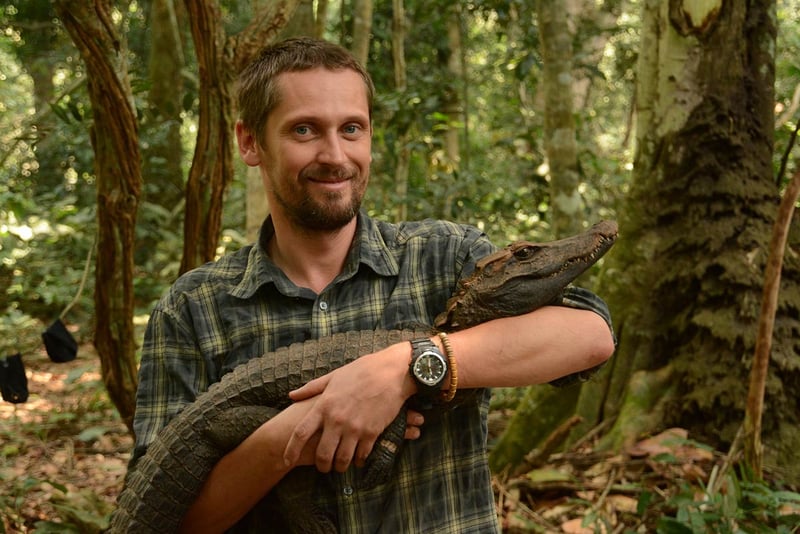
The Congo dwarf crocodile, as Václav Gvoždík has provisionally named it, is not yet generally accepted by experts, and the scientific community still confuses it with the West African dwarf crocodile. Seeing these, some of the smallest crocodiles in the world, is fairly rare. The herpetologist Václav Gvoždík, who works at the Institute of Vertebrate Biology of the Czech Academy of Sciences and at the National Museum, managed it during research into the amphibians and reptiles of the rainforests of the Congo Basin.
The discovery came at night, when crocodiles' eyes shine red
On one expedition, during night surveys, Václav Gvoždík noticed morphological features in dwarf crocodiles that surprised him. The dwarf crocodile got its Czech name from its strikingly prominent forehead, but while observing several crocodiles the Czech scientist came across individuals with striking differences in the shape of the head. On closer examination he then found a whole series of characters indicating that he had a different species in front of him. Newly obtained data from the field, where Gvoždík travelled again thanks to the financial support of the Neuron Endowment Fund, support the initial hypothesis that a hitherto unrecognised species of crocodile really does live in Congo.
Václav Gvoždík works at the Institute of Vertebrate Biology of the Czech Academy of Sciences and at the National Museum. The members of his expedition team were (from the right): the doctoral student Matej Dolinay, the assistant Jérémy Thomas from France, the Congolese collaborator Ange Zassi-Boulou and other local assistants.
From the rainforest back to the laboratory
"The field work was only the first part of the research; now genetic research in the laboratory will follow. In Congo we tried to travel around a wider region and map where the Congo dwarf crocodile lives," the naturalist said. Václav Gvoždík expects that his research will lead to definitive recognition of the Congo dwarf crocodile as a valid separate species. Václav Gvoždík obtained tissue samples for genetic analysis from two sources: directly in the rainforest and also from the local inhabitants, who commonly eat crocodiles.
A crocodile in the freezer of a Congolese restaurant.
An item on the local menu
Besides mapping crocodiles in the wild, the research team also focused on what is called bushmeat — how the trade in meat from wild animals from the rainforest works. "The bushmeat issue is complicated. It is topical especially in the countries of central and west Africa, where it has a deeply rooted tradition. One might therefore say it is a normal state of affairs in the African countryside, but one has to see the wider context — with the increasing rate of forest clearance, the environment of wild animals is shrinking and becoming more and more accessible to people, and therefore to hunters, and the hunting pressure is then already too great. What is more, country people have long since stopped hunting only for their own needs, but chiefly in order to sell to the cities."
A crocodile message for future generations
Distinguishing a new species of this large vertebrate should help protect nature and the crocodile itself. Only a correct understanding of species diversity can lead to adequate protection and thus to the preservation of fauna and flora for future generations. Including the Congo dwarf crocodile, so that it can still be seen not only in photographs but in the rainforests of central Africa.