Vaccine refusal is almost as old as vaccines
Neuron Online Club – Not every vaccine is the same
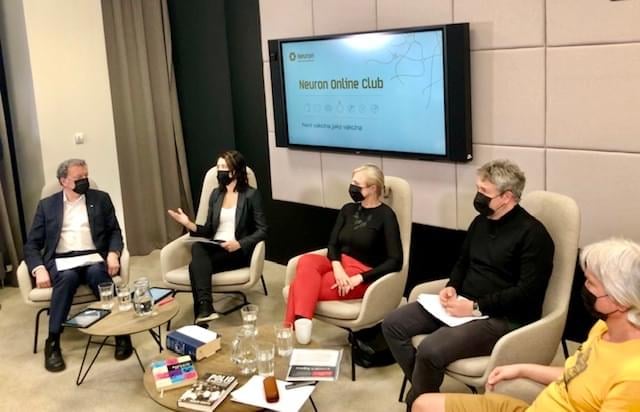
Contradictory and confusing information about vaccination circulates in society. People are saturated with specialist articles and statements and urgently need good information. That is why, on Wednesday 13 January 2021, we held the public online debate "Not every vaccine is the same". Among the experts were the immunologists Václav Hořejší and Anna Šedivá, the physician Ladislav Machala, the psychiatrist Cyril Höschl, the epidemiologist Petr Smejkal and the economist Filip Matějka. The discussion was co-hosted by the biochemist Jan Konvalinka and Neuron's co-founder Monika Vondráková.
Watch the recording of the whole debate or read a summary of it.
The online panel discussion with scientists took place as part of the Neuron Club. The Neuron Foundation launched this platform in 2020 in response to the need to find one's bearings in a new pandemic world and in the excess of information flooding over us. The discussion was made possible by our general partners IOCB and IOCB Tech. Thank you also to Deloitte CZ, Pilulka.cz, ABRA Software, Forbes and Seznam.cz for partnering the online debate.
"I am very glad we can explain the current situation to the public clearly and help people find their bearings in the subject of vaccination. Because we work with the very best scientists, I firmly believe we are succeeding," says Neuron Founder Monika Vondráková.
A description of the weapons we hold
The first vaccines saw the light of day almost three centuries ago. As early as the mid-18th century the English country doctor Edward Jenner realised that milkmaids did not catch smallpox. On the strength of this he introduced the first vaccine, using cowpox to create immunity to smallpox. The most significant French scientist, Louis Pasteur, then discovered a vaccine against rabies in the 19th century, a disease that is still always fatal. A great turning point in society-wide acceptance of vaccines came in the 1950s. Paralysing polio was cruelly afflicting the child population at the time. Scientists responded relatively quickly and Jonas Salk discovered the Salk vaccine, with which children began to be vaccinated worldwide. Czechoslovakia did not lag behind and vaccinated its children against this disease (and other infectious diseases) very quickly and effectively.
"There was almost no anti-vaccination movement at the time, because people had direct experience of the diseases and their terrifying consequences," says the parasitologist Julius Lukeš.
How do the COVID-19 vaccines work?
All the vaccines so far attack the so-called SPIKE protein. Both the mRNA vaccines that have already come to market and been tested on tens of thousands of people and those that will arrive in the foreseeable future focus on disabling this protein, which is key to infection.
People are often concerned that the coronavirus vaccines were developed very quickly. Classic vaccine development takes as much as 10 years. So how was it possible to compress development into a single year? In the normal process, vaccine development is slowed by the design of the study itself and by preclinical studies, which in the case of the current coronavirus vaccines were speeded up from years to weeks. Because of the high number of infected people, different phases of clinical studies could run simultaneously, and at the same time pharmaceutical companies began producing doses before the vaccine's final approval, at the risk that it might not be approved and that they would have to destroy the drugs they had made.
Immune defence against viruses
Professor Šedivá says "our immune system is perfect". Immunity begins on the surface of our bodies, especially on the skin and mucous membranes. In many cases our nasal mucosa can stop viruses on the surface, but mostly they penetrate the body. The next phase of defence is white blood cells, T-lymphocytes, B-lymphocytes and antibodies. The body produces targeted antibodies against coronavirus either after an infection or thanks to vaccination. By combining people who have overcome infection with those who are vaccinated we achieve the much-desired population immunity.
Why not let the disease run through the population?
Professor Hořejší rejects that idea as follows: "The virus's fatality rate in our population is 1%, so out of 10 million people 100,000 would die here." "It is also not yet clear how long the immunity acquired after the illness lasts. Results so far show that the protection acquired through vaccination will be better and last longer than after the illness," he adds. People often ask whether immunity from vaccination is sterilising. At present nobody can confirm or refute whether a vaccinated person can be a carrier of coronavirus, or how far vaccination also strengthens mucosal immunity.
Vaccine refusal is almost as old as vaccines themselves
Where did worldwide distrust of vaccination come from? At the end of the 1990s the British gastroenterologist Andrew Wakefield published a paper in which he stated that 8 children developed autism after being vaccinated with the MMR vaccine against measles, mumps and rubella. Anti-vaccination movements took up the article and the result was a worldwide fall in vaccination against these infectious diseases, as a consequence of which practically eradicated infections are returning to school populations. The connection between vaccination and autism is a delusion that persists to this day, even though it has been clearly and repeatedly refuted.
"A conflict between individual and social interest. Sensationalism and fear," is how Professor Cyril Höschl sees the current wave of resistance to vaccination. Besides the coronavirus itself, our country is experiencing society-wide stress. "We are in a time when nobody much trusts anybody, and media-fed distrust of the political leadership contributes to it; questions around vaccination are being politicised, and that is wrong," the psychiatrist says.
The Czech Republic's vaccination plan
The physician Petr Smejkal said vaccination would be carried out centrally. "The strategy was drawn up in December 2020 and the implementing regulation is already finished and approved by the Czech government. Group 1A, that is, health workers and pensioners over 80, will be vaccinated during January. Group 1B is people with high risk factors, that is, age and specific illnesses, patients after transplants, with lung disease, cardiovascular disease and so on — they will be vaccinated in February. General practitioners will begin vaccinating in March, because the plan so far counts mainly on the Pfizer vaccine, which has to be stored at −80 °C, and GPs are not equipped for that."
Vaccination against coronavirus began in the Czech Republic, as in Germany, on 27 December 2020. Professor Machala said that we currently have the worst cumulative incidence of coronavirus in the world and are in second place for COVID-19 mortality. "The system strikes me as utterly slow. In Germany warehouses were being built at the beginning of August; during September and October volunteers were recruited and halls and stadiums were hired to build vaccination centres. In parallel, a sensible campaign ran on almost every television channel in Germany. Here, at the same time, a meaningless document from the Ministry of Health was published. And today, in January 2021, the strategy is supposed to be finished? Germany had this finished by the end of October. The result is that the Czech Republic has vaccinated half as many people as Germany, and I fear that mass vaccination in March will come too late, because more infectious types of coronavirus will have spread here."
An economic assessment
The economist Filip Matějka said that vaccination pays off tenfold in some respects and even a hundredfold in others. "Vaccination costs us about as much as just two days of a closed economy. Vaccinating one person may cost between 10 and 50 dollars, so vaccinating the whole Czech Republic would come to 10 billion crowns. If we do it three months later, the current situation will cost us half a trillion crowns. Every day in the current state costs us roughly 5 billion crowns. Part of that is closed shops and businesses. When students and children do not go to school, every day of closure for just three year groups of primary school has an impact of a billion crowns on their future salaries. And further large losses would come if we open later than others and do not capture the deferred demand of those looking forward to being able to start spending."
Despite vaccination, testing and sequencing mutations still need to continue.

The panellists:
Václav Hořejší
Prof. RNDr. Václav Hořejší, CSc. is the most cited Czech immunologist and the discoverer of new molecules important for the activation and regulation of the effector functions of white blood cells, specifically T-lymphocytes. He is among the first immunologists to formulate the hypothesis of so-called membrane lipid rafts, which significantly influenced research into the function of membrane structures and molecules in cell activation. He works at the Institute of Molecular Genetics of the Czech Academy of Sciences.
Ladislav Machala
Prof. MUDr. Ladislav Machala, Ph.D. studied medicine at Charles University. He works at the AIDS centre of the Bulovka Hospital and lectures on infectious diseases at the Third Faculty of Medicine of Charles University.
Cyril Höschl
Prof. MUDr. Cyril Höschl, DrSc, FRCPsych is a Czech psychiatrist, populariser of science and university teacher. Since 1990 he has been director of the Prague Psychiatric Centre, which in 2015 was transformed into the National Institute of Mental Health in Klecany. From 1990 to 2020 he was head of the Department of Psychiatry of the Third Faculty of Medicine of Charles University, where he is a professor.
Anna Šedivá
Prof. MUDr. Anna Šedivá, Ph.D. works on disorders of the immune system. She represents the Czech Republic on the committees of European specialist societies such as ESID, the European Society for Immunodeficiencies, and EAACI, the European Academy of Allergy and Clinical Immunology. She works at the Institute of Immunology of the Second Faculty of Medicine of Charles University and is head of department at Motol University Hospital.
Petr Smejkal
MUDr. Petr Smejkal has long worked in internal and infectious medicine; he currently works at IKEM in Prague as chief epidemiologist and, since 2008, also part-time in the USA on the coast of Maine at Maine Coast Memorial Hospital.
Filip Matějka
Doc. RNDr. Filip Matějka, Ph.D. is a Czech economist and Neuron Award laureate who uses economic theory to explain the behaviour of people and of the state. He studied physics at Charles University and gained his doctorate in applied mathematics at Princeton University in the USA. He is a researcher at the Economics Institute of the Czech Academy of Sciences and a member of the academic staff of CERGE-EI.
The parasitologist Prof. Julius Lukeš, a member of the foundation's scientific council for biology and a member of a number of European and American scientific societies, also joined the debate.
The debate was hosted by the biochemist and member of the Neuron Foundation's board and scientific council Prof. Jan Konvalinka and by Monika Vondráková, co-founder of the Neuron Foundation.
Note: the figures and percentages mentioned are approximate and were current as of the debate on 13 January 2021.
General partners of the Neuron Foundation: