The truth and the myths about the microbiome and our health, revealed
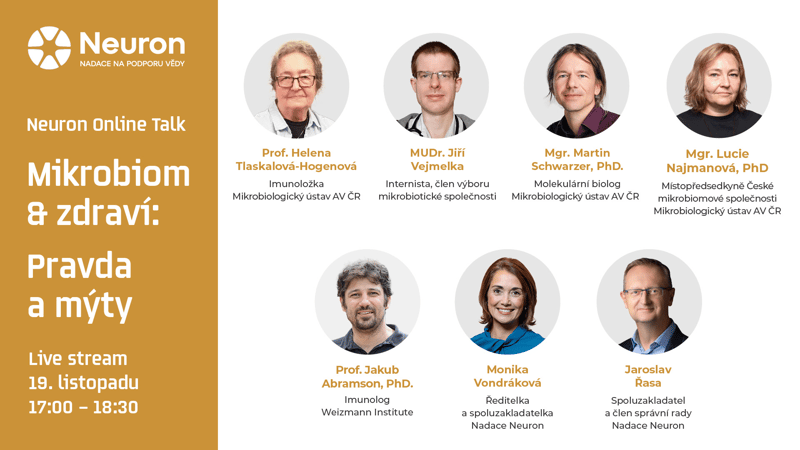
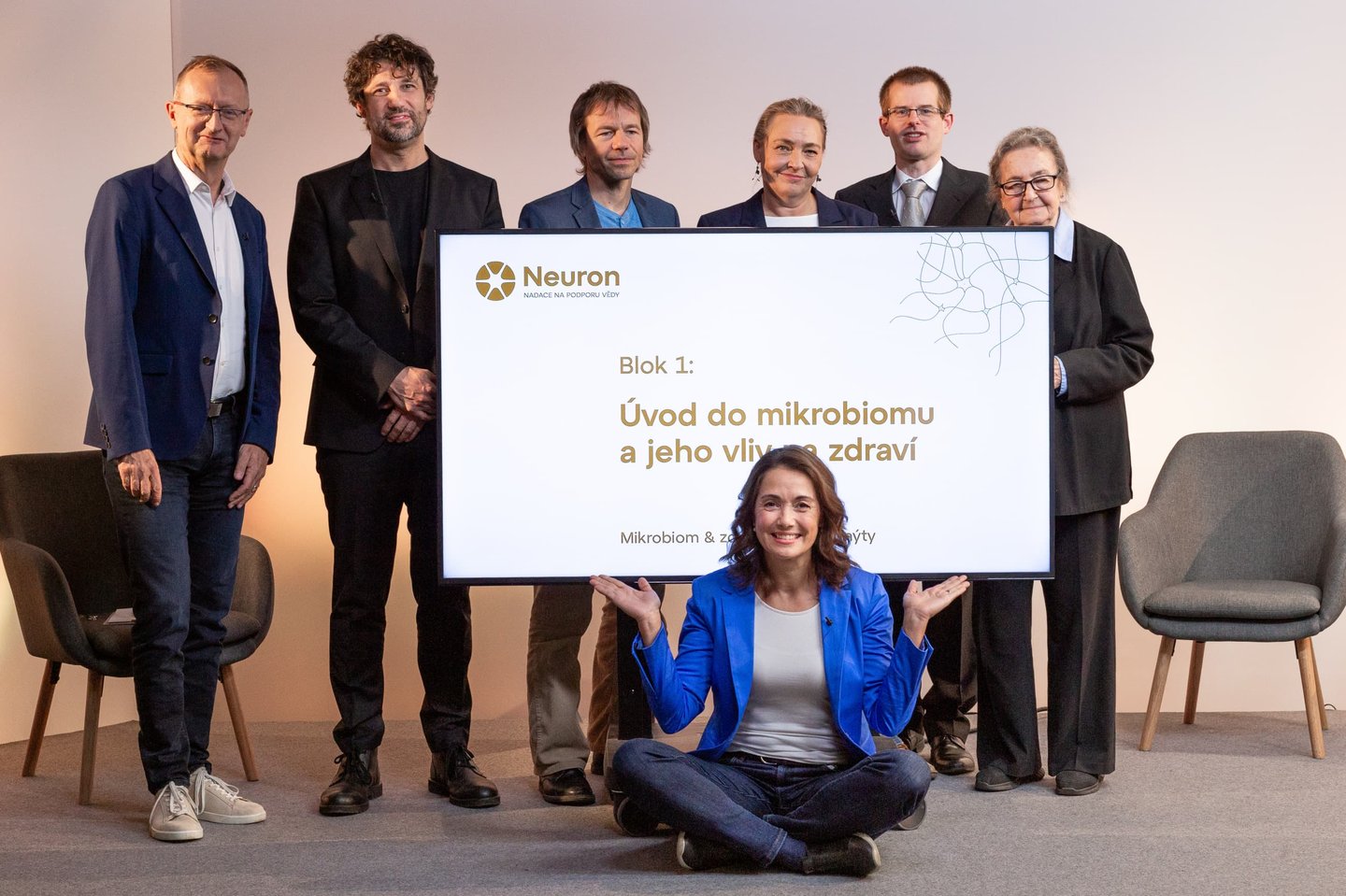
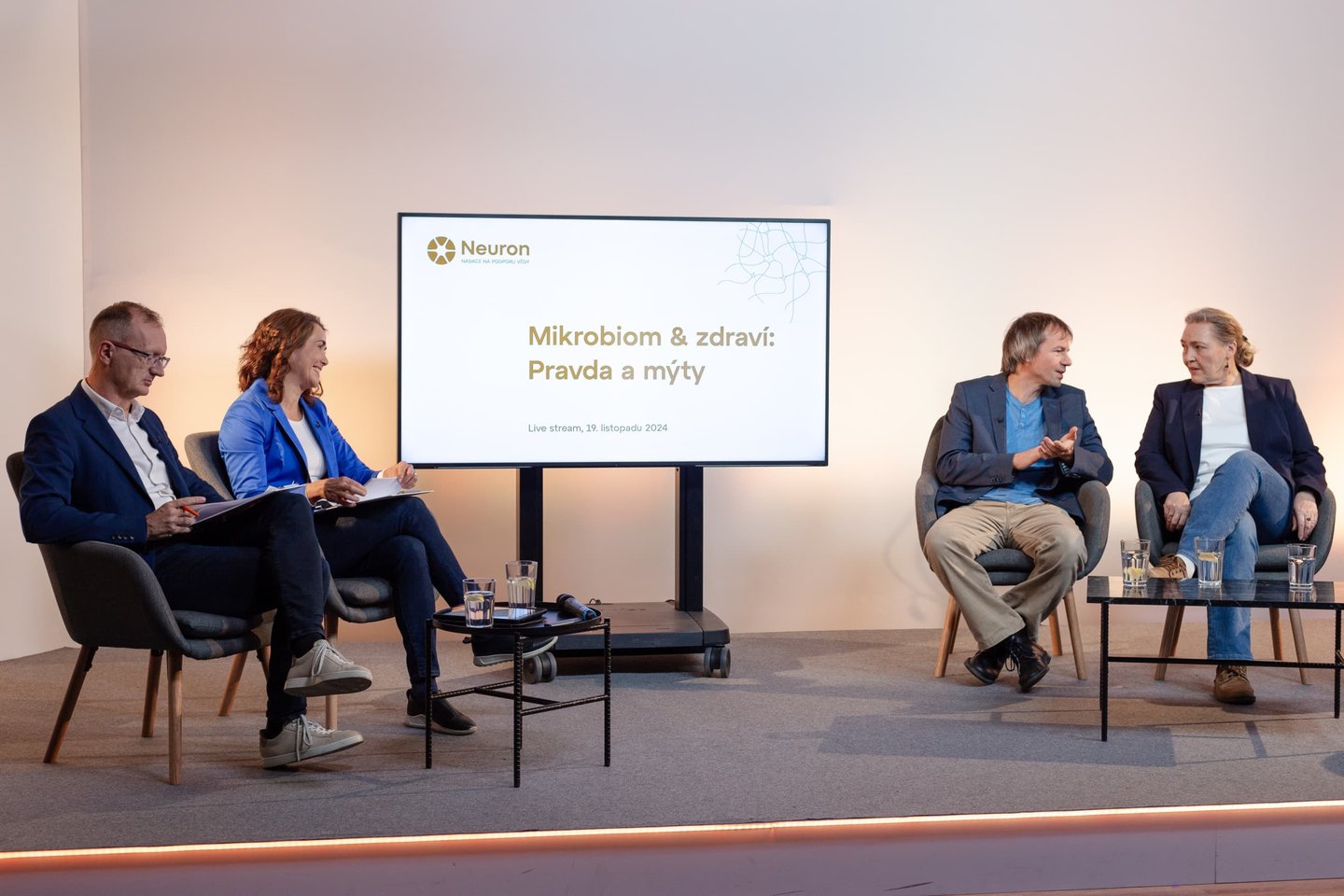
What effect does the microbiome have on our health? How far does current scientific knowledge reach? What is the experience of medical practice and what can we do for our microbiome? These questions were the subject of a Neuron Online Talk entitled The Microbiome and Health: Truths and Myths. Taking part were the immunologist Helena Tlaskalová-Hogenová, the Neuron Award laureate Martin Schwarzer, the physician Jiří Vejmelka, the immunologist Jakub Abramson and the microbiologist Lucie Najmanová. The evening was hosted by the director of the Neuron Foundation Monika Vondráková and the patron and co-founder of the Neuron Foundation Jaroslav Řasa.
What effect does the microbiome have on our health? How far does current scientific knowledge reach? What is the experience of medical practice and what can we do for our microbiome? These questions were the subject of a Neuron Online Talk entitled The Microbiome and Health: Truths and Myths. Taking part were the immunologist Helena Tlaskalová-Hogenová, the Neuron Award laureate Martin Schwarzer, the physician Jiří Vejmelka, the immunologist Jakub Abramson and the microbiologist Lucie Najmanová. The evening was hosted by the director of the Neuron Foundation Monika Vondráková and the patron and co-founder of the Neuron Foundation Jaroslav Řasa.
The microbiome: the world inside us
The microbiome is a complex ecosystem of bacteria, viruses, fungi and yeasts in our bodies and on their surface. Science has already shown that the microbiome plays a key role in the functioning of our metabolism, our immunity and our mental health. Even so, as the guests stressed, we are only at the beginning of mapping it.
"The microbiome is 500 times richer than the human genome," Helena Tlaskalová-Hogenová explained, emphasising its enormous complexity. "Each of us has a unique microbiome composition — not even identical twins have the same microbiome."
This complex ecosystem coexists with us and, according to Professor Tlaskalová-Hogenová, influences our lives far more than we have thought. The industrial development of Western society, however, is leading to a loss of our microbial diversity. And diversity is precisely what makes an organism resilient. "The more diverse a system, the more stable it is," Martin Schwarzer stressed.
Where does medicine stand?
The participants described the connections between the microbiome and diseases such as autoimmune conditions, allergies, cardiovascular and even mental illnesses. "We still do not know whether changes in the microbiota are the cause, the consequence or merely an accompanying phenomenon of these diseases. So far we know there is a connection," Jiří Vejmelka said. "We would like to change the microbiome in chronic disease, but we do not know exactly what our target should be."
Among the approaches medicine already uses he mentioned faecal microbiota transplantation — transferring stool from a healthy donor into a sick patient's digestive tract. This method is used only in recurrent Clostridium infection, when the microbiota is so damaged that it resembles a "burnt-out rainforest".
Who has the better microbiome?
So is it possible to find out whether we have a healthy microbiome? "Imagine our gut ecosystem is a city and we want to describe what life there is like, whether it is prosperous, whether there are plenty of schools…" was Lucie Najmanová's analogy. "But all we have available is information about those leaving the city. We can ask their first name, their surname… You get a picture of a kind, but it matters greatly at what point you take that picture," she says, pointing to the unreliability of one-off testing. "The microbiome is dynamic and can change over a day or over weeks," Martin Schwarzer added.
"I think at the moment we can distinguish extreme cases. If someone has very severe dysbiosis and that diversity is missing, we can identify it. But testing ourselves and guessing which of us has the better microbiome — we are not there yet," Jakub Abramson summed up.

From the left: Martin Schwarzer, Lucie Najmanová, Jiří Vejmelka, Helena Tlaskalová-Hogenová, Jakub Abramson
What should we feed the "good bacteria"?
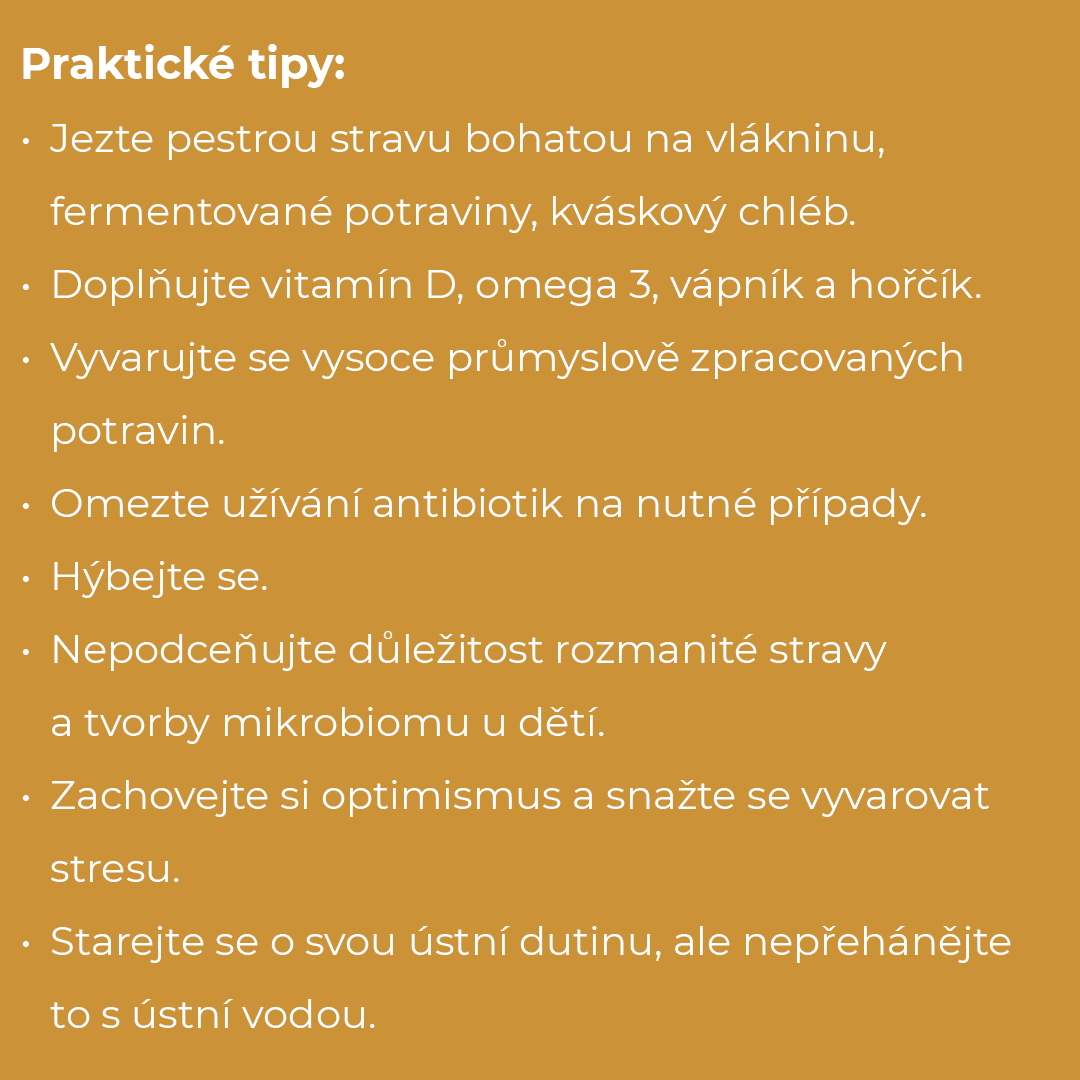
A healthy lifestyle and a balanced diet full of fibre are, according to the guests, the cornerstone of a healthy microbiome. "We are not only feeding ourselves, but the microorganisms inside us too," Abramson explained. He stressed the importance of fibre and explained that bacteria use it to produce short-chain fatty acids such as butyrate, which is key to the health of the large intestine.
"Fermented foods such as home-made sauerkraut or sourdough bread are a superb way of harmonising the microbiota," Schwarzer and Vejmelka said. Even though baking kills live microorganisms, the substances that remain, known as postbiotics, stimulate the immune system.
"And certainly some supplements, my favourite vitamin D for instance," Abramson added. "And besides that omega-3, a supplement I take every day. They prevent inflammation, but they are also a terribly important substance for our brain, especially in early childhood." Among other micronutrients, Vejmelka mentioned the possible benefits of calcium and magnesium.

The future of microbiome research
As for the breakthroughs that may await us in the coming years, Abramson mentioned "smart antibiotics" that would target specific bacterial strains. And then modified probiotics that could help address certain autoimmune diseases.
For now, though, prevention remains essential — a varied diet, a healthy lifestyle and limiting stress and the needless use of antibiotics.
The Neuron Online Talk The Microbiome and Health: Truths and Myths took place on 19 November 2024.
Thank you to the Czech Microbiotic Society.
Answers to questions from the stream:
A pair of papers in the journal Cell from 2018 by "the two Erans" suggested that taking probiotics after antibiotics is not only unhelpful but even harmful, in that it makes it harder to restore the native microbiome. That is in direct contradiction with the claims of various commercial producers of these supplements. How has the field developed since then? Have these results been confirmed, and do you recommend probiotics after antibiotics? (Adam)
I agree with you that these two papers in a single issue of Cell attracted a great deal of attention and only go to show that great care is needed in choosing suitable probiotics for a given purpose.
It has to be pointed out that the effects of probiotics are highly strain-specific and that the effects of individual strains can even be opposite (that is, from immunostimulatory to immunoregulatory/immunosuppressive). It is all the more surprising that the "Erans'" papers used probiotic preparations (commercially available, admittedly) without unambiguous identification of the probiotic strains (it is not enough to state Lactobacillus acidophilus; the specific strain has to be given — for instance Lactobacillus acidophilus NCFM).
ISAPP (the International Scientific Association for Probiotics and Prebiotics) stresses the need to state the specific probiotic strain with unambiguous identification. So administering suitable probiotics, prebiotics or synbiotics should help restore the microbiota after antibiotic therapy, but at the same time it has to be pointed out that not all probiotics will act equally positively on all people (each of us has different genetic make-up, a different history of infectious disease that has shaped our immune system, and so on).
What is your view of probiotics? Do they help with specific diseases, or as prevention too? Or perhaps only after antibiotics or an illness? And prebiotics?
With probiotics the preventive effect will certainly be greater than the therapeutic one. It has to be pointed out that the effects of probiotics are highly strain-specific and that the effects of individual strains can even be opposite (that is, from immunostimulatory to immunoregulatory/immunosuppressive).
Given the wide spectrum of probiotic effects, great care must be taken in choosing a suitable probiotic or probiotic strains for prevention or as a complement to conventional therapy for a given disease.
Besides probiotics themselves, one can consider prebiotics (organic substances indigestible to our body but serving as a substrate to selectively support the growth of suitable microorganisms) or synbiotics (a combination of probiotics and prebiotics); these should help restore the microbiota after antibiotic therapy, but again it has to be pointed out that not all probiotics will act equally positively on all people — there is no universal probiotic suitable for everyone and for treating all possible diseases at once (each of us has different genetic make-up, a different history of infectious disease that has shaped our immune system, and so on).
Thank you for the interesting information. What is the current state of knowledge about the brain microbiome?
The problem with organs where microorganisms are naturally very scarce is that the results of analysis are very often compromised by contamination arising during sample collection or processing. The brain is among the organs in which no "stable beneficial" microbiome has so far been reliably identified.
Where bacteria have been identified in the brain, it has mostly been in connection with infection and some pathological condition. The problem of analysing the microbiome in samples with a very low bacterial content is described in detail in a paper in Nature, in which the authors refute the concept of a microbiome in the foetus before birth, in the womb.
The more common type of probiotic is the classic capsule, but ever more, and many times more expensive, liquid probiotics are appearing. Is there a big difference between them and which are better?
Anything sold as a probiotic must by definition be alive (according to the WHO, probiotics are defined as "live microorganisms which, when administered in adequate amounts, confer a health benefit on the host"). As was said in the broadcast, killed bacteria can have a probiotic (immunomodulatory) effect too, but the WHO's definition of a probiotic is unambiguous.
Probiotics administered in capsules are lyophilised (that is, gently freeze-dried), and after rehydration the bacteria present are viable again — this ensures that in the lyophilised state they are preparations with sufficient stability and shelf life; a well-chosen capsule can moreover protect them from stomach acid as they pass through the digestive tract, so that release from the capsule and rehydration only occur in the favourable environment of the gut, where the probiotics can act beneficially.
With liquid probiotics I see a problem with stability (if they contain live bacteria, those have to be kept in a liquid environment often supplemented with suitable nutrients, so there is a considerable risk that the preparation's composition will change). Moreover, if liquid probiotics contain live bacteria, they are in no way protected as they pass through the digestive tract.
Do the butyrate and L-glutamine mentioned exist as food supplements, or can they only be obtained through diet? Thank you.
Yes, both butyrate and L-glutamine exist as food supplements. A diet rich in prebiotic fibre can increase butyrate production by the gut microbiota; L-glutamine is an amino acid found abundantly in meat, milk and dairy products, eggs and pulses.
What about fermented foods and drinks? Can they really help with certain health problems, as companies sometimes advertise?
As for fermented drinks, home-made milk kefir has (from my own experience) helped with many minor digestive complaints. With water kefir, kombucha and the like (made at home) my main objection is that they are above all drinks containing sugar (the bacteria and yeasts in tibicos grains or a kombucha SCOBY have to be fed with something, and that something is sugar).
So the drink will contain many beneficial bacteria and the products of their fermentation, but also a lot of sugar, which can no longer be considered outright healthy. With shop-bought versions there is also the problem of preservation — either it is a very live product, in which case its shelf life is minimal and undesirable changes occur over time, or the drink is preserved and keeps, but then it lacks the advantage of containing live bacteria.
With fermented foods such as kimchi, sauerkraut, live yoghurts and so on, many publications have shown the presence of bacterial species associated with probiotic action. These foods are at the same time a valuable source of fibre, that is, prebiotics, and of beneficial products of bacterial fermentation (postbiotics). Those can certainly be considered beneficial. But each of us is unique and has to find the combination of foods that suits us.
There are probiotics on the market recommended for cancer patients. Is it worth buying and taking them? Thank you.
Generally, when choosing probiotics with specific effects I would be guided by the results of clinical studies (ideally multicentre, placebo-controlled ones). Since probiotics are mostly sold as food supplements, they are not subject to the strict requirements applied to medicines. Taking certain probiotics could help ease the side effects associated with cancer treatment (diarrhoea, for instance).
There are isolated studies describing an anti-cancer effect of probiotics, but further clinical studies will be needed to demonstrate a beneficial effect unambiguously. So the results published to date are preliminary, and it has to be stressed that the effect of probiotics is highly strain-specific, which places demands on users to find their way around the probiotics market and, above all, to verify that the claimed effects are supported by valid clinical studies.
When does a person's microbiome begin to form? Is it affected, for instance, by the mother's diet during pregnancy?
There is an academic discussion here about whether a prenatal microbiome exists. That is, whether the foetus already has some microbiota or not (de Goffau et al., Nature 2019 vs Mishra et al., Cell 2021).
Last year the concept of a prenatal microbiome in the foetus was fairly reliably refuted by a group of authors in a paper in Nature. There is agreement that birth has the decisive influence on the emergence of the microbiota, when the newborn is colonised by microorganisms while passing through the birth canal and subsequently by microorganisms present in the environment or around the mother.
Here there will be a fundamental difference in the pioneer microbiota of individuals born vaginally and by caesarean section. Nevertheless it turns out that this difference disappears, and by the age of three the microbiota of children born by caesarean section and vaginally is identical. The question remains how this different microbiota in the early postnatal period affects the maturation of the immune system and the setting of immune responses generally.
Since diet has a fundamental influence on the composition of the microbiome, a mother's diet during pregnancy will affect the composition of her microbiota and hence the first microbiota with which the newborn is colonised after a natural birth. Current studies point above all to the effect of a diet rich in fibre, which increased microbiome diversity, while a diet high in fat conversely reduced it (DOI: 10.1017/S0007114520000847).
Is there a difference in the microbiome between people living in cities and in villages? Is a village "better" for the microbiome?
No. In the Czech Republic people may live in villages, but they mostly buy the same food in the same supermarkets as people from the cities, they travel into the cities and breathe the same polluted air, and drink water of comparable quality. Differences that might be caused by eating, say, home-grown vegetables are too small to distinguish villages from towns.
Nevertheless, in the context of the so-called hygiene hypothesis it can be assumed that people in the countryside will be exposed to a broader spectrum of microorganisms, which will support above all the maturation of the immune system in the early stages of an individual's development. It should also be mentioned that today's idea of a village differs from the original one — the satellite settlements now being built around large cities are not really villages. There is, however, a difference between the "European" microbiome and the microbiome of traditional hunter-gatherer societies that still largely maintain their original way of life (in Tanzania, for instance).
Rather than village life, what will affect the microbiome is life on a farm in close contact with livestock.
Synbiotics = probiotics + prebiotics + postbiotics. Does "the more the better" apply? Would you recommend a specific product for overall support of a healthy microbiota? (Pavel)
We certainly cannot recommend any specific product or its dosage. Given the highly strain-specific effects, there is no single miracle probiotic suitable for all situations, because sometimes it is desirable to support immune function (typically supporting anti-infective immunity) and at other times to suppress unwanted immune reactions (typically allergic or autoimmune disease).
For overall support of a healthy microbiota we can recommend above all a healthy lifestyle — a varied diet with plenty of plant fibre and great variety of plant foods, limiting smoking, alcohol and highly processed food, and conversely including plenty of exercise and, as far as possible, reducing stress. Unfortunately no pill can replace this, and increasing doses of synbiotics ad absurdum certainly cannot be recommended — companies generally compete over the number of billions of bacteria in a single dose, but that race makes no sense.
After all, the official definition of probiotics reads: "Probiotics are live microorganisms which, when administered in adequate amounts, confer a health benefit on the host." The gut community is immensely varied and the goal is to maintain and develop that diversity (through proper feeding and a healthy lifestyle), not to "pour" billions of bacteria of a few species into the system. The result of such an intervention may be beneficial, but it may also lead to entirely unexpected consequences that need not be pleasant for the user at all.