We have to be responsible, says a virologist honoured by Neuron on the current pandemic
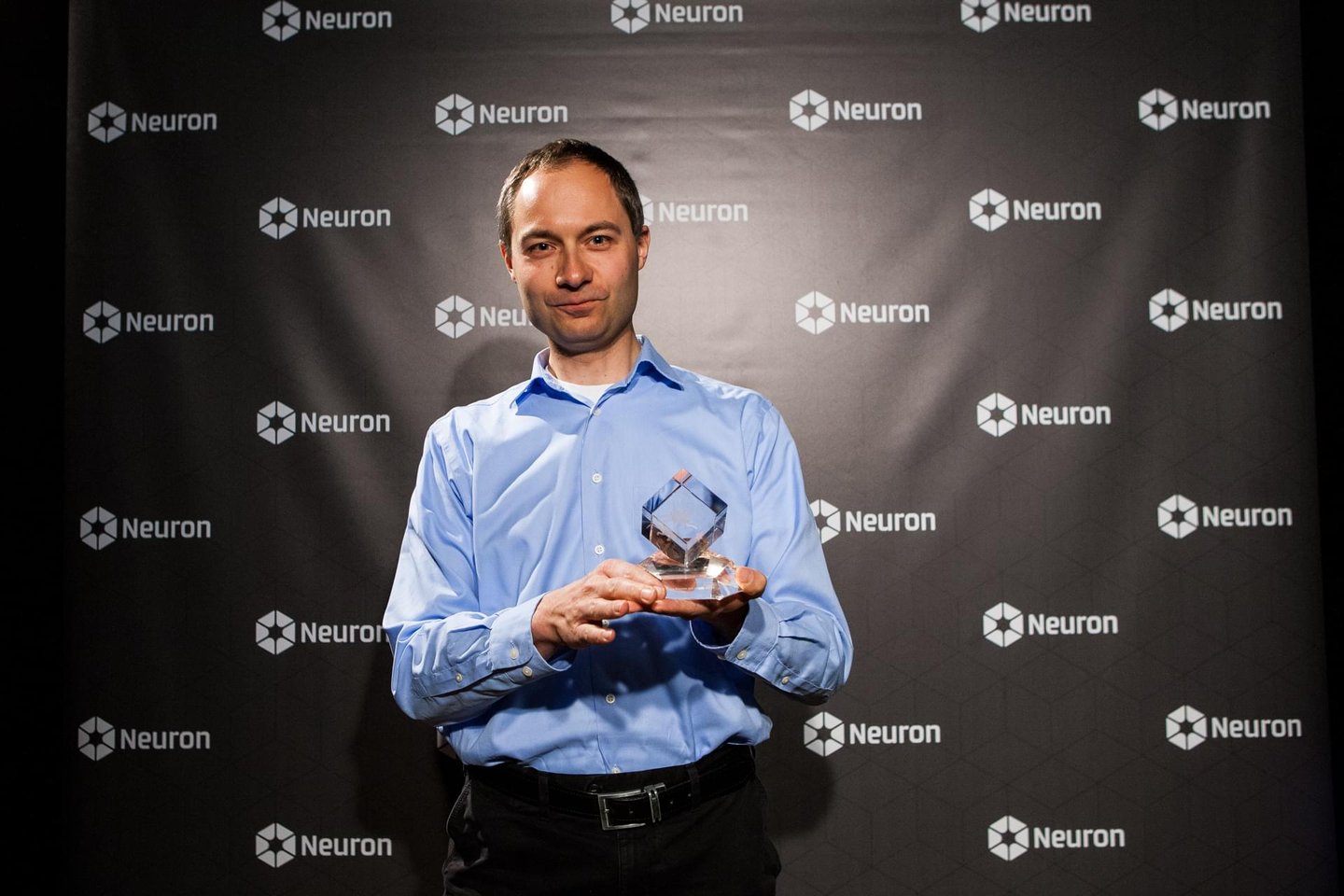
In 2016 the virologist Pavel Plevka received the Neuron Award for promising young scientists in biology. His research is devoted to the behaviour of viruses. He studies those that cause serious diseases: meningitis, for instance, which can end in a patient's death, and also picornaviruses causing eye inflammation, paralysis of the limbs or lower respiratory tract disease, which is dangerous for asthmatics.
In 2016 the virologist Pavel Plevka received the Neuron Award for promising young scientists in biology. His research is devoted to the behaviour of viruses. He studies those that cause serious diseases: meningitis, for instance, which can end in a patient's death, and also picornaviruses causing eye inflammation, paralysis of the limbs or lower respiratory tract disease, which is dangerous for asthmatics.
Now he comments on the current coronavirus pandemic. How does the coronavirus behave? What works against it — face masks, disinfectant? What awaits us in connection with it in the coming days and weeks? What are its weak points and how much longer will we be "sitting at home"? The interview by the journalist Adéla Skoupá appeared under the title "Virologist: We face shuttling between quarantine and normal life. Until a vaccine comes" in Deník N on 23 March 2020.
In recent days it has often been said that we are at war with the virus. And one of the rules of war says that if we want to defeat the enemy we have to get to know it as well as possible.
But we are also supposed to know ourselves.
True, that also becomes apparent in tense situations. But from a virologist's point of view: what kind of opponent are we facing?
Although scientists are studying this virus extremely intensively, it has only been known for about three months. Most of what we know about it is based on earlier studies of the SARS and MERS viruses. From those we infer the structure of the virus and how infection proceeds in a cell. The virus itself has an RNA genome, which is quite long.
That means its genetic information is not carried by DNA (deoxyribonucleic acid), as in humans for instance, but by RNA, ribonucleic acid.
Yes. Thanks to this form of genome, the coronavirus mutates faster than DNA viruses. That may prove a problem when using drugs, because variants of the virus resistant to the drug will appear very quickly. That is guaranteed. Nevertheless, an RNA genome is an advantage too.
And why is that?
Some drugs against the virus can work very well. They can work by increasing the rate of mutation, so that the coronavirus is then unable to produce viable offspring. That is the strategy by which the most promising current experimental drugs attack the virus.
By essentially over-mutating it?
Yes, they raise the number of mutations above a critical level and all the daughter viruses are so damaged that they cannot reproduce further.
A bag of genetic information
Let us look at the virus more closely. The appearance of the coronavirus known as SARS-CoV-2 is by now familiar from various images in the media: a small ball with spikes resembling the sun's rays — the corona, hence the name coronavirus. It is coated in protein and carries genetic information…
I would adjust that slightly. The virus is more like a little bag. Just as our cells are surrounded by an envelope — a membrane — it is coated in one too. And anchored in that membrane are proteins. Those are exactly the projections drawn on its surface. Inside the bag is genetic information, which is protected by further proteins of the virus.
Scientists argue about whether viruses are living organisms. They are called biological machines, for instance. Why is that?
They have two forms of existence. In the first they exist as the particle we have just described. That takes care of transmitting the virus's genetic information from one cell to another, or from one person to another. The virus does not distinguish between these variants, though, because it simply needs to get into another cell. When the virus is in particle form and has not yet attacked a host, it has no metabolism. That means it has none of the typical signs of life: it does not breathe, it has no metabolic exchange. At this moment the virus functions as a machine. Its only function is to find a cell and manage to deliver its genetic information into it.
What happens then?
Once it is inside, the whole cell loses its normal function in the organism and begins producing viruses. It essentially becomes part of the virus. The virus has the cell's metabolism at its disposal and uses its resources to create new particles, which are assembled inside the cell. Rather as cars are assembled in a factory. With the coronavirus, the new particles then bud out of the cell. That means new viruses tear away from the cell's surface. They then infect further cells.