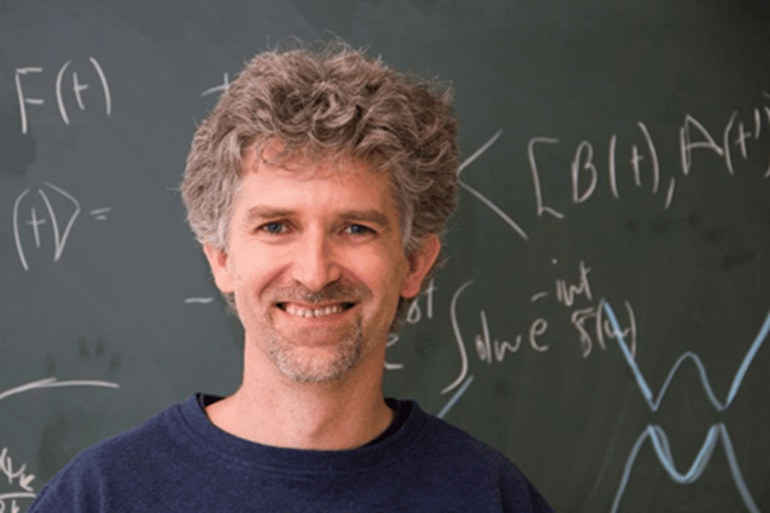
Neuron Award laureate Libor Barto will head the mathematics council
Fourteen years ago he received the Neuron Award for young scientists in mathematics. And today Libor Barto is the Neuron Foundation's new guarantor for mathematics. He is now also a professor at the Faculty of Mathematics and Physics, where he works on algebra and theoretical computer science so successfully that he has twice won prestigious European Research Council (ERC) grants. "I knew I would be a scientist. Maths and physics interested me from an early age. It was always clear. Even before I went to school I was constantly speculating about something, reading maths and physics books, solving problems," says Libor Barto, who is also a father of three, in this interview. And he is preparing to travel with his family to Berkeley in the USA.
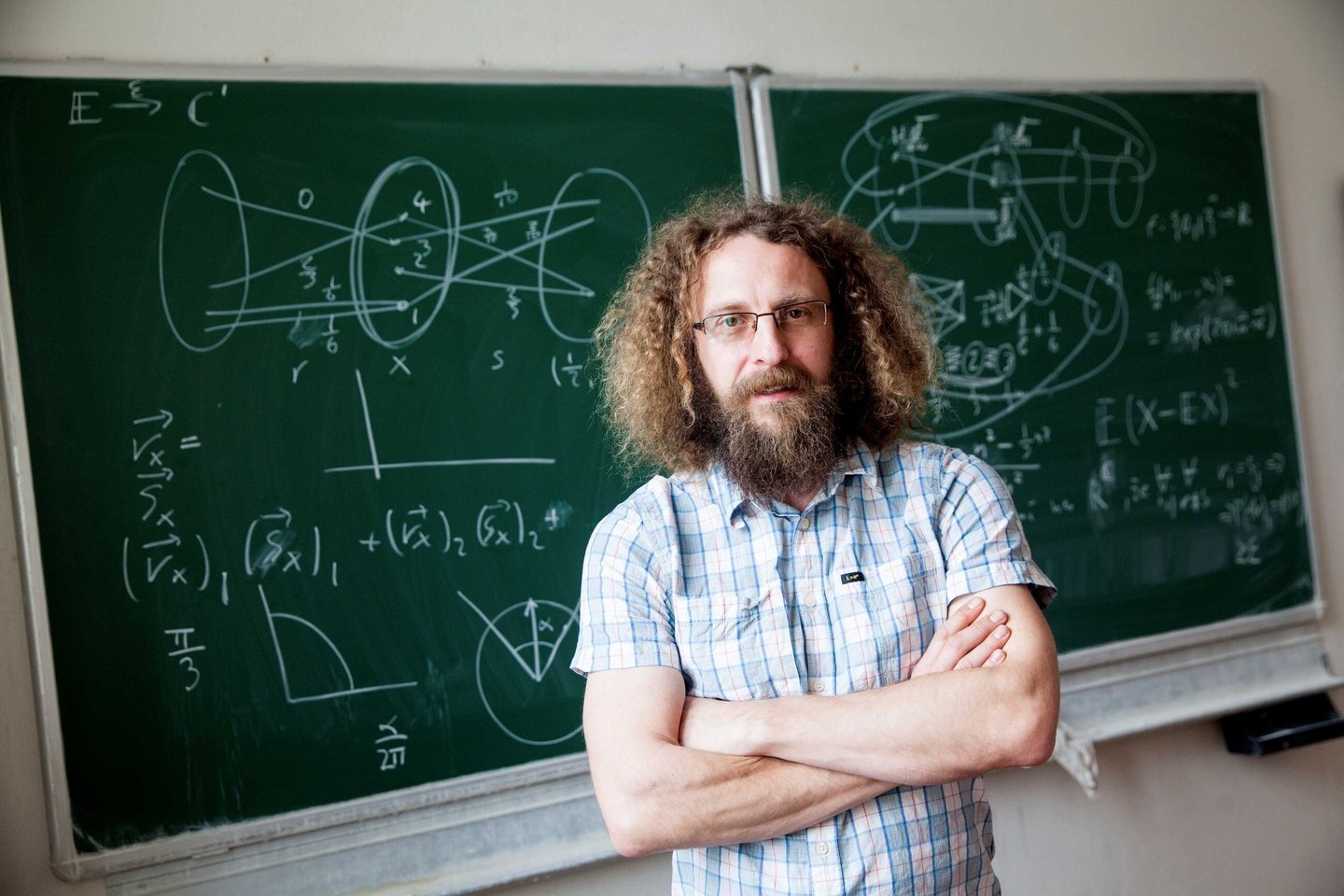
Libor, you have just become the guarantor for mathematics at the Neuron Foundation. What do you expect from that work yourself? And what would you personally like to bring to it?
I am reluctant to refuse service to the scientific community. I assume nominations for the Neuron Awards will come from outside. And the three of us, the new members of the scientific council, will try to select the very best from the proposals. The team is such that we can assess them across different sectors of mathematics.
How did you choose your two colleagues for the scientific council? It struck me as nicely balanced, that you are not all from "one stable", that you have more points of view and will complement each other…
For one thing I wanted a large part of mathematics to be covered, for it to be diversified. And secondly I wanted them to be people who care. I know both of the new men from various activities. I sit with Dan Kráľ on the scientific council of the Faculty of Mathematics and Physics, and I know that whenever something has to be decided, even a small thing, he takes it conscientiously and simply does not skimp on it. And Standa Hencl — I sit on committees with him too, and I know he takes it seriously.
Professor Hencl won an ERC CZ grant. What does he work on, what is his area?
He represents a large field of maths — mathematical analysis. Integrals, derivatives, all those things (laughs). Dan and I are not especially close to that field.
Dan Kráľ, meanwhile, was at Warwick for a long time, then at Masaryk University, and is now a professor in Leipzig and has repeatedly won prestigious ERC grants too. What is his domain?
Dan represents discrete mathematics. Analysis is the continuous things, whereas discrete mathematics is more the non-continuous things, combinatorics for instance. Dan is a superb scientist and a workaholic. What more could you want! And I am here for algebra. The sort of thing where you solve quadratic equations at school…
You make light of it, but you won an ERC Consolidator Grant (2018) and then a Synergy Grant (2023) in cooperation with colleagues from TU Wien and TU Dresden. Are you continuing that research?
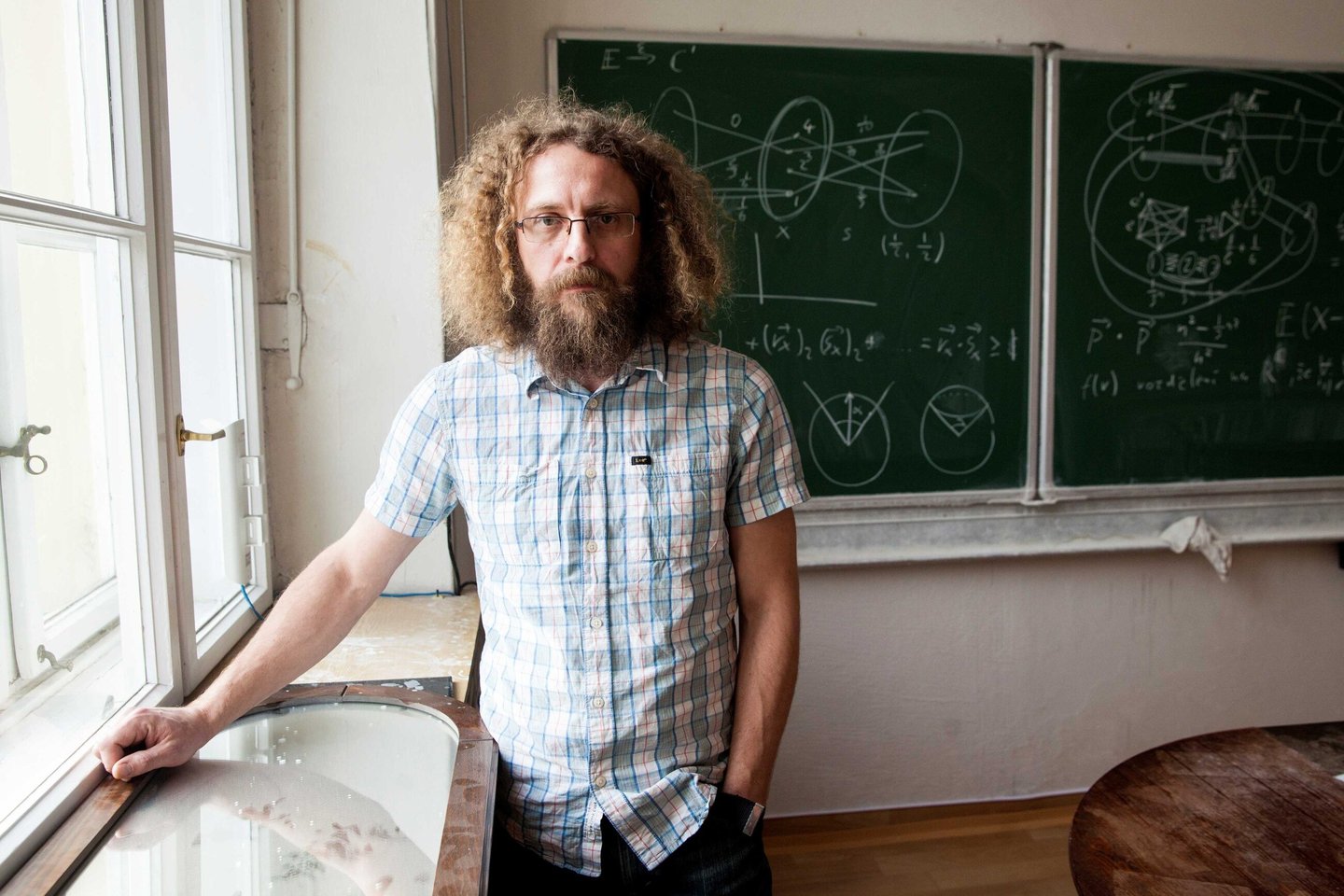
Yes, we are roughly halfway. We have a team of about twenty-five people, so it is a large project. We work on computational complexity; we want to understand better which problems can be solved efficiently on a computer. The field I would place it in is theoretical computer science, a part of mathematics where the point is not that people program something, but that they investigate things that concern computer science deeply.
I see. May I ask whether there is anything in common with what Erin Carson of the Faculty of Mathematics and Physics works on; she received the Neuron Award for outstanding young scientists in January?
Hmm. What we have in common is that both our projects are about efficient solvability, but the similarity ends there. Erin does numerics. You have some complicated equations and a lot of input data, equations modelling the weather for instance. Those equations cannot even be solved exactly, but you still need some satisfactory solution, and quickly at that — within a day, say. We, on the other hand, study computational problems that can be solved exactly, and we try to understand which of them can be solved efficiently. In our case efficiency has a precise, beautiful, useful, but certainly not straightforwardly practical definition: for instance, a program that solves a task on input data of the size used in a weather forecast in a million years is efficient for us. The goal is simply to understand better why some computational problems are easy and others hard.
People often ask you mathematicians whether your calculations and methods will ever have practical applications. Do questions about that "practicality" irritate you by now?
That question certainly does not bother me more than any other. It is fundamental research. That means we try to work out how things are, not to solve some specific engineering problem. But I also understand the question. The reality is that for a genuine practical breakthrough to come, it cannot happen without someone understanding the thing better.
There will be practical consequences, I believe. One example I use in answer to such questions is number theory, prime numbers and so on. What people cared about above all was understanding how things are. And the results are now practically absolutely fundamental, because the findings of that old impractical research, going back to antiquity, are needed for any modern communication because of cryptography. And let me give one more example from elsewhere: if I want to develop gene therapy for some disease, I first have to know that the body is made of cells and how it works.
How satisfied are you so far with how your ERC project is going?
Of course everything can always be better or worse, but overall we are very satisfied. The people are good, the outputs excellent. And I am on a roll at the moment. I have the feeling I have an idea that will change the world… (laughs)
Neuron is now launching the campaign Start with Why — aimed at young people, drawing them into science. You were already succeeding in mathematics olympiads at secondary school. Did you want to become a scientist?
I knew I would be a scientist. Maths and physics interested me from an early age. It was always clear. Even before I went to school I was constantly speculating about something, reading maths and physics books, solving problems. There used to be an experimental primary school on Uhelný trh. A maths one. Most people went from there to Zborovská, which in turn was a maths grammar school.
But I wanted to be in the company of normal people; since I am something of a mathematical oddball myself, I at least wanted to have fairly normal boys and girls with other interests around me. So I went to the Jan Neruda Grammar School on Hellichova.
And then you thought about what next.
I didn't think about it. I went straight to the Faculty of Mathematics and Physics! That was already clear. At secondary school it was already clear to me that I would do mathematics rather than physics. I did program too, but that never struck me as so interesting. The community of correspondence seminars also helped me finally decide to go into science; there is not much of that internationally.
How did it work back then?
It was a group of people who organised it and thought up the problems; it was still genuinely by correspondence, so it was sent by post — email was not yet common… And after a fortnight you sent in your solution, and for some selected solvers there were even gatherings where you went somewhere for a week. A camp, but a mathematical one. We had the chance to get involved. And in my generation I more or less know everyone who does mathematics. Because we already used to see each other at these events.
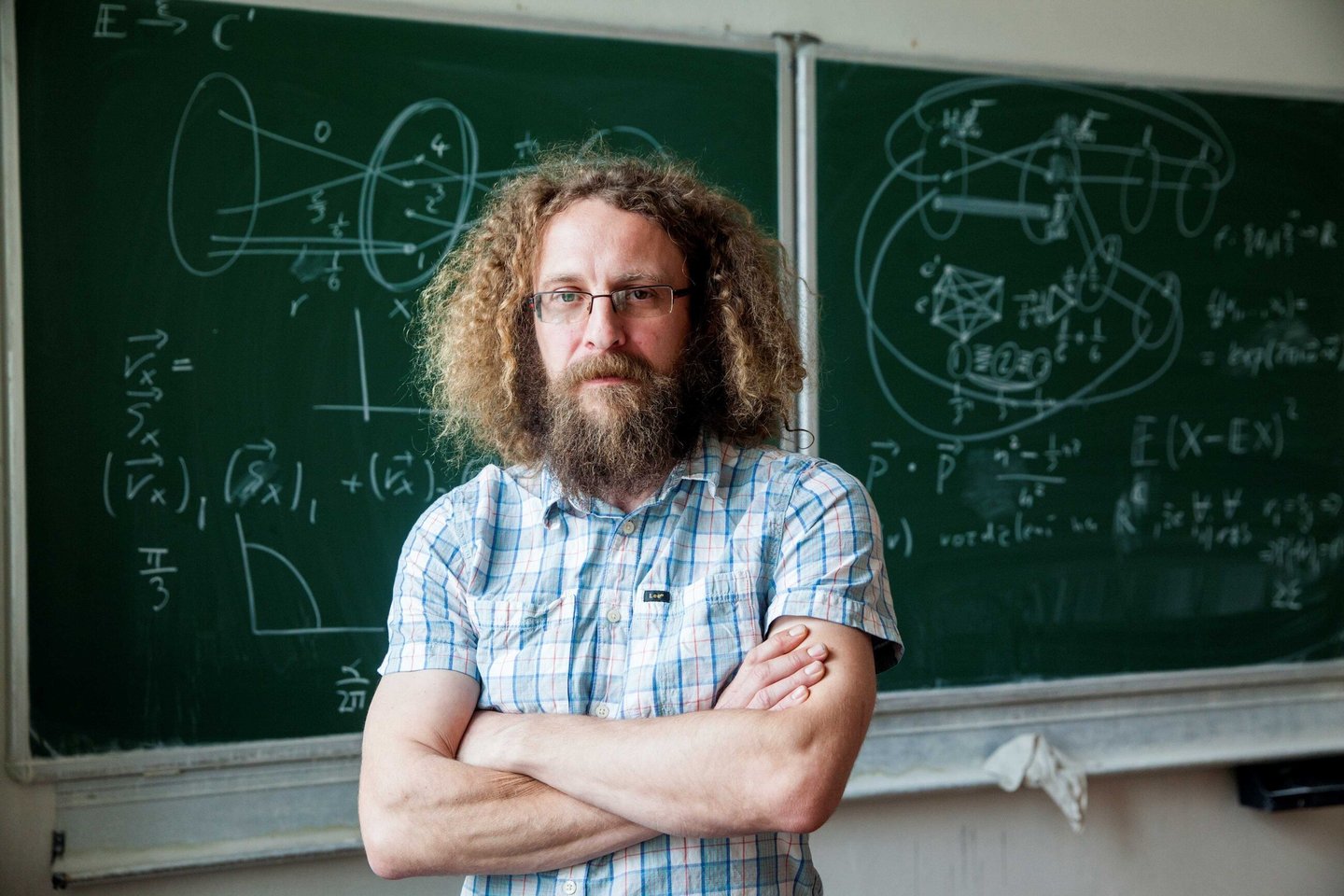
You graduated from the Faculty of Mathematics and Physics in 2003. Did you already know then that you wanted to do algebra or universal algebra? Were you heading straight for what you do in science today?
Not entirely directly. During my studies I put together my own programme of what I wanted to do, rather than letting myself be led, though the superb people I met of course influenced me. Universal algebra struck me as a "big gap in the market" in mathematics — this field is certainly not mainstream. Intuitively it seemed to me that it deserved more attention, and that is being borne out.
One of the few things I really could not stand during my studies was, paradoxically, computer science, theoretical computer science included. And that despite the fact that I programmed in my youth and knew quite a lot about it, so I wanted to have almost nothing to do with computers, apart from earning money that way… And in the end I ended up doing theoretical computer science.
I was struck in your CV by the fact that you were a postdoc at McMaster University in Canada and also worked at the famous Fields Institute in Toronto. How did you get there?
At McMaster there was a significant universal algebraist who happened to have money for a postdoc position and an interest in employing me. So I was glad to go. He was also a co-organiser of a summer thematic programme at the Fields Institute and offered me a stay there and the chance to co-organise one of the workshops. Otherwise I am rather lazy when it comes to travel. Back then it was not yet so "essential", but today nobody has a chance of establishing themselves here at the Faculty of Mathematics and Physics without periods abroad. Today it is impossible without international experience, and that is a good thing.
Did you go to the ice hockey in Canada? You used to play floorball as well.
I did not go to a single match; the only thing I saw live was baseball. We rather watched American football on television with the neighbours.
When you were coming back from abroad, did you consider a position anywhere other than Prague?
There were possibilities. But shortly after I came back I met my wife and we soon had three children. And the support you have here, grandmothers and so on, that is terribly important. So that is one thing. And the other is that travel simply does not attract me. I don't mind where we are. And I don't need a better position at some better university. My career built itself somehow, even from here, from the Czech Republic. And being at a better institution in order to feel better? That does not interest me.
I hear that is about to change, though? You are heading for California, aren't you?
We are going to Berkeley for six months now, children included. At Berkeley they run a programme similar to the one at the Fields Institute, only it is at the Simons Institute in the USA. My wife, by contrast, likes travelling, so she seized on it, and I think the children will enjoy six months of school in America.
Is your wife a scientist too?
No. But she is also a graduate of the Faculty of Mathematics and Physics. She works at the National Cyber and Information Security Agency (NÚKIB) as a cryptologist.
And how old are your children?
I don't remember. Well, something like nine, ten, eleven. Actually now nine, ten, twelve. It keeps changing, doesn't it (laughs). All around ten. A girl and two boys. They came close together; we wanted to have it compact.
I know you were also involved in music, playing the flute in the band Votchi. Do you still play?
I play less than I would like. And in secret! So when everyone is out I sometimes take out the flute and play. But I do not perform anywhere. What actually bothered me about music was performing; I mainly played for myself. And concerts and so on? Those were more of a necessary evil. The band continues without me.
And do your children lean towards music or mathematics?
One of them has just become enthusiastic about the piano and goes to lessons with enthusiasm. They are fairly clever children, yes, but we certainly do not push them anywhere. And I don't really see the drive to be scientists in them.
How do you see the Neuron Foundation, which honoured you as a hope back in 2012?
Neuron strikes me as a superb thing. Thanks to it science is more visible in the media. When the announcement is on television, it is an event. That is absolutely superb. And I will be glad to take part in it as an assessor.
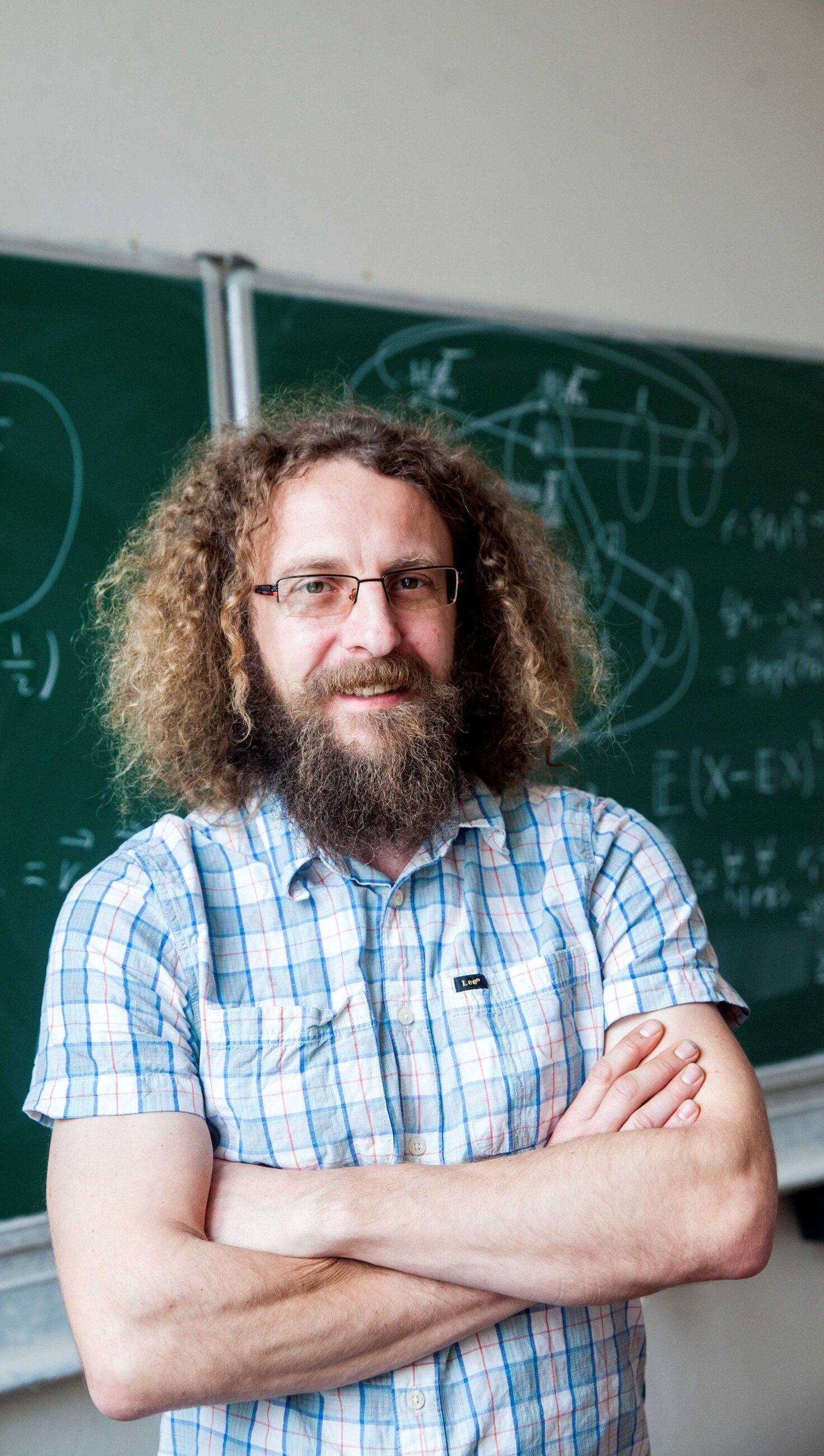
Prof. Mgr. Libor Barto, Ph.D.
He works at the Faculty of Mathematics and Physics of Charles University in Prague, where he is a professor in the Department of Algebra. He graduated from the faculty in 2003 and gained his PhD there three years later. After his doctorate he worked at McMaster University in Canada (2010–2012). He focuses on universal algebra and the theory of computational complexity. He is the author or co-author of dozens of specialist papers in leading international journals. For his research he won an ERC Consolidator Grant (CoCoSym – Symmetry in Computational Complexity, 2018–2023) and, together with M. Bodirsky and M. Pinsker, an ERC Synergy Grant (POCOCOP – Polynomial-time Computation: Opening the Blackboxes in Constraint Problems, 2023–2029). He is a laureate of the Neuron Award for young scientists (2012) and of the Award of the President of the Czech Science Foundation (2018). Besides mathematics he has also found a love of music — he played the flute in the band Votchi. He has three children.