Geopolitics at a critical point: 7 steps towards freedom
Over recent years Europe rid itself of the fear of imminent armed conflict and settled into comfortable prosperity. Russia's invasion of Ukraine was a reminder that security is fragile and that the Czech Republic need not be spared either. What is to be done? A discussion under the Neuron Online Talk banner brought answers from various points of view. Here is a summary of the most important of them.
Over recent years Europe rid itself of the fear of imminent armed conflict and settled into comfortable prosperity. Russia's invasion of Ukraine was a reminder that security is fragile and that the Czech Republic need not be spared either. What is to be done? A discussion under the Neuron Online Talk banner brought answers from various points of view. Here is a summary of the most important of them.
Regional power conflicts, imperial claims to territory, breaches of sovereignty and stability, the rise of the radical right, the spread of hatred. History has seen all of this several times before. And although today's context may be somewhat different, the similarities with historical events that have already happened are undeniable. We took a look at contemporary geopolitics as part of a Neuron Online Talk.
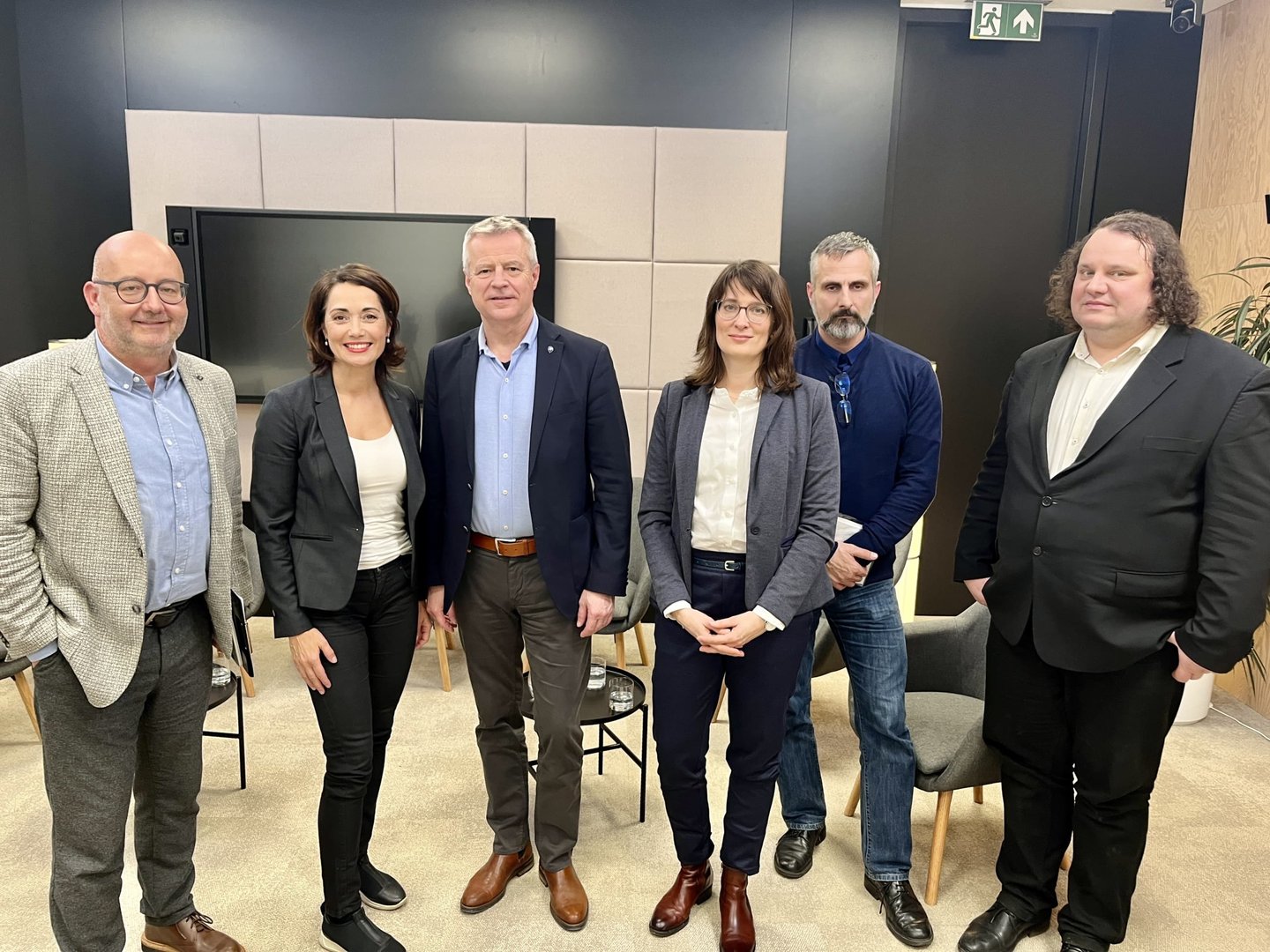
From the left: the Egyptologist and archaeologist Miroslav Bárta, the director and co-founder of the Neuron Foundation Monika Vondráková, the diplomat and presidential adviser Petr Kolář, the psychologist and Neuron Award laureate Sylvie Graf, the Czech Army officer Otakar Foltýn and the historian and Neuron Award laureate Petr Koura discussing contemporary geopolitics at the Neuron Online Talk.
Those who do not learn from history are forced to repeat it
"Now and then I have the feeling that there are events in today's news that I know from history. The idea that when a state is big and strong it can seize the territory of another state — I had the feeling that this kind of thinking ended with the 20th century, that it is the thinking of the Munich Agreement of 1938," says Petr Koura, historian, expert on modern history and Neuron Award laureate.
Winston Churchill's infamously famous sentence, spoken before the British parliament in 1948, about those who do not learn from historical events that have already happened, is therefore gaining new significance.
Let us jump to the early 1990s, when Europe, as the "East" took new shape, hoped that Russia would become a partner and ally. "But Russia took a different path. And for a long time we did not want to see the reality; we did not register the strong signals that were coming," recalls Petr Kolář, a former diplomat in the USA and the Russian Federation and an adviser to President Petr Pavel.
So why is today's world in turmoil? There are a great many connections. "What we expected when communism began to collapse in Europe did not happen. The world became multipolar; various fairly strong regional powers developed that are claiming their place. The current UN Security Council does not correspond at all to what the world looks like today," Petr Kolář adds.
And the historian Petr Koura adds: "But what we lack today is the ability to make a sacrifice. We feel that we are living well, but right now it is Ukrainian soldiers in the trenches who are paying for it. In 1938 people in Czechoslovakia chanted 'give us weapons' and wanted to defend their country. Today we see people shouting that they want peace while wanting to surrender to Putin. Society has changed."
How do we get out of it? Solutions to the current geopolitical crisis and other problems
"Ukraine's goal is to liberate occupied territory; Russia's goal — or rather the Kremlin regime's, which is not the same thing — is to hold on to power at any cost. In my view there is no other solution, whether from a legal, moral or international point of view, than Russia's defeat," believes the military analyst and Czech Army officer Otakar Foltýn, another speaker at the Neuron Online Talk on Geopolitics in Crisis.
According to the entrepreneur Dalibor Dědek, who is also a patron of the Neuron Foundation and the initiator of the "Gift for Putin" fundraiser, dramatic change can only come when Western aid to Ukraine expands significantly. That aid is happening, but as practice shows it is still not sufficient.
"The West thinks it has to support Ukraine, as it were, but with the least effort necessary. That is nowhere near enough for them to win," Otakar Foltýn points out.
How can that be changed? Only by will. "At this moment the European Union is ten times stronger economically than Russia. Together with the United States, twenty-five times. In terms of armies, the EU together has twice as many soldiers, a far larger number of modern aircraft and so on, which means the European Union is substantially stronger than Russia. If we scaled up aid to Ukraine proportionally, Ukraine would be able to liberate itself. But the aid would have to be many times greater, and even then it would not be so great that we would feel it in our standard of living," Otakar Foltýn analysed.
Global dependence versus underestimating the China card
The plan is clear and can be illustrated with another concrete example: Ukraine currently needs drones. But as Dalibor Dědek pointed out in the discussion, the technology for making drones comes from China. And that is because most Western chip manufacturers have moved their production there.
"At the end of 2023 China imposed an embargo on the export of practically anything with dual use, including drone technology. And so far drones are only being produced because China has not yet enforced that embargo very seriously."
The shortage of key components is a global problem, and dependence on China can paralyse Europe in this respect. "The China card should not be underestimated and the West really should realise that. So that we are not surprised one day to find that, thanks to scientific progress, we have created an amazing weapon but cannot manufacture it, because we do not have the components, or because they have to be supplied by someone we are not exactly in harmony with," Dalibor Dědek adds.
Understand current geopolitics in context. Watch the recorded discussion by thematic chapter:
Disinformation is not information. But its role is growing
The development of social media also plays a fundamental part in the current situation — information spreads fast, from all sides, uncontrollably, and often cannot be verified. "In the free world, for many of us the right to an opinion matters more than facts. What arises is an opinion that is not the result of thinking but a substitute for it. People then defend it all the more fiercely and are all the more unwilling to consider whether it is right or not," Petr Kolář explains, adding: "On social media it is not facts or arguments that decide, but emotions — fear and anger. Whoever knows how to handle them manipulates the crowd very well and wins elections."
But it is not only how we obtain information that matters; so does how we approach it ourselves. "What rather shocked me were the current statistics on how people avoid information about the war in Ukraine," mentions Sylvie Graf, psychologist and Neuron Award laureate.
And the reason? Negative information arouses negative feelings in us. "And yet it is possible to work with them so as to use them to our advantage. There is no need to present negative emotions as something to be avoided — the anger, or even the sadness, that news of the war in Ukraine arouses leads us to think harder."
Seven steps on the road to a free society
During the Neuron Online Talk on Geopolitics in Crisis a great deal of information was shared, along with proposals and concrete steps that could improve the current situation or that are a precondition for us to go on living in freedom. Here are 7 of them.
- Don't close your eyes; help. For instance through the initiative in defence of Ukraine and the fundraiser A Gift for Putin, behind which stands the Neuron Foundation patron Dalibor Dědek.
- Defend the values of Western democracy and explain what they are: freedom, democracy, justice, dignity, compassion.
- Strengthen our own army and defence capability, and meet our NATO commitments.
- Fight disinformation, learn critical thinking — look information up from more than one source and think about it critically.
- Don't avoid negative information; learn to process it.
- Look for a genuine leader and highlight role models.
- Don't underestimate investment in science and research; support the development of new technologies.