Curiosity and stubbornness drive me forward, says Lenka Zdeborová
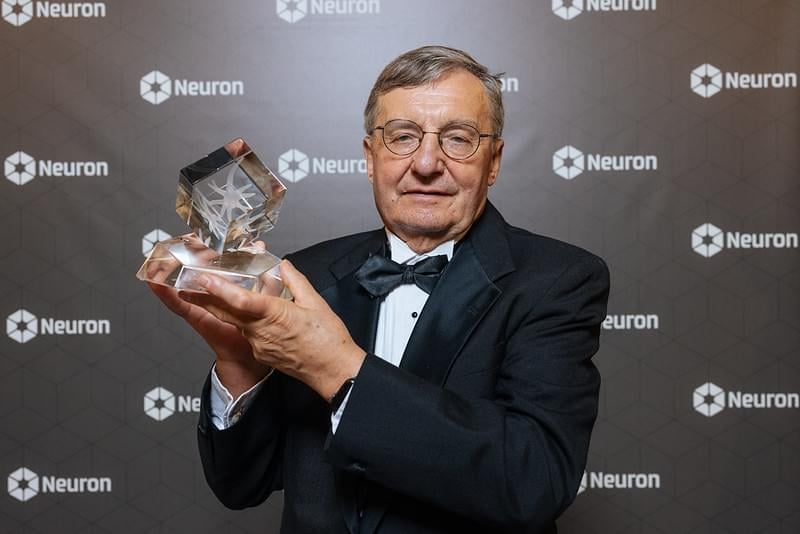
Lenka Zdeborová is a laureate of the Neuron Award 2021 for promising young scientists in physics, which in the scientific council's view she earned "for the complex solution of physical problems using algorithms based on neural networks".
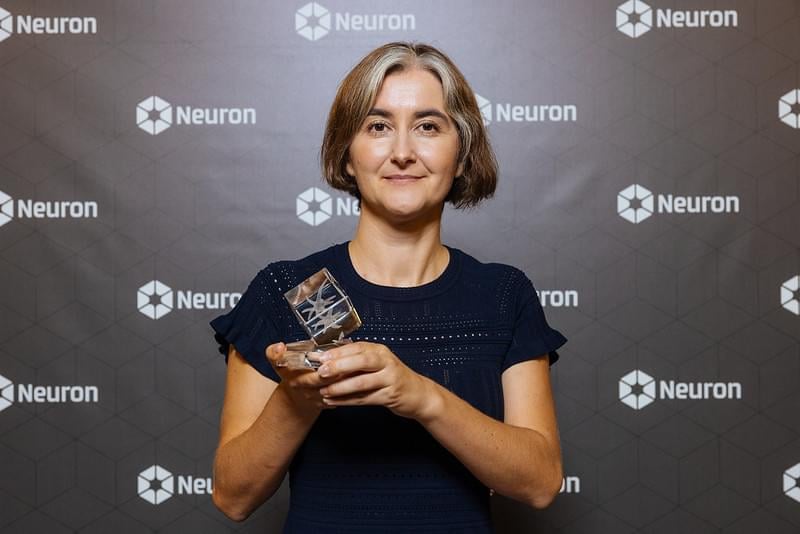
Lenka Zdeborová is a laureate of the Neuron Award 2021 for promising young scientists in physics, which in the scientific council's view she earned "for the complex solution of physical problems using algorithms based on neural networks".
Lenka Zdeborová's work lies at the interface between physics, computer science and mathematics. She applies the methods of physics to problems in computer science, combinatorics and machine learning. Her goal is to understand which complex scientific problems can be solved using computers and neural networks.
After studying at Charles University and the Université Paris-Sud, she worked as a researcher in French scientific laboratories, and her work led to the development and analysis of a number of algorithmic methods. Since 2020 she has been professor of physics and computer science at EPFL in Lausanne. Lenka Zdeborová has gained thousands of citations in specialist periodicals and has been honoured with, among others, the Irène Joliot-Curie prize and an ERC Starting Grant.
How would I explain what I do as clearly as possible in seven short sentences?
My main field is statistical physics, the discipline that can describe mathematically the properties of many interacting atoms or molecules. I use its methods to describe other systems made up of many interacting parts. Such systems include, for example, an epidemic spreading among the population, or artificial neural networks in machine learning, or images of tissue produced by magnetic resonance imaging.
Just as physics can describe phase transitions between water and ice or water and steam, I describe phase transitions in the properties of algorithms used, for example, in medical imaging or for developing artificial neural networks capable of translating languages or driving a car. My great goal is to build a theory that explains which practical problems can be solved by computer, and how.
What do I enjoy at least as much as my work?
Watching my daughters get to know the world and learn new things and skills. Apart from my family and children there is nothing that fulfils me the way my work does. Mushroom picking probably comes closest.
What was the greatest obstacle I have overcome in life?
Probably that at a very early age I realised that being able to spend time looking for answers to the questions that fascinate me matters far more to me than, say, my peers' opinions about how I spend my time.
Talent, temperament, hard work, luck, something else — what determines success?
All of these play an important role in science. In my case also an insatiable curiosity and the kind of stubbornness we know in pre-school children. What also defines me is an unflagging astonishment that more and more phenomena and processes can be understood, described and predicted.
Another essential aspect is support from family and those around you, and also humility before the fact that I may be one of those pushing the boundary of human knowledge forward step by step. And not least, I would stress that behind every success in science there is always the unflagging work of many scientists without whom the discovery in question would not have happened, but who do not come to the fore or do not want to.
What do I consider the greatest success I have achieved?
In science today, where many fields are very narrowly focused, I look for bridges and connections between disciplines. Among the most interesting of them is the connection between the existence of phase transitions in computational problems and their complexity, that is, the time a computer needs to solve a given problem. Understanding that connection allowed us to improve algorithms in a whole range of computational problems, and it is those results I am most proud of.
What would I change in the world if I had the power?
I would like an organisation of society in which money and material wealth play no significant role and in which humanity does everything it can to make the Earth a good place to live for many generations after us.
What is the greatest challenge facing my field and science in general?
Science has the potential to move humanity forward and also to protect it from itself. Science has to be a step ahead of human vanity and greed. It is our responsibility to ensure that life on our planet is pleasant in the future too. Machine learning and artificial intelligence will certainly play an important role in that.
WATCH THE RECORDING OF THE DEBATE WITH THE NEURON AWARD 2021 LAUREATES
THANK YOU TO THE PATRONS AND PARTNERS OF THE NEURON FOUNDATION AND THE NEURON AWARDS