Anežka Kuzmičová: I study how children experience reading facts
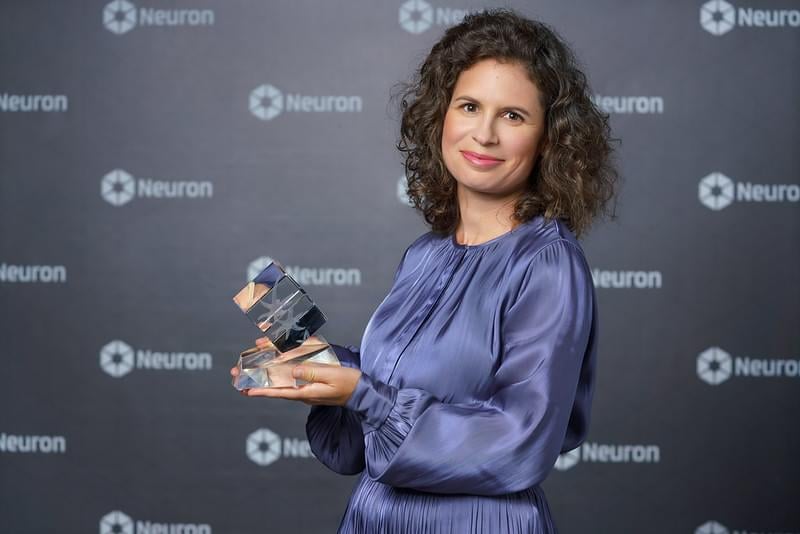
Anežka Kuzmičová is a pioneer of a discipline that represents a new approach to research into literacy in children and adults. Her exceptional work won her the Neuron Award 2022 for promising scientists in the social sciences. What has changed since last October, when she received the prestigious scientific award at the National Museum? What does she expect from the future? "I like that science across disciplines is increasingly taking into account the reality of cultures other than the majority one. Whether that means children, who are in fact the largest minority culture in the world and whose voice carries ever more weight in science," says Anežka Kuzmičová.
Anežka Kuzmičová is a pioneer of a discipline that represents a new approach to research into literacy in children and adults. Her exceptional work won her the Neuron Award 2022 for promising scientists in the social sciences. What has changed since last October, when she received the prestigious scientific award at the National Museum? What does she expect from the future? "I like that science across disciplines is increasingly taking into account the reality of cultures other than the majority one. Whether that means children, who are in fact the largest minority culture in the world and whose voice carries ever more weight in science," says Anežka Kuzmičová.
You received the Neuron Award last October. How has your field moved on since then?
I was drawn to research on children's reading by a long-standing interest in what consciousness is. How is it that we begin to experience some things consciously, while other things simply happen to us unnoticed? There are several competing theories about how this works. Their proponents came together some time ago in a quite exceptional way and helped researchers around the world carry out verifying experiments. They presented the first analyses in New York this June; the publications are now eagerly awaited.
What interesting things have happened to you personally since October?
I managed to get research going into how children experience reading about facts, which is completely uncharted territory. What information captures children's attention in everyday life, and why? How do they then keep feeding their interest in a particular subject — cars, say, or animals, or space? What role does reading play in that? My colleague Markéta Supa and a team of other wonderful people are working on it with me, and we are thoroughly enjoying it.
How can your field help society as a whole in 2023?
Research like ours helps show what fulfils and motivates children, but also what adults do that hinders or downright annoys them in their learning. What that means for all of us probably needs no elaborate explanation.
What do you expect from science further into the future?
I like that science across disciplines is increasingly taking into account the reality of cultures other than the majority one. Whether that means children, who are in fact the largest minority culture in the world and whose voice carries ever more weight in science; or, for instance, the fact that after years psycholinguists are discovering that models of reading built on data from English-speaking readers need not hold for other languages. Only a science of everyone can serve everyone.
And who should be the next Neuron Award laureate?
Someone who works for a science that is creative, inclusive, communicable and philosophically far-reaching. If social developments over the past few years have shown us anything, it is the enormous gaps in our understanding of who we are as people and what connects us.