The hammer and the dance strategy is helping us cope better with the pandemic
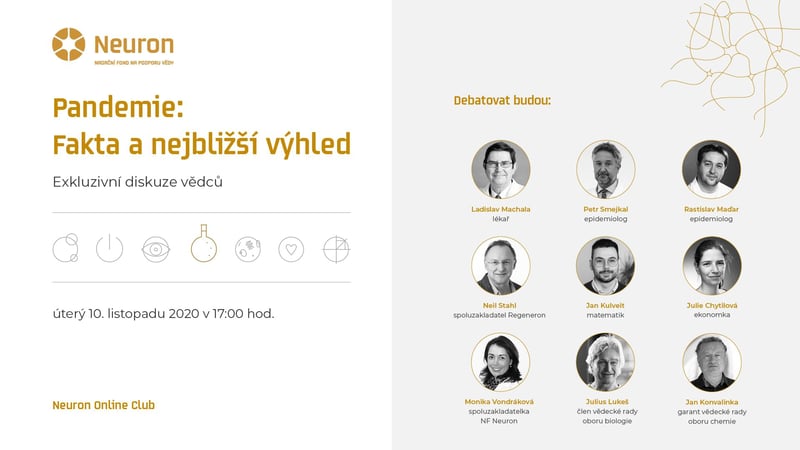
Neuron Club online — The pandemic: facts and the nearest outlook
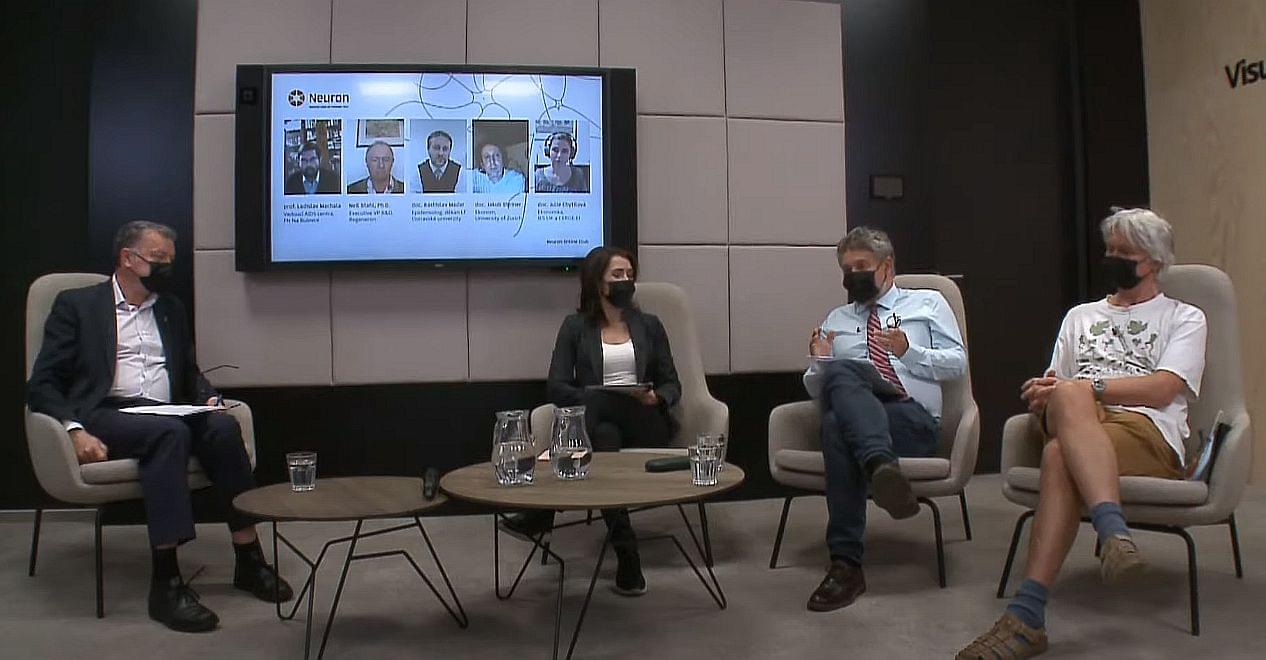
Contradictory information about the pandemic is bringing uncertainty into society. The Neuron Endowment Fund therefore decided to organise, as part of the Neuron Club online, a clear panel discussion with top scientists on the theme The pandemic: facts and the nearest outlook, so that people can get their bearings better in the current situation. The online panel discussion took place on Tuesday 10 November and focused on the facts about the pandemic, the nearest outlook and the fact that while the pandemic is a threat to humanity, it is at the same time an impulse for positive change.
"Germany relies on the Robert Koch Institute, which after the first wave rapidly improved its communication with the public. In the Czech Republic a similar institution that would give comprehensive information about the state of the pandemic situation is so far lacking," Monika Vondráková, Neuron Founder, explains of the motivation for organising the discussion. Associate professor Jan Konvalinka, the host of the discussion, said that drivel kills. What is the current state of affairs in the experts' words? Find out in a clear summary of the discussion with respected scientists.
The "Hammer and the Dance" strategy
There are two basic strategies for dealing with the pandemic — the mitigation strategy and the tougher suppression strategy, to which the "hammer and the dance" strategy belongs. Scientists agree that this strategy is one of the most effective and at the same time the least destructive. In the first phase it is necessary to act quickly and aggressively and to set draconian measures so that the rapidly growing curve of infections does not have time to gather strength and slowly changes direction. After several weeks of the "hammer" phase, society can switch to the "dance" phase, that is, a long-term effort to tame the epidemic until there is a vaccine. Thanks to the hammer phase we are managing to cope with the situation better.
A strong second wave
The current second wave is stronger than the first, which practically did not take place here. A large proportion of people who are infected therefore still escape detection. The number of those hospitalised is at most 4 % of the daily increase. What is alarming is the rising number of older people admitted to intensive care in a serious condition, coming mainly from care homes. Another problem is the almost 5 % of health workers who are positive, and who are the bottleneck. There are enough machines in our country, but the staff who know how to work with them are the limiting factor. It is not possible to teach people to work with a lung ventilator in 14 days.
Testing and tracing
The number of tests needs to be increased further, to at least 50 thousand, so that asymptomatic individuals are caught and life in the country can return to normal. Only once the numbers tested and traced increase will it be possible to ease the rules gradually. What matters is that public trust in the government has increased and the ministries have improved their communication, the scientists think.
The problem is the danger of hospitals being overwhelmed
Professor Ladislav Machala from the Bulovka hospital states that the vast majority of patients have a mild course of the illness that they can get through at home. Even so, the number of people requiring hospitalisation is considerable; the problem is the sheer scale. Places in hospitals are needlessly blocked by social admissions. In future, people from homes who have minimal need of medical services could be placed in other capacities, hotels for instance, so as not to needlessly occupy staff who are needed for moderately and seriously affected patients.
Therapy for a serious course of the illness
Patients with a serious course of the illness are given oxygen therapy. Supporting therapy is either antiviral treatment such as the well-known remdesivir, or the administration of natural antibodies from people who have got through covid-19. Dexamethasone, a corticoid hormone suppressing inflammatory changes, is also administered.
Supporting drugs and vaccination
Vaccines are a great hope; the one doing best at the moment is that of Pfizer and BioNTech, which is currently reporting 90 % efficacy. It is an RNA vaccine, in which an RNA molecule is introduced into the patient, with the help of which the protein of the given virus is produced on the ribosome so that the body creates antibodies against it. It is also positive that another 10 vaccines are currently in phase 3 clinical research.
Also interesting is the preparation of the company Regeneron Pharmaceutical, which was administered to the American president Trump as well. Neil Stahl, one of the company's CEOs, states that this cocktail of antibodies helps people who have no immune response to the virus of their own and significantly reduces the viral load in the body, so that these people do not burden the health system and do not spread the virus further. A cocktail with a similar action from the company Eli Lilly, which the American FDA has approved for emergency use, is also promising.
Epidemiological developments
According to the epidemiologist Rastislav Maďar we are still in an unfavourable epidemiological situation. The current improvement we are seeing is caused by the limited mobility of the population. Once schools open and the rules are eased, the situation will probably worsen slightly. It is therefore necessary to find the right degree of tightening and easing. For example, letting first-year classes into schools. One solution may be rotating pupils — individual classes attending school alternately.
Road safety — safety measures
Just as road safety measures came about and we now, for instance, use seat belts in cars as a matter of course, from now on we will have to learn for a certain time to live with safety measures against viral infections too, which will be carried out automatically. It will be necessary to vaccinate the risk groups and convince the majority of the population that vaccination makes sense, which will make it possible to create herd immunity. Until then it will be important to wear masks and keep our distance.
Does a mask protect?
If an asymptomatic infected person is wearing a mask and meets a healthy person who is also wearing a mask and keeps at least a metre's distance, then the risk of transmitting the illness is almost zero. A mask catches the droplets. Masks make sense. It has been demonstrated in several cases that, for instance, a person infected with the virus infected nobody during an eight-hour flight, because both they and everyone around them were wearing masks.
Mathematical models and the R number
The most basic mathematical model of the current pandemic is simple. Imagine mechanical balls meeting, and when an infected one collides with a healthy one a spark occurs — the illness flares up. But people are not balls, they have goals and will. So there is burning out thanks to restrictions, but also the kindling of new little fires. Testing can reveal these little fires, but people need to be motivated to test more.
The R number measures how fast the epidemic is growing. It is important to think about it in orders of magnitude. The R number leads to restrictions; we never know for certain what helps, and yet we have to respond. Jan Kulveit estimates the impacts by looking at international comparisons. Measures cannot be measured statistically.
Covid-19 and the impacts on mental health
As Doc. Chytilová said, worries about ourselves and our loved ones, worries about losing our jobs. The impacts of the pandemic and of the measures against it are leaving a negative mark on our mental health. Data from the long-term survey "Life during the pandemic", which began in March with 2 thousand respondents, show that the percentage of people showing symptoms of clinical depression has risen markedly. From the original 6 %, 20 % of those asked reported a worsening. The worst affected are young people aged 18–24.
That is why it is important for the state to target help at the affected group and to take inspiration from abroad, where they have very good experience of working with vulnerable groups.
---
The online panel discussion with scientists took place as part of the Neuron Club online. The Neuron Endowment Fund launched this platform this year in response to the need to get one's bearings in a new pandemic world and in the excess of varied information flooding us. The platform has now opened to the general public for the first time. The discussion also took place thanks to the general partners IOCB and IOCB Tech. We also thank Deloitte CZ for partnering the online debate.

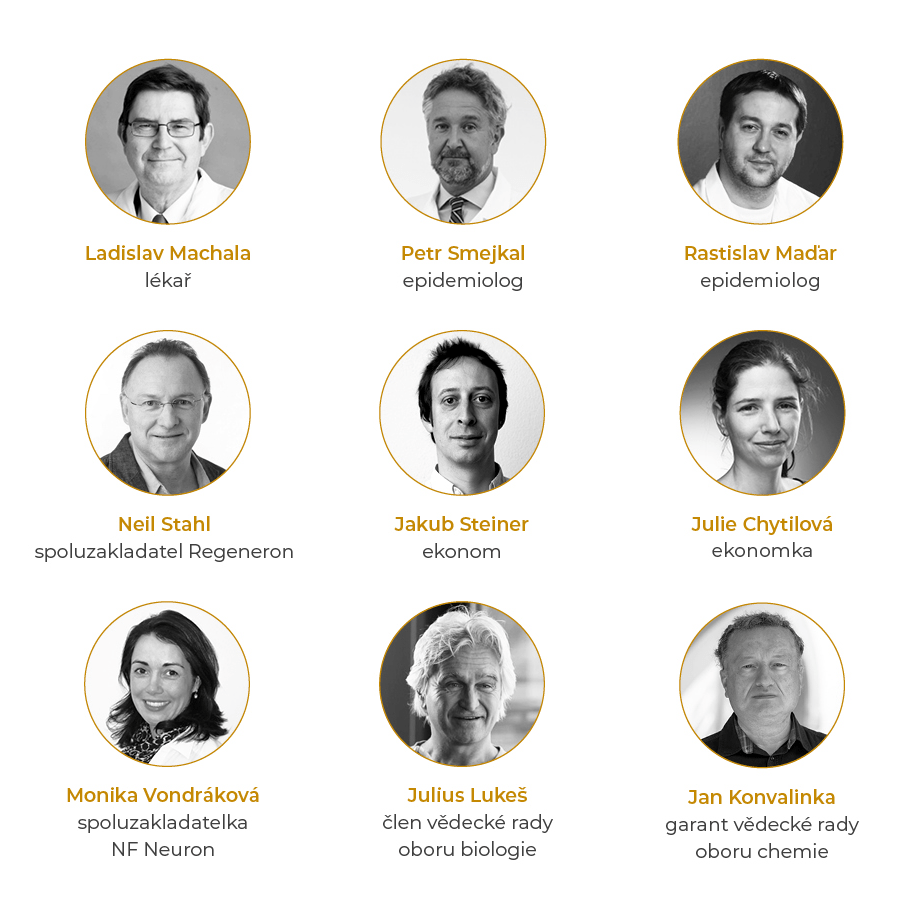
The panellists:
the doctor Ladislav Machala
Prof. MUDr. Ladislav Machala, Ph.D., studied medicine at Charles University. He works at the AIDS centre of the Bulovka Hospital and lectures on infectious diseases at the Third Faculty of Medicine of Charles University.
the epidemiologists Petr Smejkal and Rastislav Maďar
MUDr. Petr Smejkal, as. has long worked in internal and infectious medicine; he currently works at IKEM in Prague as chief epidemiologist and, since 2008, also part-time in the USA on the coast of Maine at Maine Coast Memorial Hospital.
Doc. MUDr. Rastislav Maďar, Ph.D., MBA, FRCPS is a Slovak epidemiologist, an expert on travel medicine and head of the Department of Epidemiology and Public Health Protection of the Faculty of Medicine of the University of Ostrava.
the economist Julie Chytilová
Doc. PhDr. Julie Chytilová Ph.D. received the Neuron Award for scientists under 40 in 2011. She is behind research dealing with the connections of mental health. She works at the Institute of Economic Studies of Charles University and at CERGE-EI.
the economist Jakub Steiner
Mgr. Jakub Steiner, Ph.D. works on theoretical economics, above all game theory. He looks for the causes that in recent years brought about the economic crisis in the United States and in Europe. Since September 2011 he has worked at CERGE-EI. He is a laureate of the Neuron Award for young scientists in the field of social sciences.
The parasitologist prof. Julius Lukeš, a member of the Scientific Board of the Neuron Endowment Fund, also joined the debate, connecting with prof. Neil Stahl, co-founder of the company Regeneron Pharmaceuticals, which developed the REGN-COV2 antibody cocktail.
The debate was guided by the biochemist and member of the Scientific Board of the Neuron Endowment Fund doc. Jan Konvalinka and Monika Vondráková, co-founder of the Neuron Endowment Fund.
Note: the figures and percentages mentioned are indicative and were current at the date of the discussion, 10 November 2020.
General partners of the Neuron Endowment Fund: