Why is energy so expensive? Watch the recording of our debate

What influences the price of energy for the end customer, and what role do the European Union and politics play in it? How did we deal with a similar energy situation in the past? And what does the future hold? Are Czech scientists ready to put their inventions for storing energy into practice, and should we concentrate more on nuclear, gas, hydrogen or renewable solutions? These were the questions answered by the guests of the February Neuron Online Club on the theme Why is energy so expensive?
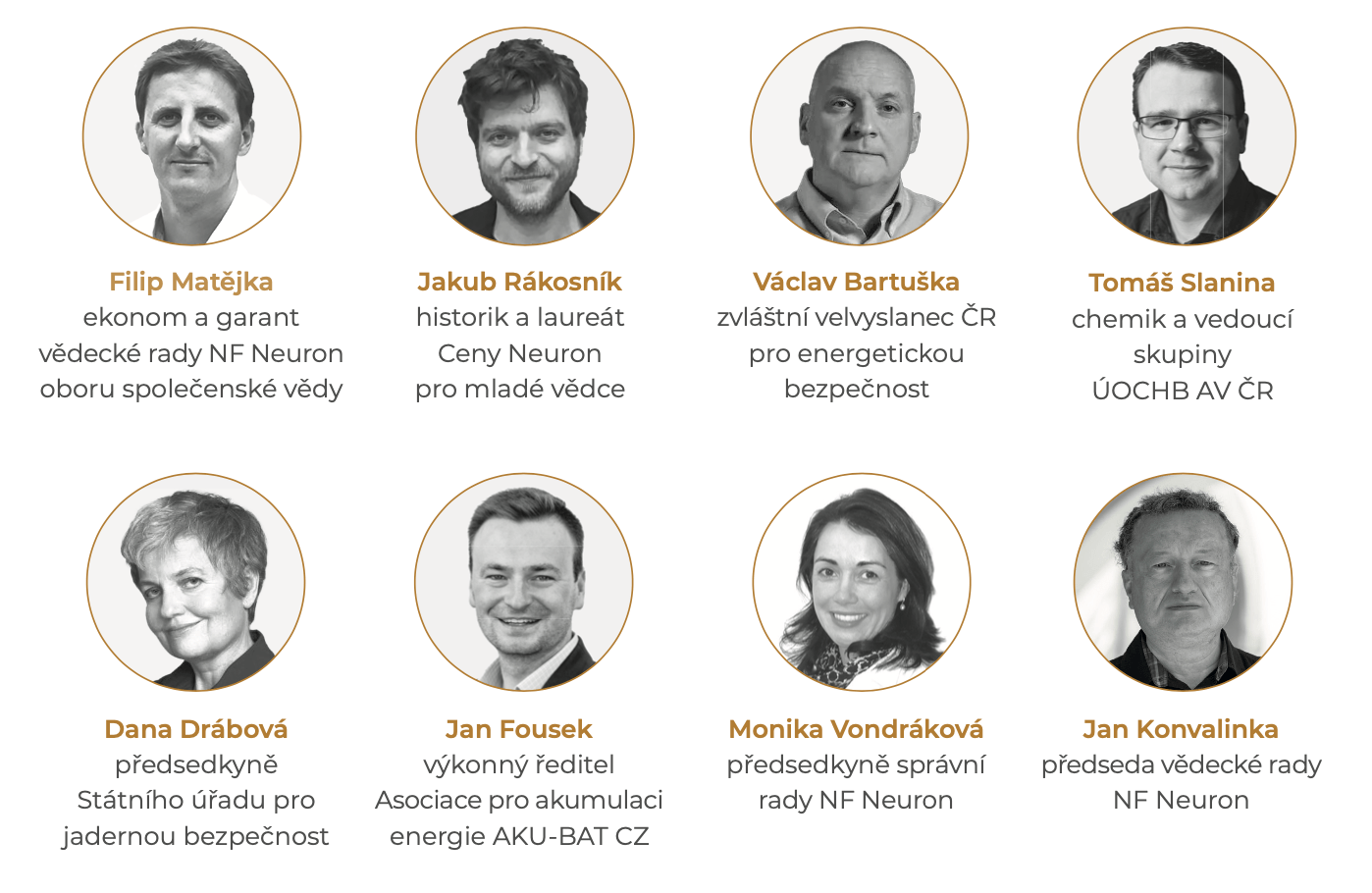
"Our debate is meant for everyone who has no idea what is going on around them but can see that their electricity bill is going up," said Jan Konvalinka, opening the discussion; together with Monika Vondráková he hosted the meeting. After the debate, which was divided into four thematic blocks, it was clear to everyone "what is going on around us".
The price of energy and its factors
What creates the price of energy and what is the reason it has shot up so dramatically? That was the first question for the economist Filip Matějka. "There is an energy auction every day and the more of it is needed, the more expensive it is. And on top of that traders buy a year or two in advance," Matějka explained. "In the past the most expensive offer came from coal-fired power stations, today it is gas-fired ones. And it depends on how much of it the 'tsar in the east' sends us, and that shapes the average price on the market."
Emission allowances and the European Union's efforts to get rid of fossil fuels are not raising the price of energy so far. "The Green Deal hasn't even started working yet, the price rise is a coincidence of circumstances," added Dana Drábová, chair of the State Office for Nuclear Safety. "The rise in the price of gas was first influenced by increased demand in countries outside Europe, which revived after the pandemic; the second factor is the fact that last autumn the wind 'wasn't blowing' in Germany and cheap sources dropped out. The price of emission allowances has little effect on the final price, only about twenty per cent."
The role of politics in the price of energy
"In the European Union we declared fifteen years ago that we did not want fossil fuels, but the suppliers of gas and oil — Russia and its neighbours, the Gulf states and the United States — took that with a large pinch of salt. But now they are in real danger of losing the money from oil and gas, which represents 80 % or more of their total revenues, and logically they are resisting," added Václav Bartuška, the Czech Republic's special envoy for energy security. Despite the fact that the energy situation has been stable for the last twenty years, the oil countries have managed to create a feeling that there is not enough gas and that its price must rise — which is one reason why before Christmas gas on the exchange was twenty times more expensive than two years earlier.
Jan Konvalinka then directed his question to Dana Drábová again, asking what role last year's closure of nuclear power stations in Germany had played in the price of energy. "Of course it is related to that," Drábová agreed, "but let's not forget France, which had a big problem with maintaining its reactors and had to shut them down." Filip Matějka added that energy is traded globally, so individual countries are in no rush to build new sources — a new power station would not serve only the citizens of the given state, but would be traded across the world.
Can we learn from history?
The third part of the debate was opened by Jakub Rákosník, a historian and Neuron Award laureate for promising scientists who specialises in the social history of the 19th and 20th centuries. In his view today's situation of rapidly rising prices is not exceptional from a long-term perspective — we may have forgotten short-term crises such as the twentyfold jump in the price of coal in England 100 years ago, but long-term crises left a marked imprint on history. "They were caused by the geopolitical situation, by the environmental situation, when for example civilisations destroyed their forests and there was no wood, or by economic factors such as a mismatch between supply and demand — and it seems that today all of these factors have met," said Jakub Rákosník.
He added that he sees even the crises of the past as a step forward. "Today we curse fossil fuels, but when coal appeared in England it was a gift from heaven for them. It gave the country's growth an enormous kick and fundamentally influenced the industrial revolution," Rákosník added. Dana Drábová followed on from him, recalling that any crisis is a motivation for a shift towards modernisation: "The oil crises of the 1970s meant the development of technologies for using nuclear energy. And I think the current situation will also bring greater investment in research into modern technologies that would make it possible to store electricity for a reasonable time for reasonable money."
The development of energy technology
"We are technological optimists and we believe everything will turn out well," said Jan Konvalinka, opening the final part of the Neuron Online Club. The floor went to Tomáš Slanina, head of a group at the IOCB, who is currently working on a project for the fast and environmentally friendly generation of electricity and its storage at the same time. "We want to make a solar panel that is active, that can store electrical energy and release it at the moment when the sun is not shining. A solar panel and a battery in one. In the laboratory it already works for us," Tomáš Slanina explained of his project, for which he has just won an ERC grant. The research part, planned to last five years, must then be followed by an engineering and commercial solution of a similar length.
Read more from the conclusions of our debate in the Czech media:
Forbes: War over energy? It will be more about water, said a debate of the Neuron fund
Note: everyone appearing in the studio tested negative for covid-19 and is covered by the exemption from the extraordinary measure of the Czech Ministry of Health which allows presenters, reporters and other people appearing in radio, television and other programmes not to wear respiratory protection.