Neuron Story with Kateřina Falk: The award helped me to a new discovery
The physicist Kateřina Falk, who received a Neuron Impulse grant for her research in 2017, successfully completed the project with a new discovery, which she described in Scientific Reports. "One shot is enough and we can get a radiographic image, or a diffraction image, that tells us something about the structure of the sample under study," the scientist says. How will biologists, doctors and materials engineers use her discovery? How did the Neuron Impulse help her gain both vindication and further funding? And how would laser-driven low-energy electron beams work in Star Trek?
The physicist Kateřina Falk, who received a Neuron Impulse grant for her research in 2017, successfully completed the project with a new discovery, which she described in Scientific Reports. "One shot is enough and we can get a radiographic image, or a diffraction image, that tells us something about the structure of the sample under study," the scientist says. How will biologists, doctors and materials engineers use her discovery? How did the Neuron Impulse help her gain both vindication and further funding? And how would laser-driven low-energy electron beams work in Star Trek?
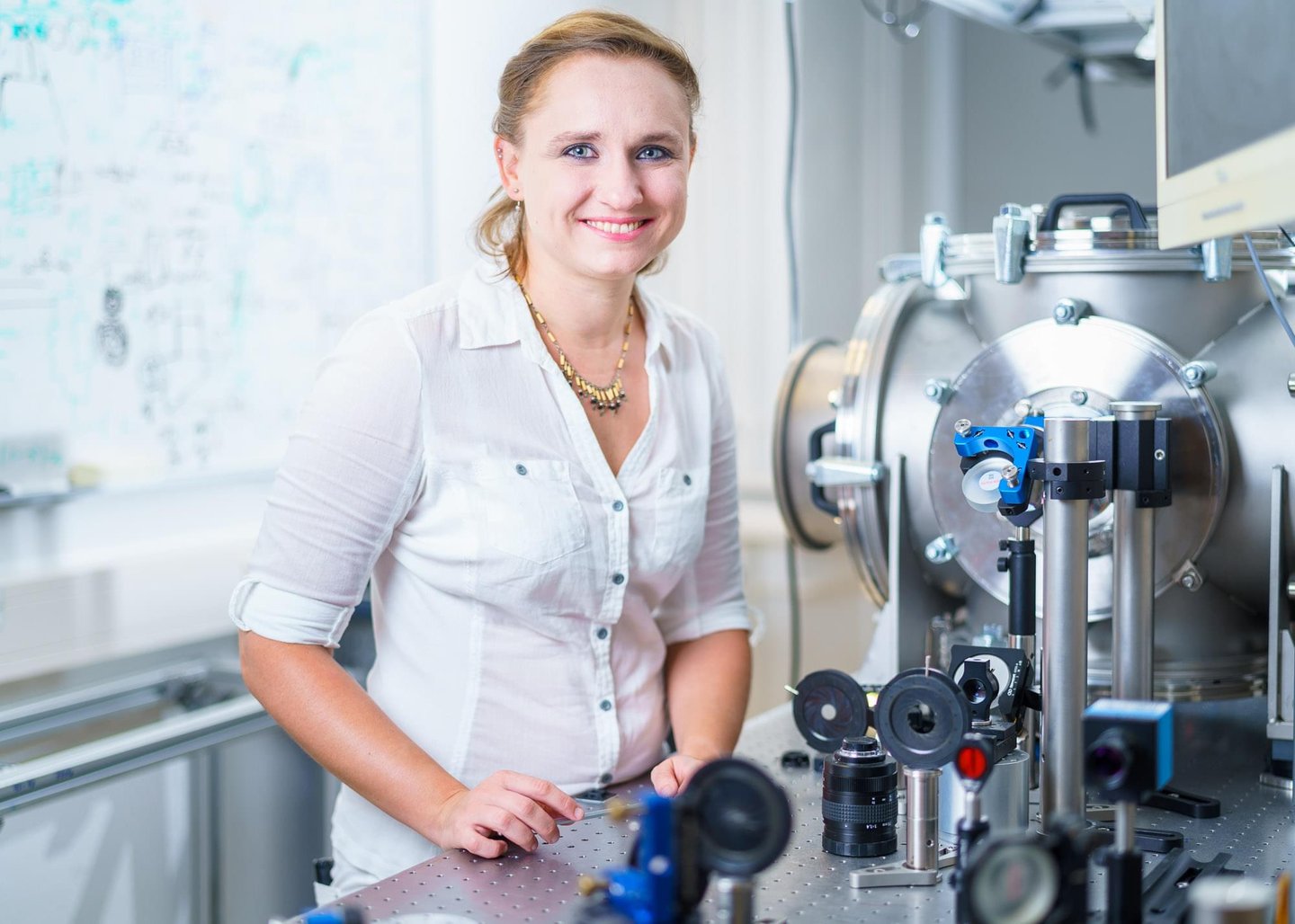
I read that you like Star Trek. Let us start by moving into a fictional world. Can you imagine an episode featuring an invention based on your current discovery?
The most recent episodes of Star Trek were filmed in fusion laboratories in America, where they do a similar kind of research to ours. We developed a laser-accelerated electron beam, and thanks to that beam we can determine the properties of matter during a fusion reaction. Fusion reactions are also what powers the starship Enterprise. In Star Trek they could use our invention to study the properties of matter during a fusion reaction better and thereby ensure that their "engine" works properly. But I rather think they would use our invention in their obligatory time-travel episodes. I can imagine an episode in which, say, the Klingons wanted to prevent the Federation from coming into being. They would have to travel into the past and destroy the laboratory of those historical scientists who created the first beams, which then allowed them to create the first working fusion reactions. And we could be one of those laboratories of first scientists trying at all costs to save the Federation so that the future could happen at all.
Let us hope some scriptwriter notices the idea. But back to reality. Does this invention let us study matter better in the present too? And what exactly does it consist of?
We produced a femtosecond to picosecond low-energy short electron beam. What is special about it is that we produced it using a short-pulse laser we were using in Prague. It is focused into a gas jet; a plasma forms in that environment and plasma waves then arise from the plasma. These waves accelerate electrons on the same principle as a surfer is accelerated on the waves in Hawaii. Then the electrons are released and we can use the resulting beam. A great advantage is that the electron beam is directional and has relatively low energy. This method is very useful when you want to study something only a few millimetres across and need to capture a short interval of time. It is difficult to create a large number of electrons in that low-energy mode. So we had to use a different type of acceleration, and we managed it. A large number of electrons is accelerated in this special regime, and the beam is strong enough for a so-called single shot. One shot is enough and we can get a radiographic image, or a diffraction image, that tells us something about the structure of the sample under study. Until now several images had to be accumulated, at least 30. Accumulating several frames into one image is less precise; instead of a sharp image you get a smear. We managed to reach a regime where one shot is enough, and the image is therefore sharper.
In what areas can this discovery be used?
What is important from our point of view is that our system does not need the huge kilojoule laser that similar methods in use require, of which there are only a few in the world. A relatively small laser is enough for us, and almost every university has one. On the basis of this publication — which is hopefully only the first step — more research groups can build this themselves and so obtain better-quality imaging of samples. It is certainly useful in analysing biological samples. Biologists, doctors and materials engineers can use it. It can also be used in developing explosives for tunnelling. We are interested in studying plasma and exotic phenomena, for instance during melting. Astrophysics too can better study exotic phenomena, such as the impact of certain bodies on the Moon. It would also be interesting if someone took our research further and began using this technology for diffraction measurements, which could directly reveal ultra-fast changes in the structure of crystal lattices.
What role did the Neuron Impulse play in your research?
For this experiment specifically the Neuron Impulse was very important. The financial support was essential. From Neuron we funded a student, the gas, special mixes and jets. It was also a boost; I think receiving that award helped me obtain further grants, since a certain prestige comes with it. There is vindication in it too — a scientist needs recognition that the ideas they have and the work they do have some merit. An award like the Neuron Impulse gives that great weight. And the publication itself proves it was a good investment; it produced quite a fundamental and significant result.
What are your future missions and plans?
I now work at the Helmholtz centre and the Technical University in Dresden. We are working on an interesting project for one of the largest fusion laboratories, where we are trying to study the movement of electrons in plasma using X-ray and proton beams. Looking further ahead, I am toying with the idea of a start-up. Our sources lend themselves well to commercialisation. Quite a lot of scientists are now taking the start-up route — they have greater freedom and better funding.