Martin Schwarzer: From Neuron's support to a paper in Science
The successful microbiologist Mgr. Martin Schwarzer, Ph.D., who studies the effect of a particular bacterium on malnutrition, has published in the journal Science again. What conclusions did he and his team reach? What further applications may his new research lead to? And what does he think about probiotics and microbiome research? You can find out all of this in the interview below.
Martin Schwarzer received the Neuron Impulse award for 2017. You can read about his now confirmed hypothesis here.
What did the Neuron Impulse award you received in 2017 mean for you?
Above all it allowed me to get my research going faster.
During my postgraduate studies in Dr François Leulier's laboratory in France we obtained results suggesting that the bacterium we were studying would reduce the impact of malnutrition not only in germ-free models but also in mice with their own microbiome. When I was leaving to return to the Czech Republic, François and I agreed that we wanted to invest time, money and human effort in further research and that we wanted to take the research as far as possible. Today I can say we managed it. It was at exactly that moment that the Neuron Impulse came in and provided us with the initial funding for this research. Then came further grants, which allowed me to expand the research team.
"We wanted to take the research as far as possible. Today I can say we managed it."
What were your next steps?
We established chronic malnutrition in mice under conventional conditions at Nový Hrádek, and then concentrated on the questions connected with our research. We were interested, for instance, in whether we had to use this one specific bacterium or whether growth would be stimulated by any other. We showed that it is only one specific bacterium — Lactiplantibacillus plantarum WJL.
Is this bacterium present in probiotic products too, for instance?
It is one of the lactic acid bacteria. Lactobacilli such as casei or rhamnosus are commonly part of probiotics. But our research shows that not all bacteria are the same.
What do you mean?
Let me use an analogy to explain. Say we have two men. Both are called Ludvík Culík. But one is a bricklayer and the other an electrician. When you talk about them you simply say Ludvík Culík. But if you want to build a house you have to call the one who can work with bricks, and if you want the electrics put in you have to call the one who is an electrician.
Lactiplantibacillus plantarum WJL is only the taxonomic designation of the bacterium. The classification of a bacterium follows from one place in the genome, but what is elsewhere in the genome is often unknown. That is where so-called strain specificity lies. To prevent a particular disease you have to test the given strain of bacterium, and only then can we say — yes, this bacterium could serve to prevent this disease.
"We got as far as finding that in order to stimulate growth the bacterium does not even have to be alive; its cell wall is enough."
5) How does this finding relate to your paper in Science?
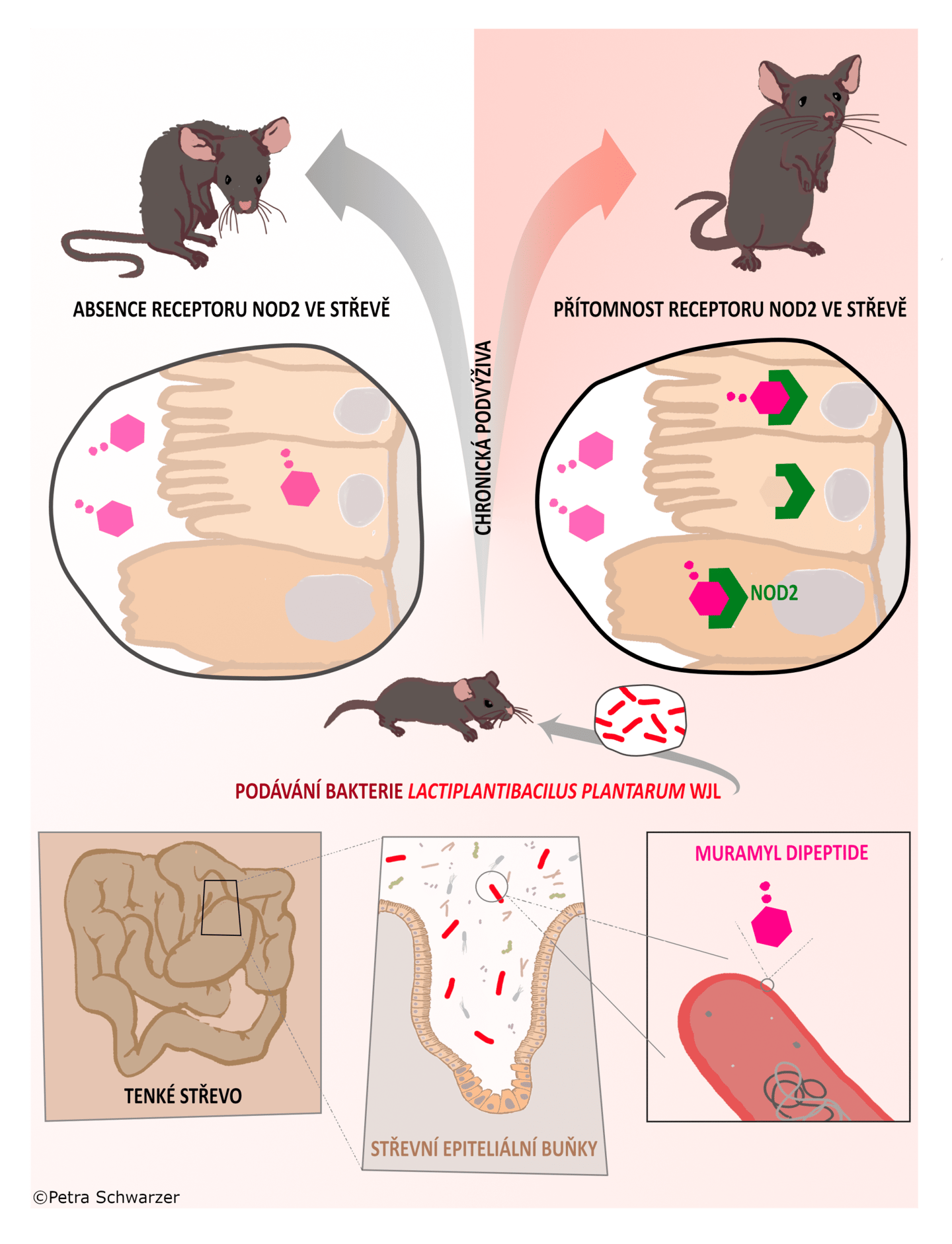
When our research established that not all strains of Lactiplantibacillus plantarum are able to stimulate growth, that moved us further on. We got as far as finding that in order for our bacterium to stimulate growth it does not even have to be alive; its cell wall is enough. On the host's side we then identified the receptor responsible for sensing the bacterium. That receptor is the innate immunity receptor NOD2. We then also established that this receptor has to be present in the epithelial cells of the gut, that it plays the key role there. And that is exactly the content of our paper in Science.
"We think that if that bacterium or its cell wall… became part of renutrition strategies for children suffering from malnutrition, it could help them overcome the long-term consequences of malnutrition, such as stunting."
In 2017 you suggested that your research might also result in a drug to mitigate the consequences of malnutrition. Is anything like that "on the table" yet?
I was still being too bold then. Today I would not promise a drug. Our published paper is a piece of basic research; we described the mechanism by which it works. If we manage to establish cooperation with partners who would test our bacterium in practice in a human study, that would be another big step. We think that if that bacterium or its cell wall, or a substance that binds to the NOD2 receptor, became part of renutrition strategies for children suffering from malnutrition, it could help them overcome the long-term consequences of malnutrition, such as stunting.
In 2017 this bacterium became part of a probiotic product available in France. The company began selling it as a food supplement supporting healthy growth.
"In 2017 this bacterium became part of a probiotic product available in France."
How do you view probiotic treatment; is its effect sometimes overrated?
Probiotics were seen as a kind of "cure-all". It seemed enough to take a bacterium and put it in a capsule. Now we are entering a phase of probiotics that already have, or will have, scientific studies behind them, and that is a good thing. We, for instance, show that this particular bacterium has a demonstrable positive effect in a model of chronic malnutrition.
And what about the microbiome — is the key to solving all our health problems buried in it?
The famous saying "All disease begins in the gut" was uttered 2,500 years ago by Hippocrates, and in recent years it has become clear that the gut microbiome really is key to the overall physiological state, or if you like the health, of the organism. From that knowledge came the great expectation that, with the development of sequencing technologies, we would be able to describe it in full and that this would give us answers, let us determine causes and effects and adjust everything accordingly to be healthy. We really are learning more and more about the microbiome, but there are still many unknowns.
Here too we often run into the chicken-and-egg problem — did changes in the gut microbiome come first and then the disease, or did the changes appear only with the disease? Here we have to be careful in our interpretation.
"In recent years it has become clear that the gut microbiome really is key to the overall health of the organism."
What are your research plans for the future? And what counts as satisfaction in your field — a paper in Science, for instance?
What I enjoy most is the chance to work with different people on a particular problem — discussing, planning, doing, arriving at results… The greatest satisfaction is when I first see results that nobody has obtained before.
As for future plans, we want to examine in detail the mechanisms around the bacterium's effect on mucosal cells. What we know from studies on fruit flies is that this specific bacterium increased the production of proteases there. That means the fly larvae were then able to obtain more protein even from the limited amount they had in their diet. The question is how it works in mammals.
Our group is also interested in postbiotics. These are defined molecules we are able to isolate from a bacterium. They may be, for instance, the components of bacterial cell walls already mentioned, or the sugars bacteria coat themselves in. We then use these defined molecules in models of human lung allergy or food allergy. In basic research we see that many probiotic bacteria work in preventing allergic disease. In humans, though, it is still controversial. If we managed to have defined molecules that worked in prevention, we could have a defined substance that would again be easy to work with in applied research.
"In basic research we see that many probiotic bacteria work in preventing allergic disease."
10) What can you tell us about your workplace at Nový Hrádek? Is there anything special about it?
The Laboratory of Gnotobiology is a detached workplace of the Institute of Microbiology in Prague. It is the only workplace in the Czech Republic that has long bred germ-free mice. It was founded 70 years ago by Prof. Jaroslav Šterzl and is one of the oldest, if not the oldest, continuously operating gnotobiotic facilities in Europe.