Mikolov & Boháček: On artificial intelligence and a placement at Berkeley
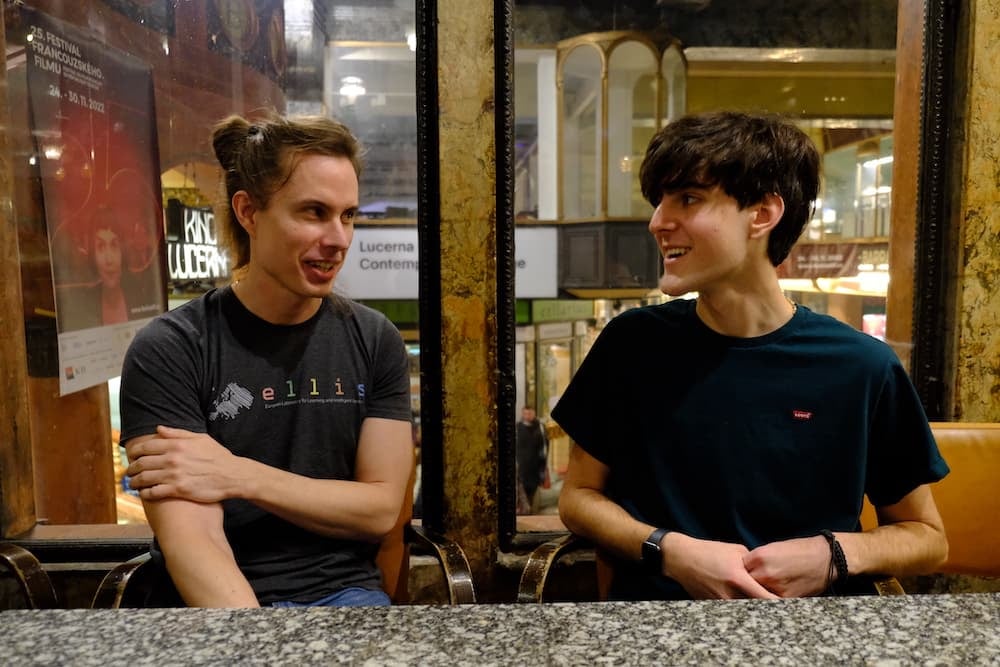
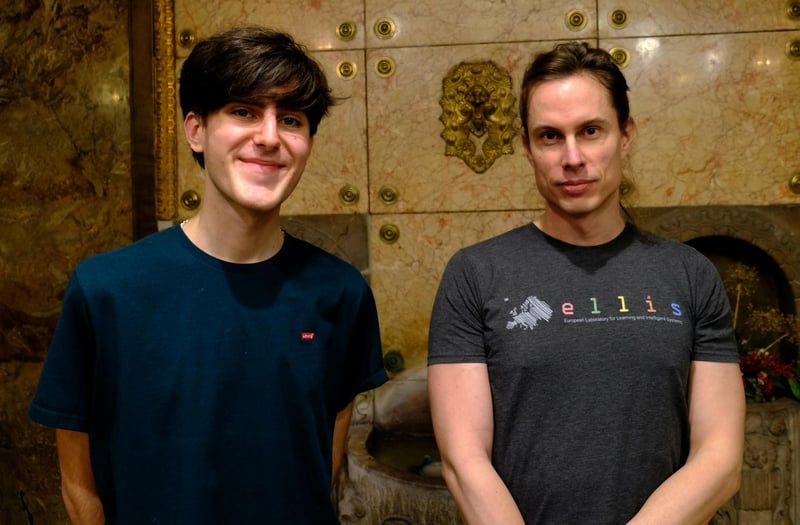
One is an internationally recognised expert on artificial intelligence and machine learning; the other works intensively on the same subjects in the context of digital forensics. The first worked for the largest technology companies and now leads his own group at the Czech Technical University; the second is preparing for his school-leaving exams at the Jan Kepler Grammar School and for studies at Stanford. Although a generation separates Tomáš Mikolov and Matyáš Boháček, they share an interest in the future use of technology. So when Matyáš Boháček approached the Neuron Foundation for help with a summer placement in Artificial Intelligence Research at the University of California, Berkeley, we connected him with Tomáš Mikolov. Now we have sat them down together at one table to compare their experiences.
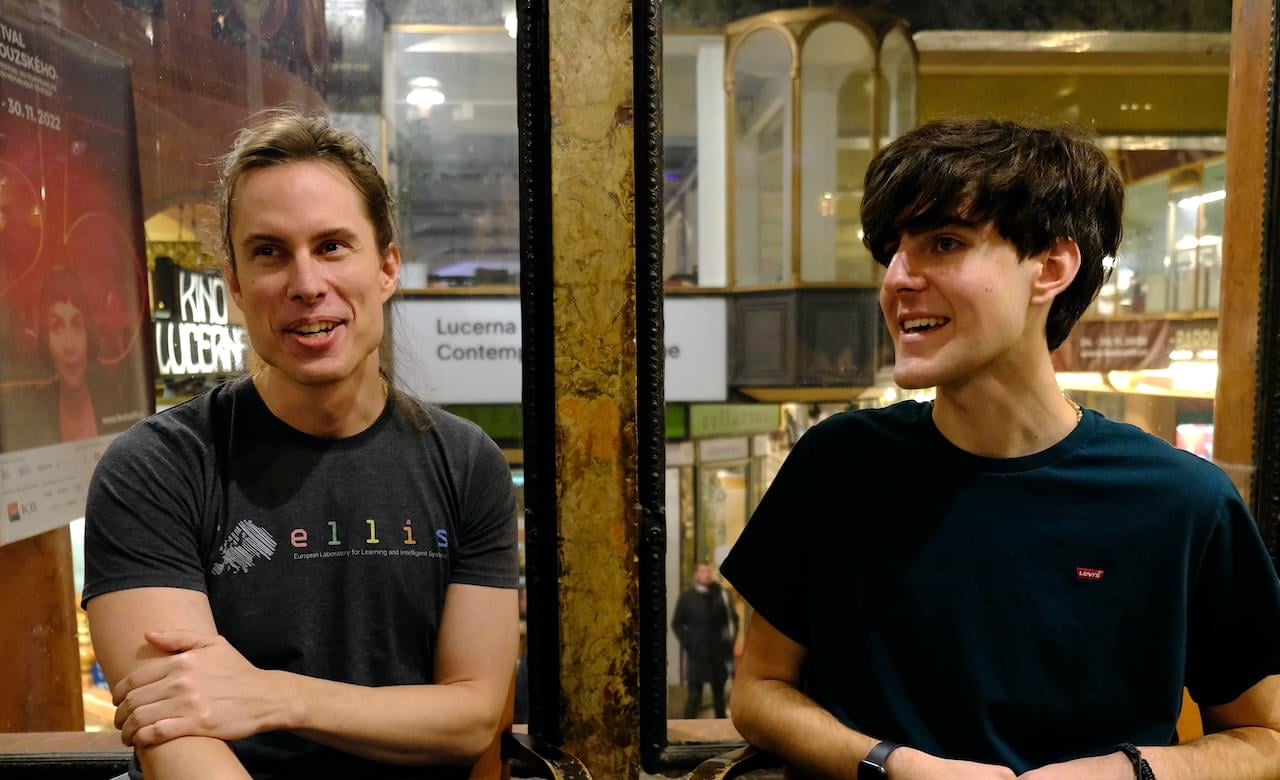
Tomáš Mikolov: Before we get into the technology, what if we start gently? You were at Berkeley for a month over the holidays…
Matyáš Boháček: I left in July originally for a month, but in the end it stretched to a month and a half.
Tomáš Mikolov: California strikes me as very interesting; I lived there myself. How did it seem to you? What would you say to Czech students thinking of going abroad too? Tell us something about the environment, the way of life, the food.
Matyáš Boháček: California fascinated me; I am enthusiastic about its energy and about people who have superb drive. Their way of life, their leisure time and their food are very different from ours. The shape of the day is different because of it. I made friends with colleagues from the lab, PhD students who went climbing at a climbing wall. But that was forty minutes by car, so every bit of leisure time was an event that had to be prepared. And I am also used to public transport in the Czech Republic and to being able to get everywhere on my own; I still do not have a driving licence. But in America a journey that would take five minutes by car took me either forty minutes on foot or, when there was no other way, an Uber. And the food? There everything revolves around food all the time; it is a regular social event.
Tomáš Mikolov: What food did you find most interesting or strangest?
Matyáš Boháček: I liked Burmese cuisine, which is more intense than Indian; a restaurant in Chinatown was good. For the first few weeks I enjoyed burgers, but then I could not any more and my eating pattern changed entirely. The portions are so large that I switched to two meals a day, mostly sandwiches, chips and salad, which come out best on value for money. For the halls of residence I bought food from the supermarket, lots of bananas and sweetened bread. That is why the first place I went from the airport in Prague was a bakery; I bought Czech bread and spread butter on it at home.
Tomáš Mikolov: Tell me what you set off to Berkeley with and what your main task was.
Matyáš Boháček: I worked on detecting deep fakes, videos created by artificial intelligence. Our task specifically was the automatic detection of videos of world politicians, which have great potential to mislead social media users as disinformation. In the context of recent events we took President Zelensky as our demonstration and test subject. Using machine learning methods we determined when videos were manipulated or artificial. Another project was the analysis of generative models such as Dall-E or Stable Diffusion and the distinguishing factors they show when creating human faces.
Tomáš Mikolov: Those are popular tools any of us can use. Did you find out at Berkeley how they work technically and where their weaknesses lie?
Matyáš Boháček: They have a big problem generating meaningful text. If you ask them to create an image containing any text, the letters will probably be just a jumble of strokes. If I want an image of a winter forest with the words Merry Christmas, for instance, I get a mess that from a distance may look like text, but close up they are not letters.
Tomáš Mikolov: It depends on the particular case. If I want to generate an image from a café, the word Café may be there correctly, because the program has seen it a million times in the training set. But if I want an image from a café in which a guest is reading a newspaper, I will see paper with some gibberish on it. The program has seen too many different newspapers and cannot deal with it; there may be letters, but they will not make sense. And what is more, the person in the picture will have six fingers; machine learning still has trouble with that.
Matyáš Boháček: Exactly, and there is a problem with space and its lighting too. If you tell the program to generate a hundred balls on a lawn in bright sunlight, the shadows will be unrealistic. If I want to generate a ball standing on a cube standing on a car, the conception of space is so complex that the models cannot yet manage it.
Tomáš Mikolov: That is a matter of time. These technologies make graphic creativity accessible to ordinary people, and tools will appear that let me edit a generated image further, change its mood or the arrangement of its elements. That will happen not only with images but with text and video too. It is superb that these tools are not just for a closed group but that anyone can try them out. Actually that raises another question for me: what about applying research at Berkeley? Do professors and students have their own start-ups there?
Matyáš Boháček: For Americans business is natural. The research I did was guided by potential demand; everyone watches how a result can help the market. Lots of professors have their own spin-offs; their laboratories are funded by companies that help transfer research into their products. The results are still published for other scientists and help them, but the emphasis on application is greater than here.
Tomáš Mikolov: In Berkeley and the whole of Silicon Valley there is an order of magnitude more money than in Europe. You are surrounded by experts, you have the chance to scale up and take a project to world size. Their ecosystem comes from a long tradition of cooperation between business and universities, where important technology companies were founded. In return, Google for instance sends huge amounts of money to Stanford every year. It is all interconnected. Here the mentality is more academic. We talk a lot about basic research, but we have cut it back to a minimum and we only pay lip service to applying it. So nothing properly. Nothing big can grow out of that.
Matyáš Boháček: On my second day at Berkeley we met in a conference room; there were five professors and twelve students altogether, and also the head of research at Adobe Research. He came to present his research to us and looked for weak points with us, wanted our feedback; we all brainstormed openly.
Tomáš Mikolov: Yes, that is another difference between America and the Czech Republic; they have a different mindset. Here professors are distant, they cling to hierarchy, a teacher often looks for what students do not know and picks at their work. Then we should not be surprised that a student only wants to get a degree and escape that environment. In America they treat students as younger partners with whom they think things up together and found start-ups together.
Matyáš Boháček: American professors want to help; they sat with us in one open-plan space, talked to us about everything, invited us for coffee. The students likewise connect with each other, work on their topics together, write joint papers, work on projects together. I took advantage of that too; in a month and a half at Berkeley I wrote a paper for PNAS, the journal of the American academy, entitled Protecting world leaders against deep fakes using facial, gestural, and vocal mannerisms, which was published in November. America also changed the way I think about writing. From the Czech Republic I was used to writing to a template, copying out the results and adding a table; at Berkeley we first discussed what the story of the paper was, how and to whom we wanted to convey our findings, and we rewrote it a great deal.
Tomáš Mikolov: I had the same experience. When I did my doctorate in the Czech Republic, I spent 98% of the time on technical things and experiments, and a few days before writing the paper I summed it up and hastily wrote it. In terms of content my research was an order of magnitude better than that of some students from American universities who devoted perhaps only 20% to the technical side but wrote a fine story in a flawless presentation. It took me a long time to understand that if I want to make my way among them, I have to accept that clothes make the man.
Matyáš Boháček: I once wrote a paper on sign language and its translation; I reduced the need for input data from twenty to four, but it was rejected. At Berkeley I came back to the subject and, with colleagues' help, rewrote it, added images, visualisations and a demo, and it was immediately accepted at a very good conference. And yet I changed nothing about the results or the paper's architecture.
Tomáš Mikolov: The important thing is to make science accessible to as many people as possible. To think while writing about where the research can be used and whom it can help. Of course it must not be overdone or promise what is not possible. But the reproducibility of results, their presentation and their accessibility are an essential thing that we have to work on in Czech science.