Jan Kynčl: After the Neuron Award I successfully completed my habilitation
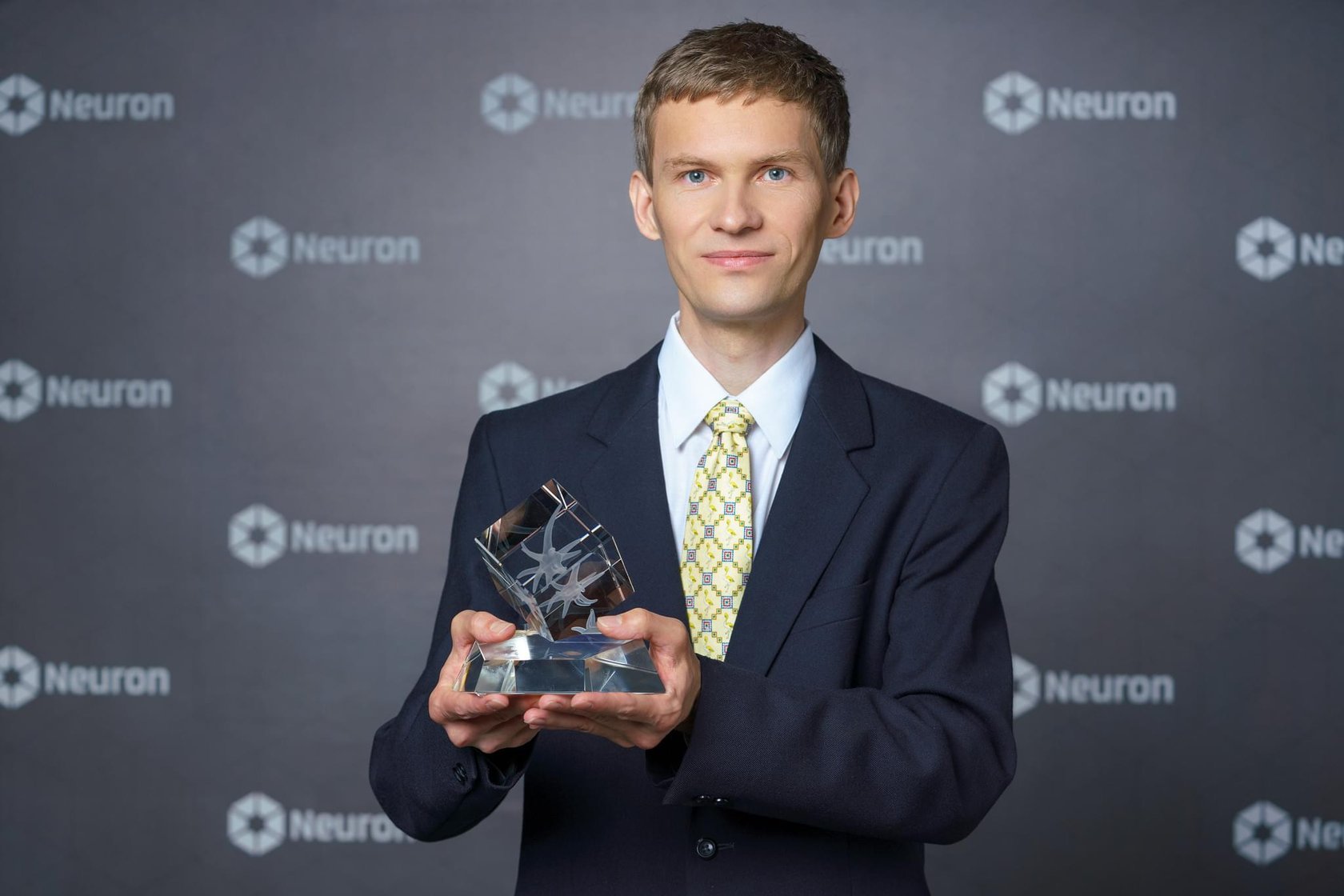
Jan Kynčl is a leading specialist in combinatorics and discrete geometry,
in which he has made groundbreaking findings. He improved algorithms for drawing abstract topological graphs and obtained new bounds for the crossing number of a graph, for which he received the Neuron Award 2022 for promising scientists in mathematics.
What has changed since last October, when he received the prestigious scientific award at the National Museum? What does he expect from the future?
"After a long time I travelled abroad to a workshop again, which was a welcome change after all those online seminars in recent years," says Jan Kynčl.
You received the Neuron Award last October. How has your field moved on since then?
The most popular recent result in our field is the discovery of the "einstein" — a polygon that can tile the whole plane, but not periodically; all the "tiles" known until now also allowed periodic tilings, like squares in a square grid. The first such aperiodic tile, called the "hat", also uses its own mirror copies. Not long after its discovery the authors constructed another aperiodic tile, called the "spectre", which tiles the plane in only one orientation and therefore no longer needs its mirror copies. That has practical advantages too — usually we do not want to turn tiles upside down.
What interesting things have happened to you personally since October?
After a long time I travelled abroad to a workshop again, which was a welcome change after all those online seminars in recent years. I also successfully completed my habilitation.
How can your field help society as a whole in 2023?
Thanks to an algorithm from number theory that is thousands of years old, we have had the letter "s" in "https" for some time now. On the other hand, on the basis of this year's discovery described above I expect a new type of ceramic tile to appear soon, which — partly thanks to that letter "s" — we will be able to order online safely. Algorithms based on graph theory will then plan the route for the courier who brings the parcel to our door.