How to get a whale into a swimming pool, or Jan Nekovář for Neuron
6 November 2019
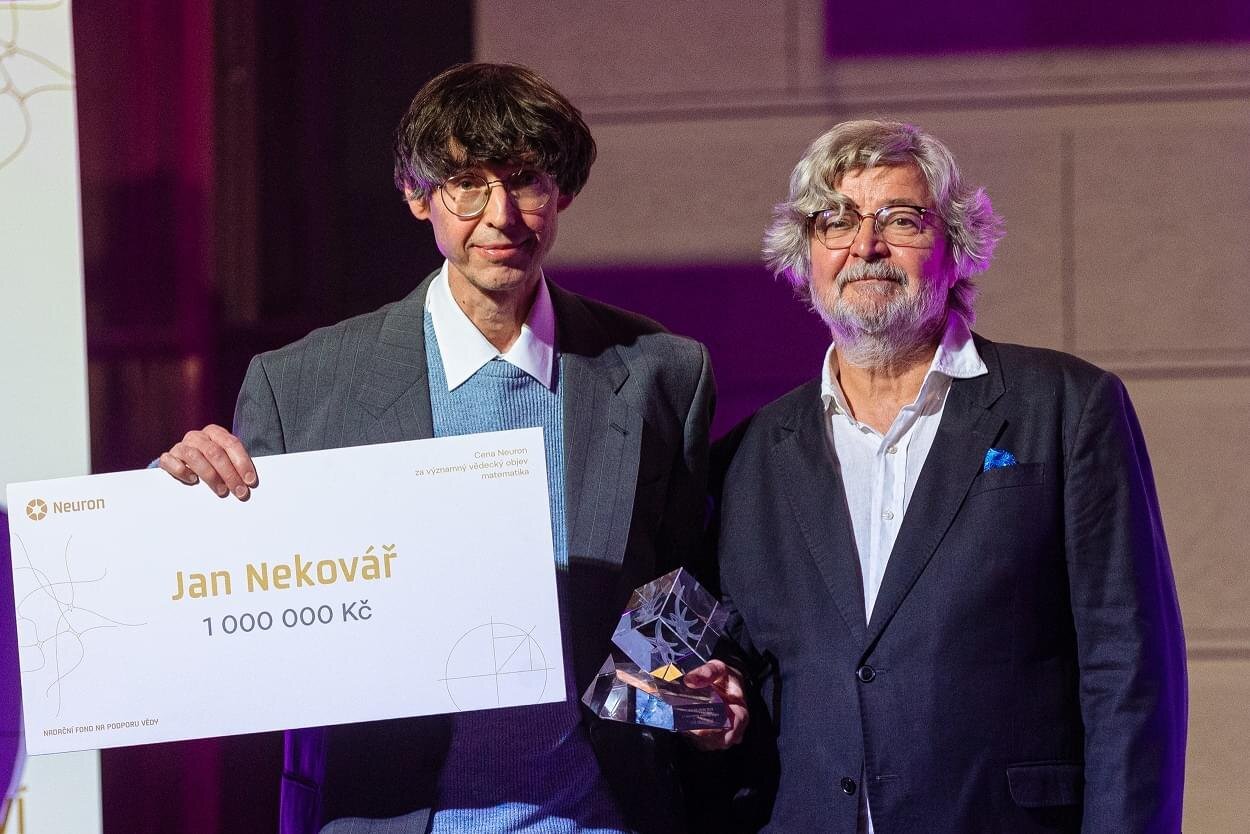
Jan Nekovář, today a professor at the Sorbonne in Paris, is not himself a holder of the Nobel Prize — or rather of the Fields Medal, which is awarded in mathematics — but he contributed to its award. Manjul Bhargava, who received it in 2014, built on one of Nekovář's results in the theory of elliptic curves. It was those that made it possible to prove important cases of what is called the Birch and Swinnerton-Dyer conjecture. By way of explanation, this conjecture is one of the six still unsolved millennium problems of the Clay Mathematics Institute — a reward of one million dollars is offered for solving each of them. The conjecture states that for a certain type of equation there is a relatively simple way of determining whether the given equation has a finite or an infinite number of solutions in rational numbers.
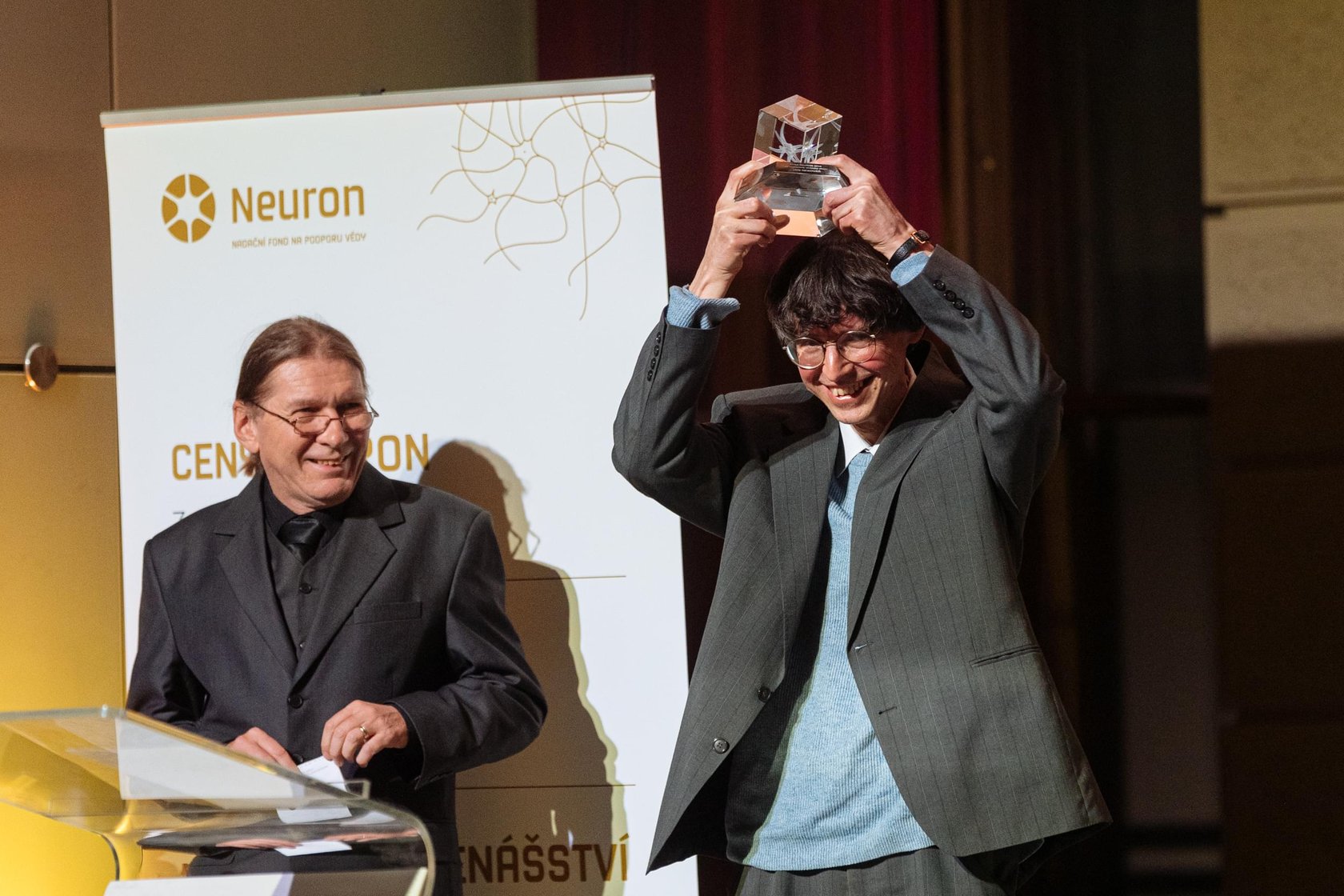
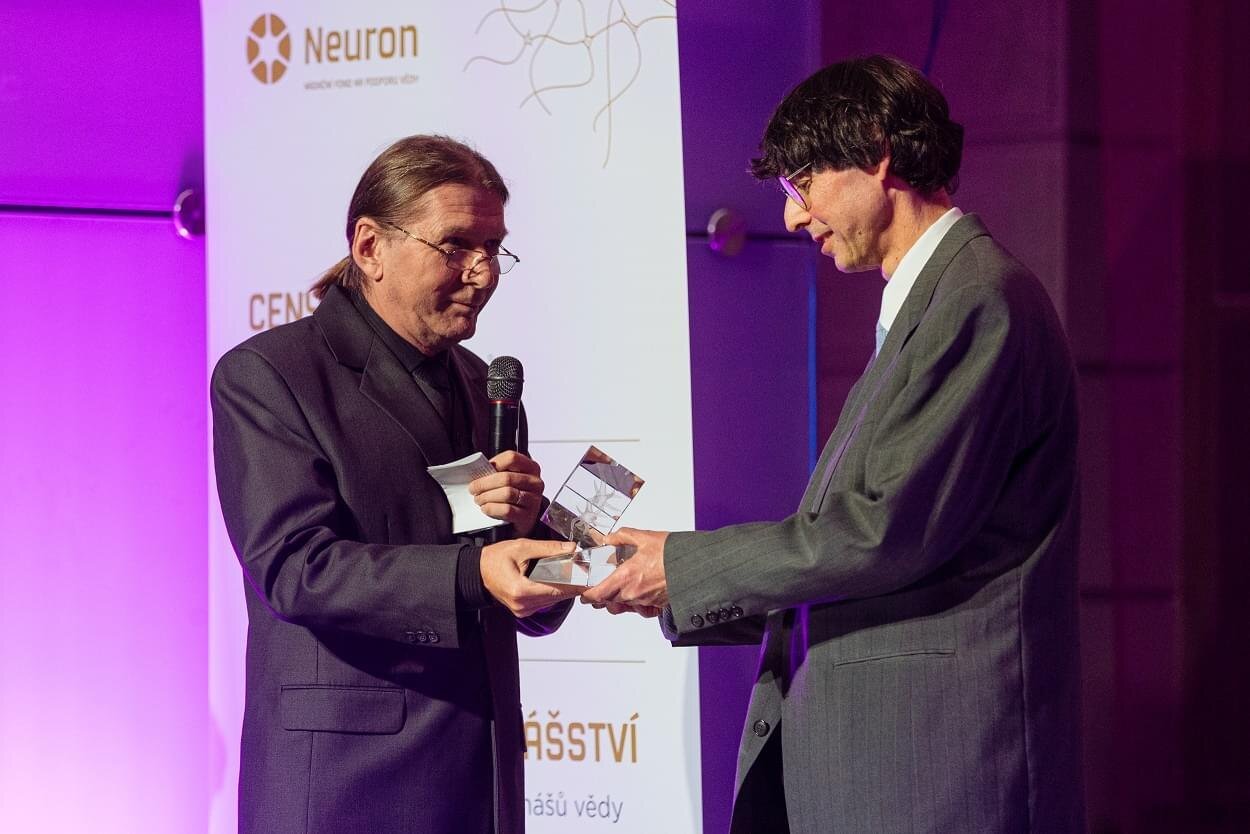
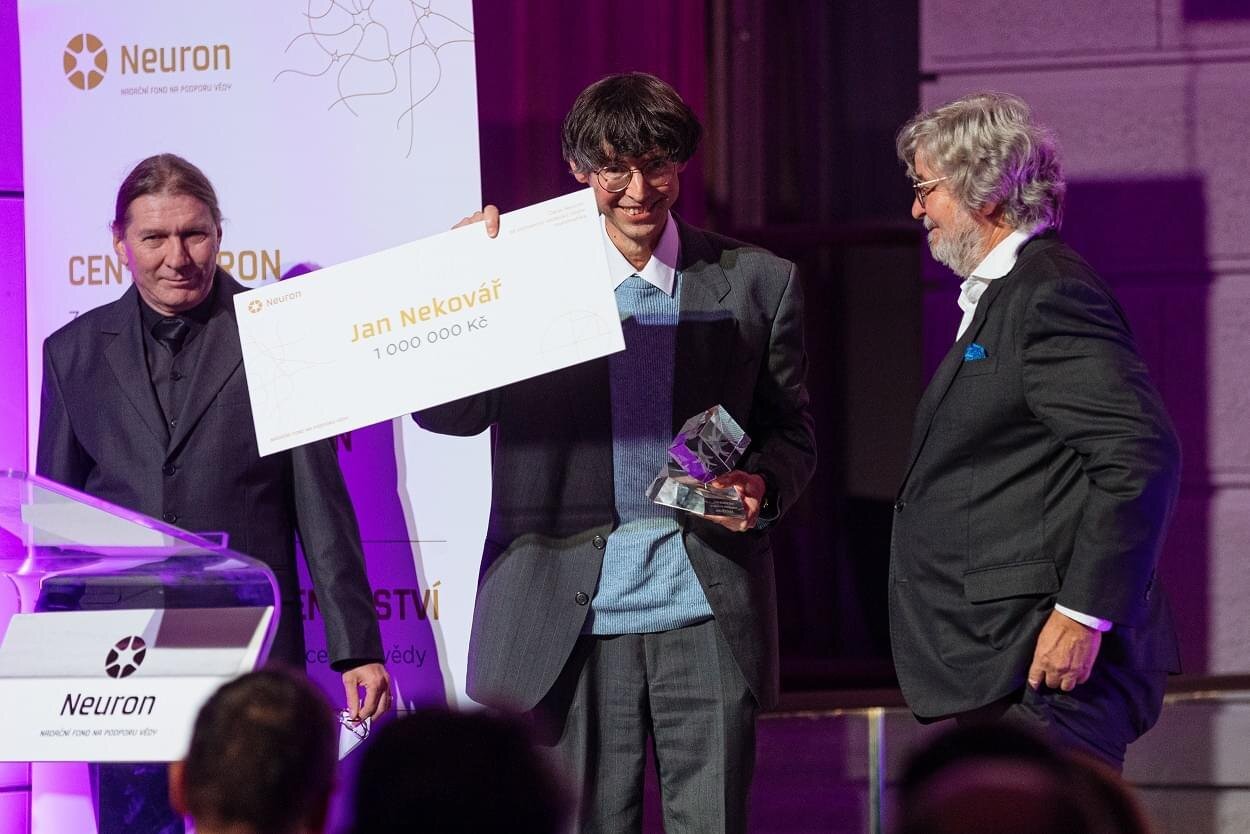
Jan Nekovář, today a professor at the Sorbonne in Paris, is not himself a holder of the Nobel Prize — or rather of the Fields Medal, which is awarded in mathematics — but he contributed to its award. Manjul Bhargava, who received it in 2014, built on one of Nekovář's results in the theory of elliptic curves. It was those that made it possible to prove important cases of what is called the Birch and Swinnerton-Dyer conjecture. By way of explanation, this conjecture is one of the six still unsolved millennium problems of the Clay Mathematics Institute — a reward of one million dollars is offered for solving each of them. The conjecture states that for a certain type of equation there is a relatively simple way of determining whether the given equation has a finite or an infinite number of solutions in rational numbers.
If you are not sure you safely understand the sentences above, do not worry about it. As Jan Trlifaj of the Faculty of Mathematics and Physics of Charles University says, for even one of his own students to be able to talk to Professor Nekovář at all, they already have to know something.
The world in which Jan Nekovář moves is number theory. The queen of mathematics, as the famous Karl Friedrich Gauss already called it. One of the classical mathematical disciplines, which has been developing for centuries and around which complex theories have grown up. "I liked it best because it is unpredictable; you don't know what will happen. Which questions will turn out to be interesting and which you ought to be asking," says the fifty-six-year-old Professor Nekovář, picking up a pencil every few moments to draw something. That is where the magic of the field lies: a solution can be approached both algebraically and geometrically. "At the start you never know what will come out, and that is why it is fun. It is like reading a gripping book. You turn the pages, you have no idea what will come, and at the same time you are somewhat writing it."
He got his gift in his genes from his parents. His mother told him stories, and with that gave him the important gift of imagination. His more exact father, in turn, gave him riddles. One of the typical riddles was how many whales would fit into the swimming pool in Podolí in Prague without it overflowing. "So let's work it out, shall we?" Professor Nekovář smiles, and off it goes like clockwork. The basis is Archimedes' principle, so a whale displaces as much water as it weighs itself. "How many tonnes a whale weighs I knew, because at the age of six I was given a book called Numbers Are Our Friends, which said that the largest animal is the blue whale, which weighs as much as 25 elephants, and that one elephant weighs six tonnes. Ergo a whale displaces 150 tonnes, which is 150 cubic metres." Then it is enough to determine, at least approximately, the size of the pool from the number of swimming lanes, to know that the water level is some 30 centimetres below the edge and so on and so on — the result being that one whale fits into the pool but two do not. Young Jan Nekovář arrived at this answer, with his father's hint, when he was eight, perhaps nine years old.
At that moment one thinks of the famous story about the Karl Gauss already mentioned: when a teacher wanted to be rid of his pupils for a while, he set them the task of adding up all the numbers from 1 to 100. Whereupon the ten-year-old Gauss immediately wrote the result on his slate: 5,050. His abilities were beyond all measure, and the well-known Gaussian curve is named after him.
Where on that curve would you place yourself among mathematicians? I ask Professor Nekovář. "What matters more is where my colleagues would place me," he answers. "I am not a superstar, but perhaps I am in the category just below the superstars."
His father, a chemical engineer, also gave him books to read, but they contained ordinary mathematics, which gradually stopped being enough for him. One day he found a book called Elliptic Functions in a Russian bookshop in Prague. It was not very thick, so he bought it and read it. "At the end there was number theory and I did not understand it. That struck me as the most interesting thing about it. It was like reading about exotic lands. And there was nobody here within many hundreds of kilometres who was interested in number theory in connection with elliptic and modular functions."
Did you ever get a mark worse than a one in mathematics? I ask boldly, to which Jan Nekovář answers with a question of his own: are you joking? True, he says, once at a university exam he talked nonsense, but that was because he came to it with a temperature of 39 degrees.
Already at university, in 1984, he went on a placement to Moscow, which was a professional shock for him because "everyone there understood everything". At the end of August 1989, when the regime was relaxing, he then managed to travel to Marseille in France. But it was touch and go. "I was due to leave on 23 August and on 21 August a friend and I agreed we would go to a party in the evening. But somehow we did not find each other, because there were no mobile phones yet, so he went alone. In the end he spent 48 hours in Pankrác prison — and thanks to the non-existence of mobile phones I was able to leave for the conference in Marseille." A trip to Bonn in October of the same year turned out to be similarly close-run, when thousands of East Germans longing to get to the West via Hungary were climbing over the wall of the German embassy — at the same time Nekovář's passport was at that embassy. Everything turned out well, the Germans were allowed to leave for Budapest and Jan Nekovář for Bonn. From there, at the Max Planck Institute, he followed the events of November, and when he returned in December everything was different.
It was a turning point, when the borders opened completely and further opportunities awaited the then twenty-six-year-old Jan Nekovář. First a prestigious placement in the USA at Berkeley, then offers of posts at Cambridge and at Stanford, with his choice falling on Cambridge because the great figures of number theory itself worked there. "Gradually it turned out that I had learned quite a lot and was able to think something up. But it is true that I am probably the only one in that field who did not learn it from anyone, but effectively on my own."
In 2002 he moved to Paris, where he works to this day. "He does not publish all that often," Professor Jan Trlifaj says of him, "but when he does write, they really are lovely things. One of his papers appeared in the elite journal Inventiones mathematicae, another as a monograph in the prestigious Astérisque series published by the French Mathematical Society." In Trlifaj's view number theory is a hard field, in which a proof may easily run to two hundred pages. "And everything in it takes a long time; it can happen that you work on some task for two years and come up with nothing."
But that is precisely what Jan Nekovář enjoys. When he does have to leave a mathematical subject, he starts talking about the Japanese city of Kyoto, which enchanted him. "It has a fractal structure — there are large boulevards, and as soon as you turn off them you are immediately in a small lane. But in those you have to watch out for cyclists who ride along texting. You definitely have to see it, best in April when the cherry trees are in bloom."
He also likes good films, but the classic division into working days and weekends does not exist for him. "I enjoy doing mathematics, for me it is a reward," he says. When he does need to switch his brain off, detective stories are apparently best for that. An excellent distraction, something like video games, which he does not play. He compares it to a kaleidoscope, in which everything in the brain is shaken up and rearranged.
A mathematician's brain works constantly. "Most mathematicians will confirm to you that the most important part of the day for them is the morning, when one is not yet fully awake and is moving on the edge between dreaming and waking. That is when most things occur to you. Some outright night owls keep a recording device or a notebook by the bed to record their thoughts. Most things occur to me in the morning in the shower, when things from the night transform from the subconscious into consciousness," Professor Nekovář explains, and adds: "When you discover something big, it is like being kissed by the muse. In my life I have managed it two or three times — and that is already worth something."
Text: Martina Riebauerová
NEWS & CURRENT AFFAIRS
Unexpected discoveries, happy accidents,
hard work and dreams come true.
Be informed
Discoveries lie waiting all around, do not let them slip by! Every month we will send you a fresh batch of information about the world of science and Neuron.