E15: The Czech woman who gave the world a prostate cancer drug has a new subject
4 May 2026
Martina Benešová-Schäfer is impossible to overlook. She was there at the birth of the radiopharmaceutical (marketed as Pluvicto) that helps patients with prostate cancer. In 2024 she received the Neuron Award for promising scientists and became the guarantor of the Neuron Award for connecting science and business. As E15 magazine now writes, she leads a team in Heidelberg developing a new therapy against breast cancer. "A colleague gave me good advice — not to try to outdo myself in future. Because that is actually a burden you then have to carry on your shoulders. Now I try to concentrate on making my work meaningful for me and for society, on bringing up a new generation of students and on working with colleagues I enjoy working with," she says.
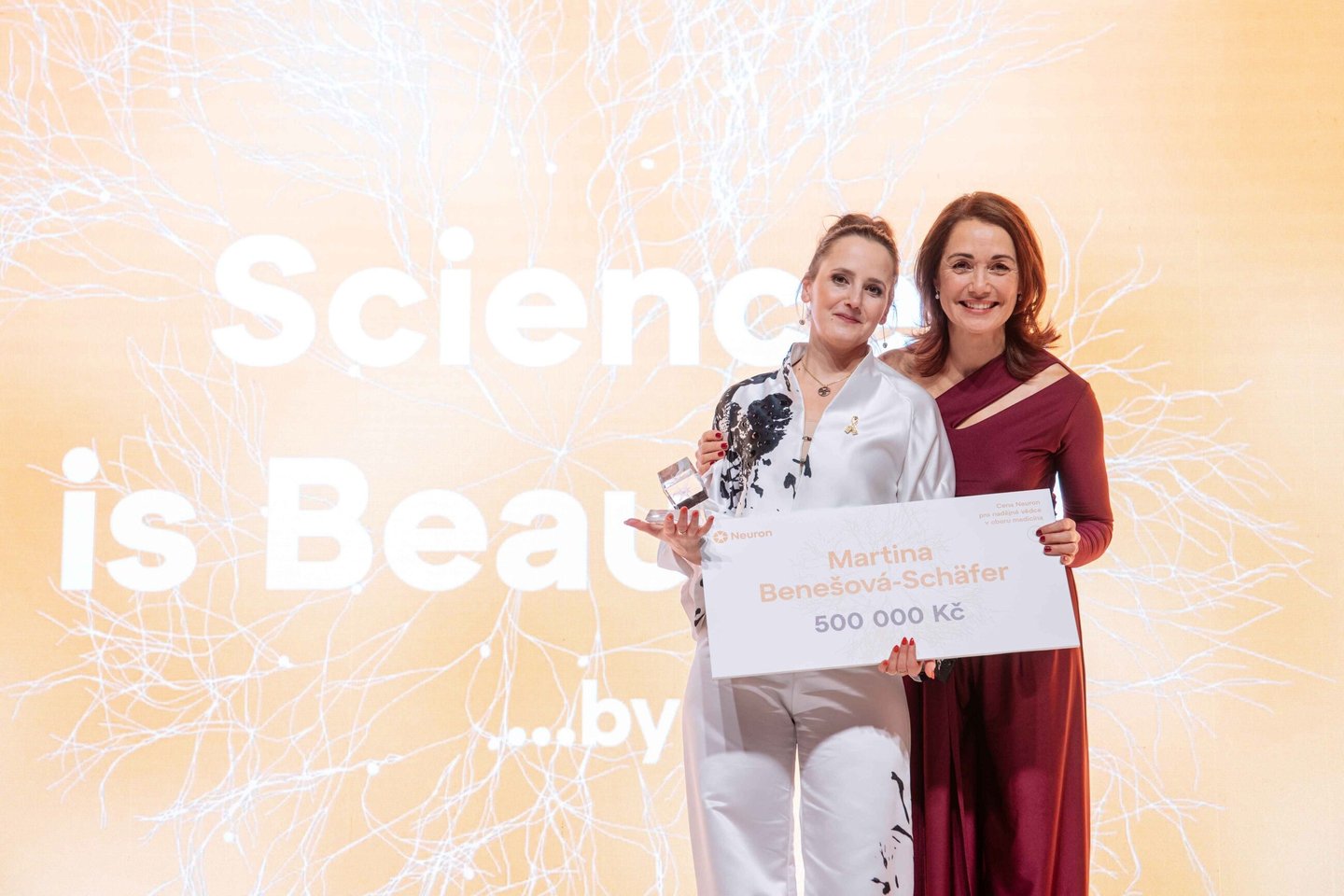
Martina Benešová-Schäfer is impossible to overlook. She was there at the birth of the radiopharmaceutical (marketed as Pluvicto) that helps patients with prostate cancer. In 2024 she received the Neuron Award for promising scientists and became the guarantor of the Neuron Award for connecting science and business. As E15 magazine now writes, she leads a team in Heidelberg developing a new therapy against breast cancer. "A colleague gave me good advice — not to try to outdo myself in future. Because that is actually a burden you then have to carry on your shoulders. Now I try to concentrate on making my work meaningful for me and for society, on bringing up a new generation of students and on working with colleagues I enjoy working with," she says.
As a young scientist she achieved what other colleagues have not managed in an entire career. The drug — more precisely the radiopharmaceutical — at whose birth she stood has already begun saving human lives. After the success of Pluvicto, which can act against prostate cancer, Martina Benešová-Schäfer's team in Heidelberg, Germany, has now turned to another enemy: breast cancer. She tells her story for the current issue of e15 magazine. When you meet Martina Benešová-Schäfer you get no sense at all that you are facing one of the most successful Czech scientists. She is an unorthodox figure who added a dedication to Ozzy Osbourne, co-founder of Black Sabbath, to her doctoral thesis. She likes eccentric fashion — she was married, incidentally, in a dress belonging to the actress Cate Blanchett — and does not come across in the least as someone who lives shut away in an inert world of molecules.
Work on a drug against breast cancer
Her radiopharmaceutical Pluvicto, born at the German Cancer Research Center (DKFZ) in Heidelberg, now faces an evolution. From an original "drug of last resort", given to patients in the final stage of prostate cancer, it is gradually becoming a drug of earlier choice. At the same time, in Heidelberg, Martina Benešová-Schäfer is overseeing the construction of a research centre for radiopharmaceutical chemistry, and her team is working on a new drug against breast cancer.
The Czech-born scientist has had a natural and warm relationship with Germany since childhood. "I have been a Germanophile since I was small. My father and I used to travel to mineralogical exhibitions in Munich; I loved everything German. And so when, after my final exams in nuclear chemistry, I was deciding what to do next, the German Cancer Research Center caught my eye. It had advertised three-year doctoral scholarships," she recounts. Out of roughly a thousand applicants, eighteen were chosen in Heidelberg. Martina Benešová-Schäfer was one of them. And so long before she won the Česká hlava award or the Neuron Award for promising scientists, it was clear that an exceptional story had begun.
Read more in E15 magazine: https://www.e15.cz/domaci/ceska-ktera-prinesla-svetu-lek-na-rakovinu-prostaty-ma-noveho-soupere-1431800