Time spent in the laboratory fulfils me, says a young scientist
Real research while still at secondary school. An 18-year-old scientist studies nanofibres. If you enjoy science, go for it — it is never too soon! Those could be the headlines that best capture Terezie Štěpánková and the project she presented at the Junior Science Conference. What is she studying? What results has she already achieved? And what future does she think nanofibres have?
She applied for an internship for secondary-school students, tried her hand at laboratory research and at real-world application, and then headed to the Junior Science Conference, where she caught the attention of the Neuron Foundation. We are talking about the grammar-school student Terezie Štěpánková and her project Preparation of a nanofibre dressing for healing minor wounds, which she presented at the conference organised by the Faculty of Science of Charles University so professionally that she can now fulfil her scientific dream together with Neuron.
"Specifically, I worked on the biomedical application of nanofibres. That is a direction where there is still plenty to discover or improve. The challenge could be not only treating more serious injuries using nanofibres, but also using them as absorbable implants," says Terezie Štěpánková.
Terezie, will you introduce your project to us?
The subject of the project was the preparation of a nanofibre dressing with a targeted application for healing minor wounds. A year-long internship at the company Contipro involved preparing the nanofibre layers themselves, using electrostatic spinning, and went on to study their properties. The very first step was designing the composition of the spinning solution, and thus of the future nanofibres, so that it would be gentle on the skin and would actively take part in healing the wound.
Why this subject in particular?
From the start I liked the way it brings together chemistry, physics, biology and medicine, and I was drawn by the possibility of translating laboratory research into a real application. I had attended various lectures about nanofibres, but I wanted to get to know them from the practical side as well.
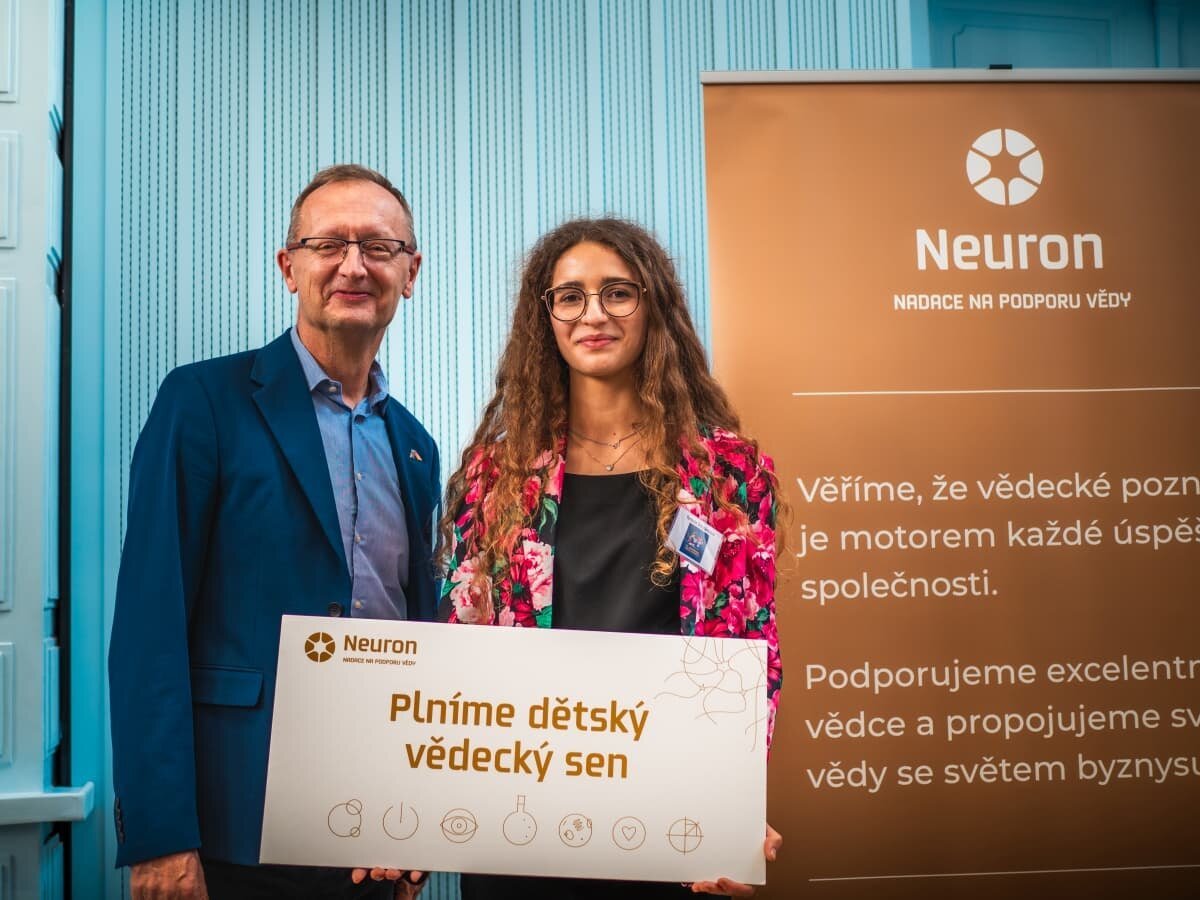
Jaroslav Řasa, founder and patron of the Neuron Foundation, presented Terezie Štěpánková with a cheque to fulfil her scientific dream
What have you managed so far, and where do you see the greatest practical benefit of the discovery?
At the moment our nanofibre dressing is only inching its way towards practice. We now know that the nanofibre layer is safe and functional. Even so, we still have some way to go. The idea is that a nanofibre dressing supporting healing can offer not only faster closure of the wound but also a less visible scar, so the patient avoids a reddened or raised scar that can encourage not only physical but also psychological discomfort. Thanks to its composition, the nanofibre dressing represents an affordable and convenient care option.
Was there anything that surprised you during the testing?
During the research I was very pleased by the results of the ex vivo test (note: applied research) of transdermal penetration. The test made it possible to demonstrate the effect of the nanofibres, that is, the release of active substances into the deeper layers of the skin. Besides the appealing microscope images, we know that the nanofibres work as we intended.
Working in science constantly brings some kind of surprise. And I enjoy that! Looking back, you could say I did not have a very accurate idea of the adventurous journey hidden behind every product that can end up in a patient's hands.
What are the biggest advantages of this nanofibre dressing?
Active substances incorporated into the structure of the nanofibres, that is, into a solid form, have an advantage over current gels in that no potentially irritant substances such as stabilisers and preservatives are used. The patient thus gets a material composed of specifically effective substances and, thanks to the presence of hyaluronan, of substances native to the body, with which there is no risk of an inflammatory reaction.
Nanofibres are spoken of as the material of the future. Do you agree?
Nanofibres certainly have their place in science and deserve researchers' attention. Polymers, the building blocks for "constructing" a nanofibre structure, have diverse properties, and in the form of nanofibres their use takes on further dimensions. It is no wonder they attract attention in many different directions, from use in tissue engineering to air filtration or space research.
It is precisely in the field of polymers that emphasis is placed on producing biodegradable or 100% recyclable materials. Nanofibres can be produced from such materials, by a fairly simple technological process, and can be worked into various shapes, including 3D structures. In future they could, for example, replace the packaging materials commonly used in the food industry or in medicine. That would reduce plastic production and allow efficient breakdown and recycling. So in my opinion nanofibres can help make a sustainable lifestyle more effective.
You got involved in real research while still at secondary school. How crucial do you consider that for where you go next?
There are a great many advantages, across all fields and not only in the natural sciences. Every activity can point a secondary-school student in a direction and deepen their interests, which I see as the most valuable thing of all. For me personally it also means gaining new experience, and at the same time it is a great motivation for the future. I am not fed up with the time I spend in the laboratory — quite the opposite; this work fulfils me more and more.
Discoveries lie waiting all around, do not let them slip by! Every month we will send you a fresh batch of information about the world of science and Neuron.
Sending…
Something went wrong. Please try again.
Subscription confirmed
To help you use our website by offering customized content or advertising and to anonymously analyze website data, we use cookies which we share with our social media, advertising, and analytics partners. You can edit the settings via the "Cookie settings" link and change them at any time in the footer of the site. See our Privacy Policy for more details. Do you agree with the use of cookies?