Will society take an interest in science?
Five questions for the Neuron Award 2021 laureates, five answers. How have their work and their lives moved on since last year's award ceremony, and what do they expect from the future?
Five questions for the Neuron Award 2021 laureates, five answers. How have their work and their lives moved on since last year's award ceremony, and what do they expect from the future?
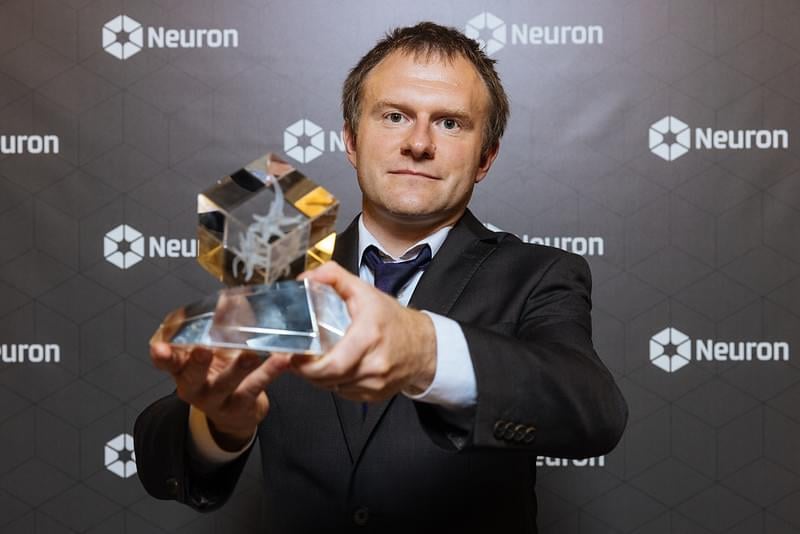
First to answer is the mathematician Jan Hladký, who won the Neuron Award for promising young scientists for his innovative applications of continuous methods in graph theory.
You received the Neuron Award last September. What has happened in your field since then?
When I received the Neuron Award I joked that the main thing I would remember many years from now would be that I still fitted into the young scientists category. Now, though, I see genuinely young scientists — colleagues perhaps ten years younger than me who have thrown themselves into the theory of graph limits, which is currently my main field, with incredible energy and have managed to achieve beautiful results.
What have you experienced personally since last September?
Excellent collaboration with colleagues at my home institute and elsewhere. In mathematics we have developed a certain general model of the evolution of large networks. Outside mathematics, I am glad that within a European working group we managed to complete the report Towards Climate Sustainability of the academic system and that we can already see a real contribution to more sustainable behaviour by some institutions.
How can mathematics help society as a whole at present?
Pure mathematics is a basic science and as such has no ambition to solve society's problems directly. Unfortunately, part of society and of the political leadership ignores the findings of the basic sciences at moments when they matter, and does so in a way that has enormous negative consequences. The social sciences are certainly exposed to greater ignorance and distortion than mathematics. Even so, we have one fine recent example in mathematics too, when during the coronavirus crisis the highest political leadership displayed an inability to understand the concept of an exponential. The consequences for public health and the economy are by now well known.
What do you expect from science in the distant future?
Science meets social demand. I would not presume to guess what that demand will be, and not only in science and not only in the distant future. Will applied research be driven by society-wide interests or by the interests of economic elites? Will the public and the political leadership want to acquaint themselves with the state of scientific knowledge, or will decisions be made on the basis of five-second videos on social media? Scientists' ability to influence the answers to these questions is small, but it is not zero.
What should future Neuron Award laureates strive for?
To build a welcoming and fair academic environment. A good scientist can grow up in any environment. But in a clientelistic academic environment there will be far fewer of them, and their motivation to continue doing excellent research will be low. No environment is perfect, but these problems are particularly acute in the Czech Republic.