Biology has the power to predict and to explain
Five questions for the Neuron Award 2021 laureates, five answers. How have their work and their lives moved on since last year's award ceremony, and what do they expect from the future?
Five questions for the Neuron Award 2021 laureates, five answers. How have their work and their lives moved on since last year's award ceremony, and what do they expect from the future?
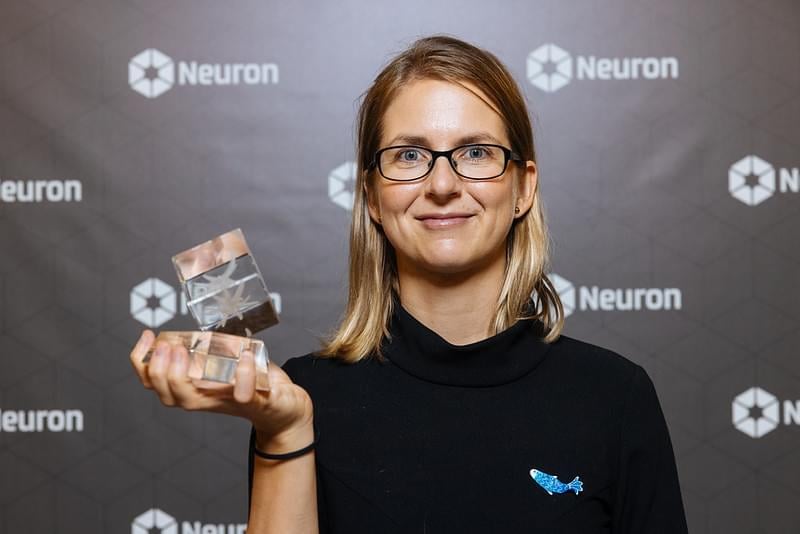
Next to answer is the biologist Zuzana Musilová, who won the Neuron Award for promising young scientists for her research into the evolutionary processes of fish and her study of their adaptations from innovative angles.
You received the Neuron Award last September. How has your field moved on since then?
Biology has recently been moving fairly dynamically towards ever more intensive use of molecular methods to answer evolutionary questions. Methods that were at first applicable only to selected model species are now more widely available, so we can uncover the secrets of the lives of animals such as deep-sea fish.
What have you experienced personally since September?
Above all a return to scientific normality, when we can actively work with colleagues abroad, visit each other in person and meet at conferences, where new ideas and plans for the future always take shape. Until recently this part of scientific work tended to be rather overlooked, but it has become clear how important it is and that not everything can be moved online.
How can biology help society at present?
The recent pandemic in particular showed quite convincingly how much society needs science, both directly (testing methods) and indirectly (retrospective analyses and forecasts). There are situations in which an informed, highly expert opinion really is worth its weight in gold and makes it possible to take the right political decision. We also noticed that even less obvious fields, such as evolutionary biology, have the power to predict and explain what is happening — for instance regarding the dynamics of the virus in the population. More generally, all fields of basic research have the potential to discover something unexpected, and you never know in advance which field will give rise to, say, a new idea for treating some disease or for new technologies.
What do you expect from science in the distant future?
Science works by primarily expanding our knowledge, and from that come the subsequent ideas that have the potential to improve our lives. Greater support for basic research means a greater probability that such ideas will arise, and consequently more successful development of applications. This can be observed across different countries. You cannot invent new drugs or revolutionary methods without strong primary basic research. So in the distant future I expect essentially the same from science as in the near future — the exploration of everything possible and the identification of what is interesting for potential application that benefits society as a whole.
And a final question: where do you keep your Neuron Award on display?
In a display case with the skulls of various animals :-)