Without support for science, the quality of society declines
Five questions for the Neuron Award 2021 laureates, five answers. How have their work and their lives moved on since last year's award ceremony, and what do they expect from the future?
Five questions for the Neuron Award 2021 laureates, five answers. How have their work and their lives moved on since last year's award ceremony, and what do they expect from the future?
Next to answer is David Preiss, holder of the Neuron Award for lifelong contribution to science in mathematics.
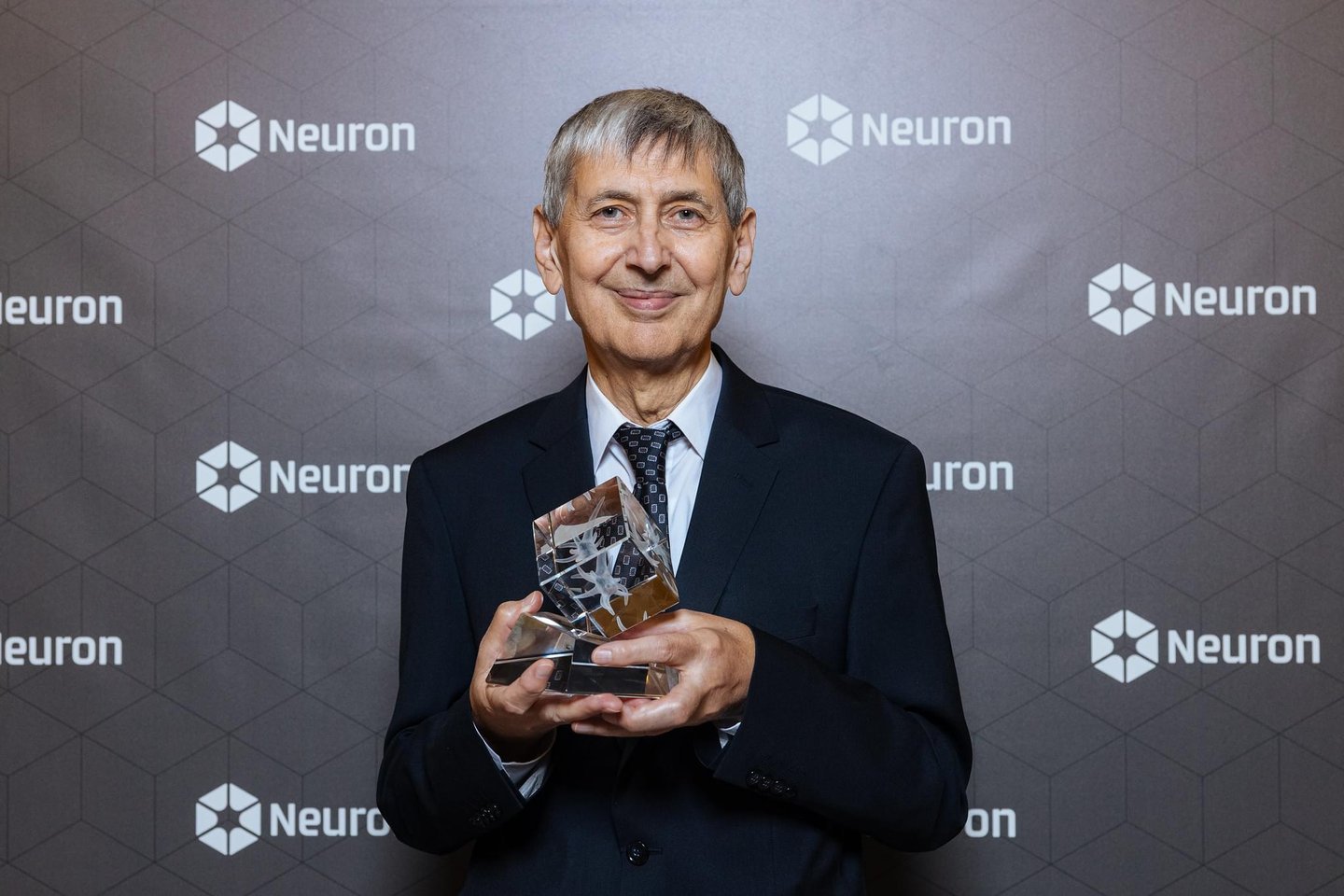
You received the Neuron Award last September. How has mathematics changed since then?
Every year mathematics gains new young mathematicians who gradually push it forward. But in pure mathematics a single year is rarely long enough for a substantial shift. Often such a shift is the solution of a famous problem, but verifying a solution takes considerably longer than a year. In fields close to mine, though ones I do not work in myself, the solution of the famous "Connes embedding conjecture" (which is equivalent to two other famous problems from other branches of mathematics) was informally published in January 2020 (with a correction in September 2020), but the review process has not yet been completed.
What did you experience personally?
One of the most pleasant experiences was the completion and publication (in Inventiones Mathematicae, one of the most prestigious mathematical journals) of a paper by my former PhD student David Bate, who generalised to metric spaces, in an almost unbelievable way, a rectifiability criterion originating in the work of John Marstrand and Pertti Mattila. In that connection I was reminded that a similar strengthening of the density criterion for rectifiability (by the same authors) is still an unsolved problem, with the best partial results due to Miroslav Chlebík from the time he was studying in Prague.
How can mathematics help society as a whole today?
The influence of "pure" science, whether it is theoretical mathematics or the study of the eyes of fish living in the deep, is indirect and mostly arrives only slowly and at one remove.
What do you expect from science in the near future?
Above all I hope that, both in the near and in the distant future, science will be able to develop freely in all its forms. The past has shown more than once that withdrawing support from any branch of science, whether for ideological reasons or out of the belief that only immediate applications deserve support, leads to an overall decline not only in pure and applied science, but in society as a whole.
What do you wish for the Neuron Awards and for those who follow you?
The Neuron Award is a great encouragement, especially for young scientists. I wish it continued success in recognising both applied and pure science, and I particularly look forward to the young Czech mathematicians who will become its holders.