Support for science competitions
Science is not only about quiet research in a laboratory; it is also about being able to defend your ideas, present your results and hold your own against the very best. Nadace Neuron systematically seeks out and supports platforms that awaken healthy competitiveness in young people and teach them critical thinking.
Where is the scientific elite of the future born?
We support projects that work as a hatchery of talent for Czech science. Places where students move from school textbooks to solving real scientific problems.
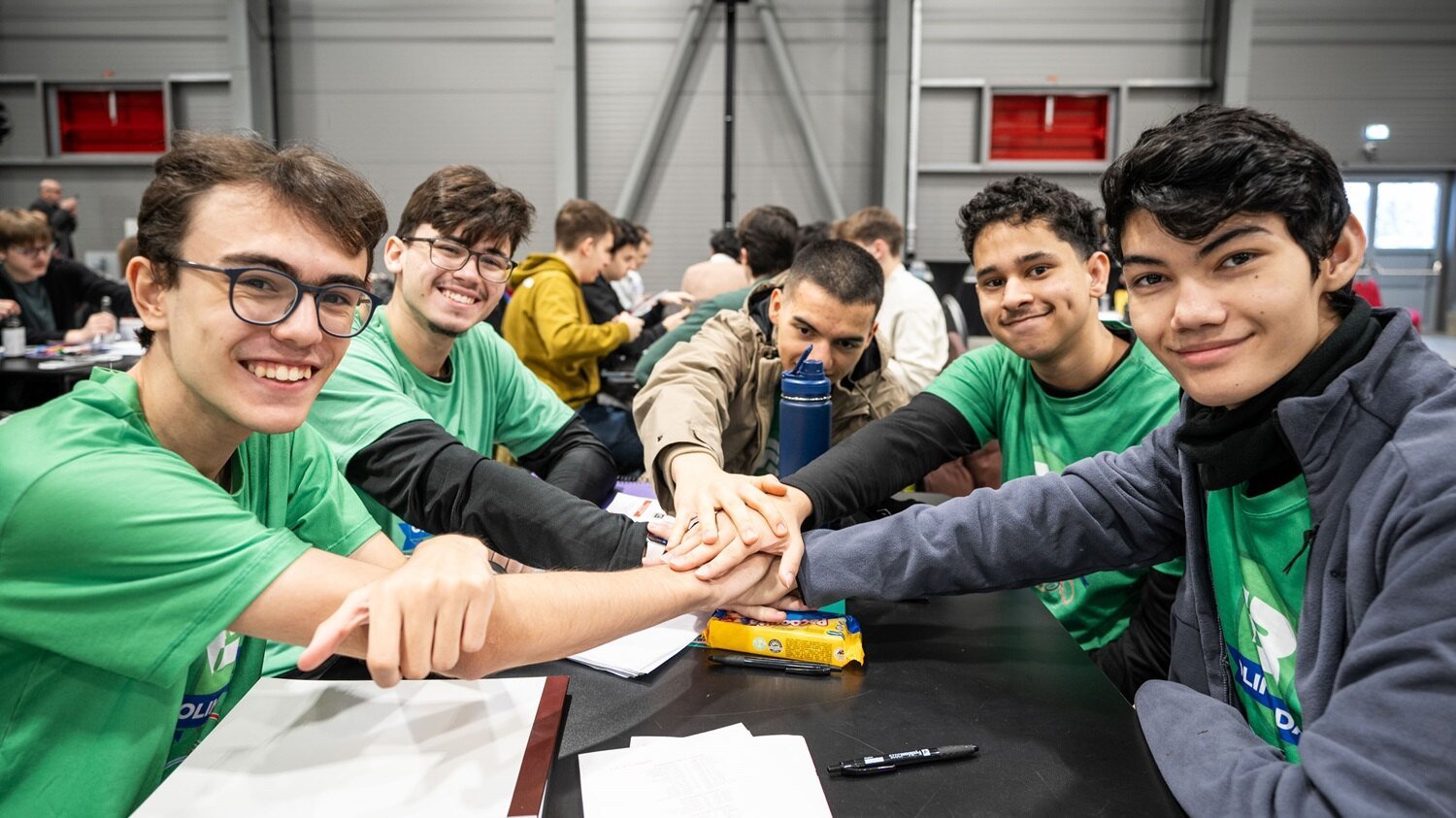
Projects that push the boundaries
We concentrate on events with a long tradition and a high professional standard, which simulate a real scientific environment for students.
FYKOS: a physics challenge for the sharpest minds
FYKOS (the physics correspondence seminar) is a legend among secondary-school competitions, organised by the Faculty of Mathematics and Physics of Charles University. It is not about working through exercises but about the all-round development of physical thinking.
- What is it? A year-round competition in which students solve demanding, creative problems that often go well beyond the secondary-school syllabus.
- Why do we support it? FYKOS is not a one-off event. It is a community. The best solvers meet at specialist gatherings, travel to international competitions (such as the Physics Olympiad) and often go on to become leading scientists.
- The added value: Students get feedback directly from university students and teachers at the Faculty of Mathematics and Physics.
The Junior Scientific Conference: the first step onto a scientific stage
While the olympiads test knowledge, the Junior Scientific Conference (run by the Faculty of Science of Charles University) tests the ability to be a scientist. It is a simulation of a real scientific conference, with everything that involves.
- What is it? Students and pupils go through the whole process of scientific work: from their own research and writing an abstract to presenting it before an expert jury and an audience.
- Why do we support it? Science nobody knows about might as well not exist. The conference teaches young talents a key skill — science communication. They have to capture attention, explain complex phenomena and defend their conclusions in discussion.
- Breadth: Projects from biology, chemistry, geography and geology meet at a single event, which is exactly what Nadace Neuron's mission of connecting disciplines is about.
At the Junior Scientific Conference we choose one talented student every year whose junior scientific dream we grant. We send them on a placement at a renowned research institute, where their project starts to take on real scientific shape.
What do the competitions give students?
Why is it worth devoting your free time to science beyond school?
- A flying start: Those who take part in these competitions often have the door to prestigious universities open without entrance exams.
- Soft skills: They learn to present, to argue and to take constructive criticism.
- Networking: They gain contacts with mentors and peers that last a whole professional life.
- Experiences: Science is an adventure — whether at a gathering in the mountains or in the nerves before a full hall.

Be informed
Discoveries lie waiting all around, do not let them slip by! Every month we will send you a fresh batch of information about the world of science and Neuron.