Laureate Computer science
Mgr. Václav Rozhoň, Ph.D.
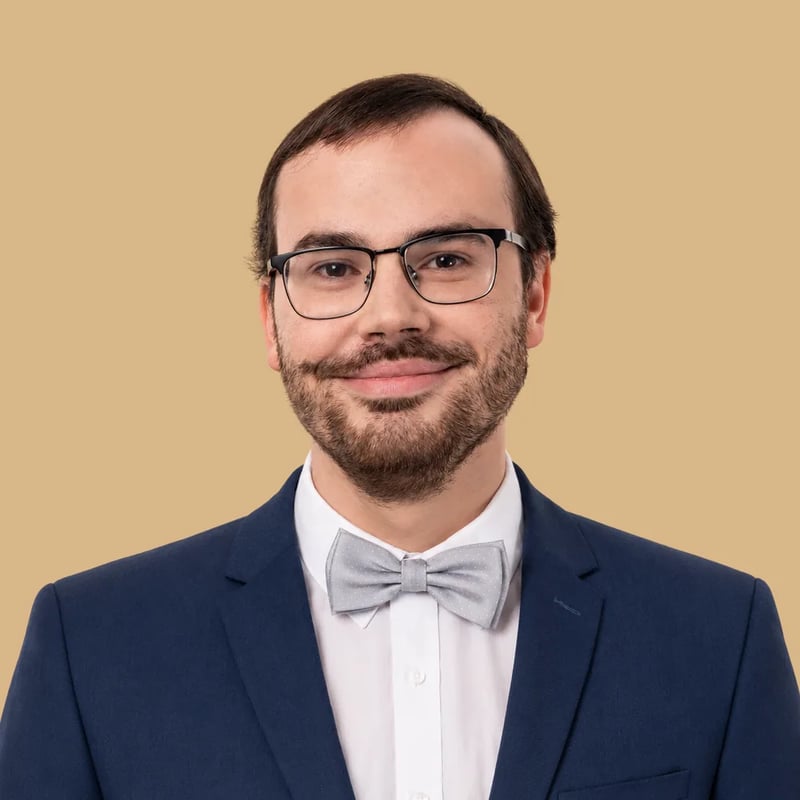
Neuron Award laureate for promising scientists
Algorithms are one of the basic building blocks of the digital world. We all use them, yet few of us understand how they really work. That is exactly what Václav Rozhoň of the Faculty of Mathematics and Physics of Charles University works on. He managed to explain mathematically why one of the most widely used data-analysis algorithms works (for connoisseurs: K-Means in the scikit-learn implementation). He also proposed a general method for constructing distributed algorithms, which is already taught at universities. Besides his research he is a co-creator of the algorithmic channel Polylog, with more than 100,000 subscribers on YouTube.
Václav Rozhoň works at the Faculty of Mathematics and Physics of Charles University. Before that he studied at ETH and spent a year at MIT in the United States. In 2024 he received the Best Paper Award at the prestigious FOCS conference for work on the classic Dijkstra algorithm, used for instance to find the shortest routes on maps.
Why did he receive the Neuron Award?
He tries to understand down to the last detail the principles on which the technologies shaping our world work. He received the Best Paper Award at the FOCS 2024 conference, for instance, for work on the Dijkstra algorithm — one of the cornerstones of modern computer science.
His work is not confined to academia and research, though. Accessibly and with a sense of humour, he offers insight into his field to the general public on YouTube, where he entertains and inspires laypeople and experts alike.
Can you recall a "eureka / aha / wow" moment of your own?
There are only a few such unforgettable moments. Two that come to mind now: when I understood quantum theory (definitively, I hope) and when GPT-3 appeared. The first left me in shock all day; I have not recovered from the second yet.
If you could have any superpower, what would it be and why?
You surely know the type of annoying people who would ask a magic fish for a wand that grants further wishes, and who would want the superpower of gaining any superpower at all. Most of them end up as programmers or scientists; I chose the second path.
Have you had a life or work "fuck-up"? What did it give you and take from you?
Small, more amusing fuck-ups happen all the time. At one conference I enthusiastically explained to a likeable gentleman what my field is about. I was pleased at how quickly he grasped what I do, and duly proud of my explanatory skills. Only later did I find out that it was Jeff Dean — the founder of the field.
What must not be missing from a recipe for good science?
I like working best on something I enjoy, that I am good at and that I consider useful. Sadly, all three conditions rarely come together at once — and I think many colleagues have it the same way.
Science and family — how do they rhyme for you?
I am enormously lucky to have an exceptionally kind wife and two wonderful children. Honestly, though, I have to admit that I am not very good at combining family and work. If you have any foolproof tips, send me an email.
MF DNES / Lidovky (in Czech): The world with AI will soon be completely different, says Václav Rozhoň