Laureate Physics
RNDr. Michal Vališka, Ph.D.
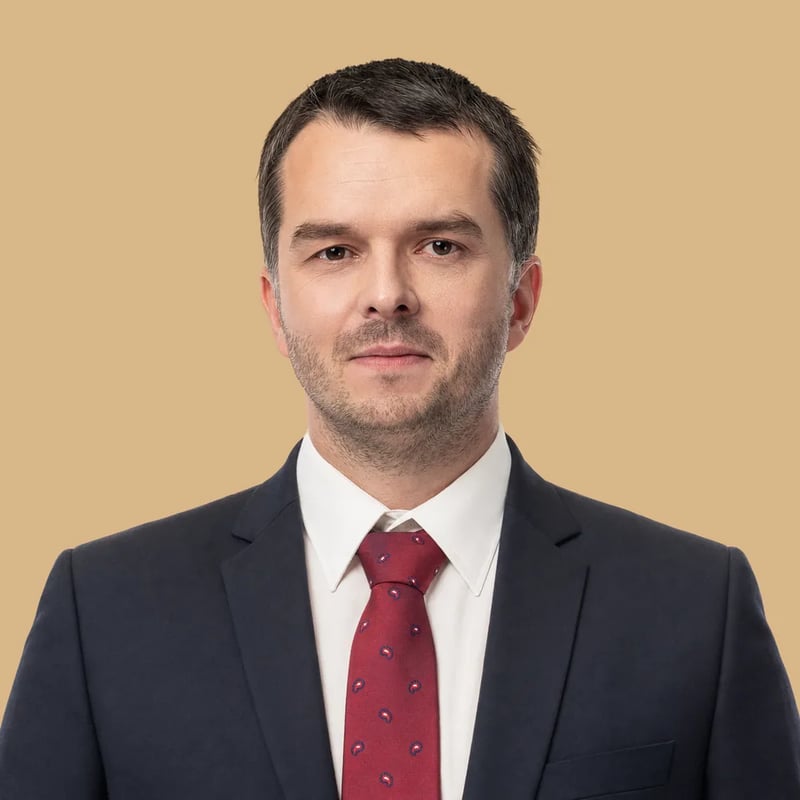
Neuron Award laureate for promising scientists
In times long past, alchemists tried to create gold by transforming less precious metals. Michal Vališka has no interest in gold — he is interested in crystals so pure that signs of unconventional superconductivity can be observed in them. He works at the Faculty of Mathematics and Physics of Charles University, where he leads a team able to turn ordinary metals into materials on which physics can be watched, as it were, live. His crystals are neither coloured nor transparent; they do not look like the ones in films or fairy tales. They may, however, become the holy grail of today's solid-state physics.
Why did he receive the Neuron Award?
He developed a way of preparing extremely pure crystals of the uranium compound UTe₂, which have fundamentally influenced world research into quantum materials and brought the development of superconductors and of next-generation quantum computers closer. They are a promising step towards technologies we find today only in literature and films.
His work looks complicated at first sight, but at its heart it is a search for perfection — how to remove every impurity from a substance so that its true nature is revealed.
Can you recall a eureka / aha / wow moment of your own?
One moment comes to mind which is not a typical "eureka" moment connected with a discovery, but rather a personal "aha" realisation about the nature of scientific work.
It dawned on me that being a scientist does not only mean spending time in the laboratory doing research, but that a key part of it is the ability to formulate and publish results and to talk about them in front of people — whether at a conference or in ordinary conversation.
Even as a child I felt that I would want to do science one day, but back then I imagined mainly the discovering itself. That science is to a large extent communication as well was a surprising discovery for me — a fundamental one and, frankly, a slightly frightening one at the time.
Do you remember any childhood questions that kept you awake? Has a child (or an adult) ever asked you a question that inspired you somehow?
As a child I had plenty of questions, mainly about the universe — I was fascinated by the Big Bang, black holes and the very fact that something so enormous can work according to rules.
In that respect I chose the wrong branch of physics, because I still do not understand most of those questions.
My children, on the other hand, often ask me about crystals. They probably find them imaginable — they know we prepare them in the laboratory and study them. They are just usually a little disappointed that the crystals are neither coloured nor transparent and do not look like the ones in fairy tales.
The physics behind it does not interest them much yet, but they often come with the hardest question of all: "And what is it actually good for?" And that is inspiring in itself — because if there is no answer to that question, perhaps it is time to try doing something else.
Which five words or phrases describe you?
Curiosity. Patience. A gift for improvisation. An inability to ask for help. Clinging to my own idea.
If you could have any superpower, what would it be and why?
Definitely the ability to split myself in two, maybe even in three. I would need to deal with plenty of things in parallel — being at a measurement, writing papers, supervising students, answering emails… and if one copy of me could devote itself fully to the family alone, that would be completely ideal.
What must not be missing from a recipe for good science?
Definitely a good team of people you get on with professionally and personally. A good idea, excellent facilities and certainly plenty of luck. Sometimes it cannot be done without luck, even when you have everything else.
Science and family — how do they rhyme for you?
We have four children, so time really is a rare commodity in our house. Science demands time, concentration and often that your thoughts are somewhere else entirely. Combining these two worlds is not easy, but it is worth it. And at the same time it teaches you to be more efficient, to plan more and to value time — your own and other people's.

MF DNES / Lidovky (in Czech): After the secret of Michal Vališka's ultra-pure crystals
“That science is to a large extent communication as well was a surprising discovery for me — a fundamental one and, frankly, a slightly frightening one at the time.”