Science in his daughter's name. That is the story of the crystallographer Václav Petříček
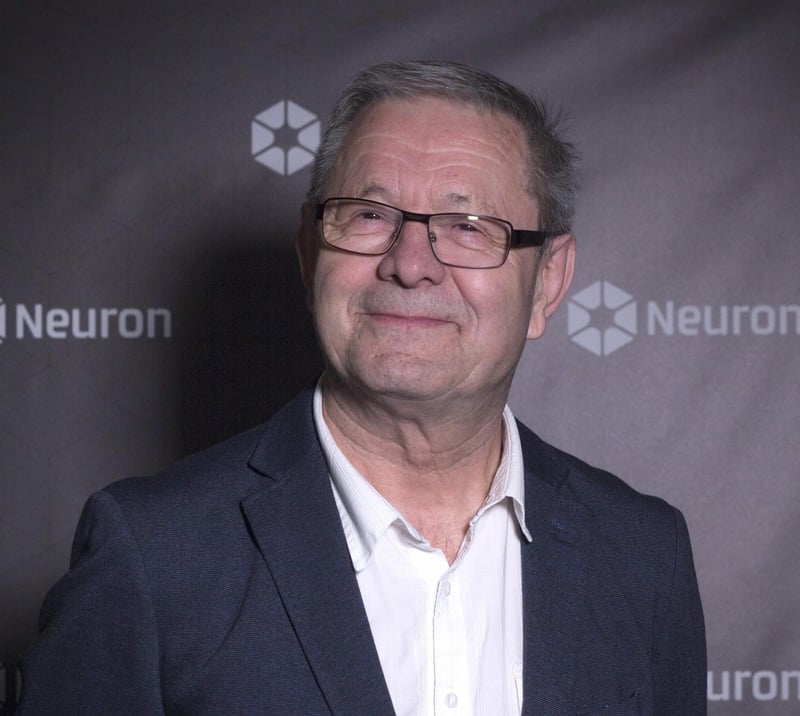
Václav Petříček is a laureate of the 2021 Neuron Award for lifelong contribution to science in the field of physics. The scientist gets up at four every morning so that he can devote himself to students or to work on his legendary program JANA. Václav Petříček wrote the first version of the most comprehensive tool for studying crystallographic structures back in 1984 and is still improving it today. "I also became a scientist so that I could do only what I enjoy," says this world-class physicist, who is also a passionate sportsman. Get to know his whole story.
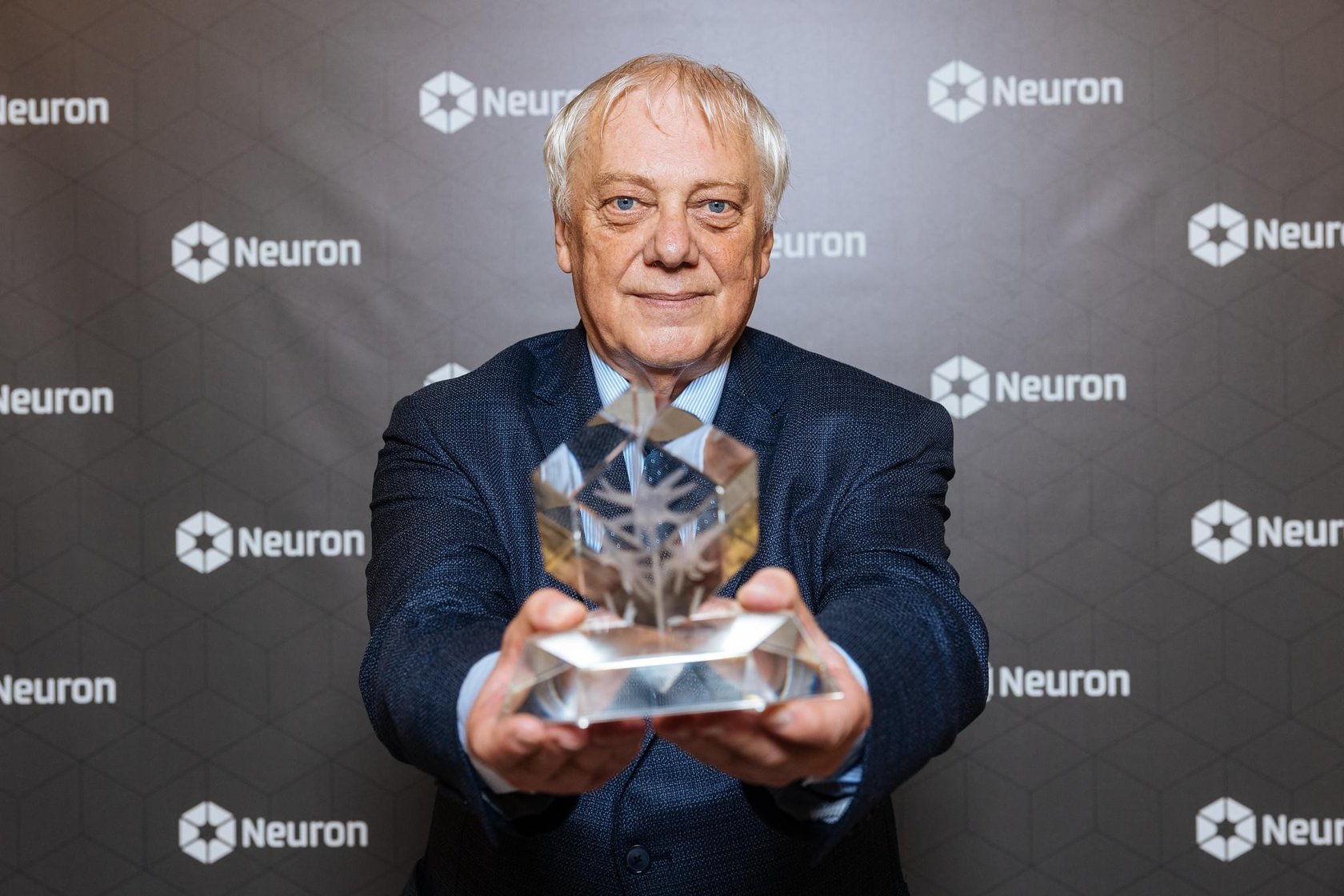
Václav Petříček is a laureate of the 2021 Neuron Award for lifelong contribution to science in the field of physics. The scientist gets up at four every morning so that he can devote himself to students or to work on his legendary program JANA. Václav Petříček wrote the first version of the most comprehensive tool for studying crystallographic structures back in 1984 and is still improving it today. "I also became a scientist so that I could do only what I enjoy," says this world-class physicist, who is also a passionate sportsman. Get to know his whole story.
In his daughter's name
What do the things around us look like inside? Does the structure of substances have its own regularities? Can they be studied, measured or even changed? When the Nobel Prize in Chemistry was awarded in 2011 for the discovery of what are called quasicrystals, it drew public interest to the crystal structure of substances, which is key to their properties. A world-recognised expert in this field is Václav Petříček, who works on developing program systems for computing complicated crystal structures.
The unique program he developed for this purpose in the 1980s, and which is today widely used by laboratories all over the world, he named after his daughter — JANA. In its code JANA encompassed almost the whole of crystallography.
"I never wanted money for my program, only cooperation," Václav Petříček reveals of the secret of JANA's phenomenal success; today it has several thousand users all over the world and gathers over five hundred citations a year. "When someone finds a bug in it or has an idea for an improvement, I ask them to send it to me. Thanks to that I have built cooperation with the best laboratories in the world."
I only do what I enjoy
Václav Petříček, one of the most significant Czech crystallographers, studied at the Faculty of Mathematics and Physics of Charles University and has been working as a researcher at the Institute of Physics of the Academy of Sciences for fifty years now. Originally, at technical secondary school, he was headed for chemistry, but the technology of chemical production did not interest him, and so he switched the points towards mathematics and physics. "From that moment on," he declares, "I have done only what I enjoy. And so it has stayed."
At present Václav Petříček works on the methodology of solving magnetic structures from neutron diffraction data. He measures the arrangement of atoms in substances whose crystal lattice is disrupted in a certain regular way, by what is called modulation. Its presence is important evidence about the electron arrangement and the nature of the chemical bonds in these substances, and a detailed determination of the structure is then the basic starting point for understanding physical and chemical phenomena.
For illustration, Václav Petříček describes it like this: "The basis of a crystal is a structure that repeats periodically. Like bricks, say. When you shine rays through a crystal, you get a diffraction image thanks to which you can see how the atoms are arranged in that structure. By periodically disrupting the translational symmetry it is then possible to change the properties of the given substance. Take graphite and diamond — it is still carbon. But each of these substances has entirely different properties. How is that possible? It depends on how the atoms are arranged and how they are bonded to one another. The method that determines what they look like is our method of diffraction analysis."
Grafters and visionaries in science
With the help of the JANA program the structure of crystals can be made visible. What physicists used to measure over, say, three weeks can today be determined in two hours with the help of modern instruments and computing programs. "But only a few people in the world can compute interesting crystals," Václav Petříček notes. "And when they do, it is with our program."
For the development of the crystallographic program JANA, Dr Petříček has received three significant and prestigious awards. In 2013 he was the first Czech physicist ever to receive the Charles Barrett Award from the International Centre for Diffraction Data. Three years later he received the Max Perutz Prize — this prize, awarded by the European Crystallographic Association, is the very highest distinction that can be attained in the field of crystallography on the European international stage. And finally, for the third time, in 2020 Václav Petříček received the Patterson Award — again for the lifelong development of the JANA program. For the first time in history this award, under the auspices of the American Crystallographic Association, was given to a scientist working outside the boundaries of what is called the Western world. In fact, though, there is a relationship between the laureate and America, since the whole history of JANA began in 1983 during Václav Petříček's placement in the laboratory of Philipp Coppens at the University of Buffalo. There he created its first version, at his supervisor's challenge. Philipp Coppens was a strict boss, but he greatly valued the work of the young enthusiast from Czechoslovakia. "During my stay he gave me a raise three times; apparently that had never happened before," Václav Petříček says with a smile.
In science, in his view, there are grafters — and visionaries. "There are not many of the latter, but I got to one of them. Philipp Coppens was a real visionary." In Buffalo Václav Petříček spent, in his own words, a wonderful year; he was close to Niagara Falls and he even met the Nobel Prize winner for crystallography, Herbert Hauptman. "I was thirty, at home I had a wife and a little five-year-old daughter Janička. So that is why the program is called JANA."
Speaking of names, Václav Petříček must also be credited with the authorship of the name "crenel function", which he thought up to describe discontinuously modulated atoms in JANA's computing system. "They looked like battlements — in English crenel," he explains.
To run a hundred kilometres a month
He enjoyed the work in the United States, but he says he would not want to live there permanently. "I missed the freedom to choose what I would research and what I would think about in the evening."
He had the chance to travel abroad several more times — and everywhere he ran in his free time. Running cleared his head and put his thoughts in order so that his brain was ready to conquer further scientific goals. "In France, where I had the chance to travel freely for five years, I liked it very much. I kept to a hundred kilometres a month. That's not much!" he waves a hand. "The lads ran far more. In America I got up to two hundred, but there I had a park right next to my flat, so I always did a few laps before I went to work. I don't consider myself any kind of sportsman, I run as one foot follows the other. But it really is very good for relaxation and for the brain. Wherever I travelled to a conference, I took my shorts and shoes with me and ran."
Today, because of his hips, Václav Petříček no longer runs, but the soul of a sportsman has not left him. He often cycles from home to work, that is, from Mělník to Prague. "There and back it is a hundred and ten kilometres, so I do it maybe only twice a week in summer. Otherwise I take the bus. And that way I have more time for work, after all. I get up at four and take the first bus after five." He has never in his life had a car, because he simply did not need one.
Physics is fair
He could have retired eleven years ago, but so far it has not crossed his mind even for a moment. "When I was at a reunion of retired classmates, I did not really understand what those people were talking about, because I get up for work every day." But the reverse applies too. "I'm that madman who does 'something', something nobody understands. Can it be said in one sentence? The other day my brother-in-law asked me what I had done that day. And I answered him: I was trying out how to transfer the formalism of describing a structure in four-dimensional space into six-dimensional space. He could not say a word to that."
He plans to do his work for as long as he enjoys it and as long as he can manage it physically. "On the bike I do feel the hills now, but it is still all right, I hope. With my head, unfortunately, I won't be able to tell, because when my head stops working I will still think it is working," smiles the optimistically inclined Václav Petříček.
He is glad of all the awards he has received, but the greatest reward for him is a good feeling from his work. "That is absolutely the best thing there can be. Conversely, when something does not work out, it is dreadful! I can't just leave work and switch off, so it is precisely in these situations that sport, or at least watching it on television, helps me."
He likes mathematics and physics because, in his view, they are "fair". "People in these fields are friendly, I have a lot of friends among them. In other areas where more money is at stake, relations are more tense. Of course I regret that I am not better at some things — Czech, say, or languages; I have no talent for them, just as I have none for music. I admire people who can play an instrument. But one cannot be good at everything."
And what has Václav Petříček paid the highest price for in life? Looking for the answer to this question, he thinks for a long time. "Actually I don't even know. When I was in America for eleven months, they let my wife come out to me and we took a holiday in Hawaii. So perhaps for that," he laughs.
The next day, though, he sends an email: "The question of what the highest price I have paid in life is rather took me aback and I had to think about it and remember a little. Now I know that the highest price was a year's separation from my family during my first placement abroad, which was, however, the fundamental starting point of my scientific career."
WATCH THE RECORDING OF THE 2021 NEURON AWARDS GALA EVENING
WATCH THE RECORDING OF THE DEBATE WITH THE 2021 NEURON AWARD LAUREATES
WE THANK THE PATRONS AND PARTNERS OF THE NEURON ENDOWMENT FUND AND THE NEURON AWARDS