The truth about artificial intelligence
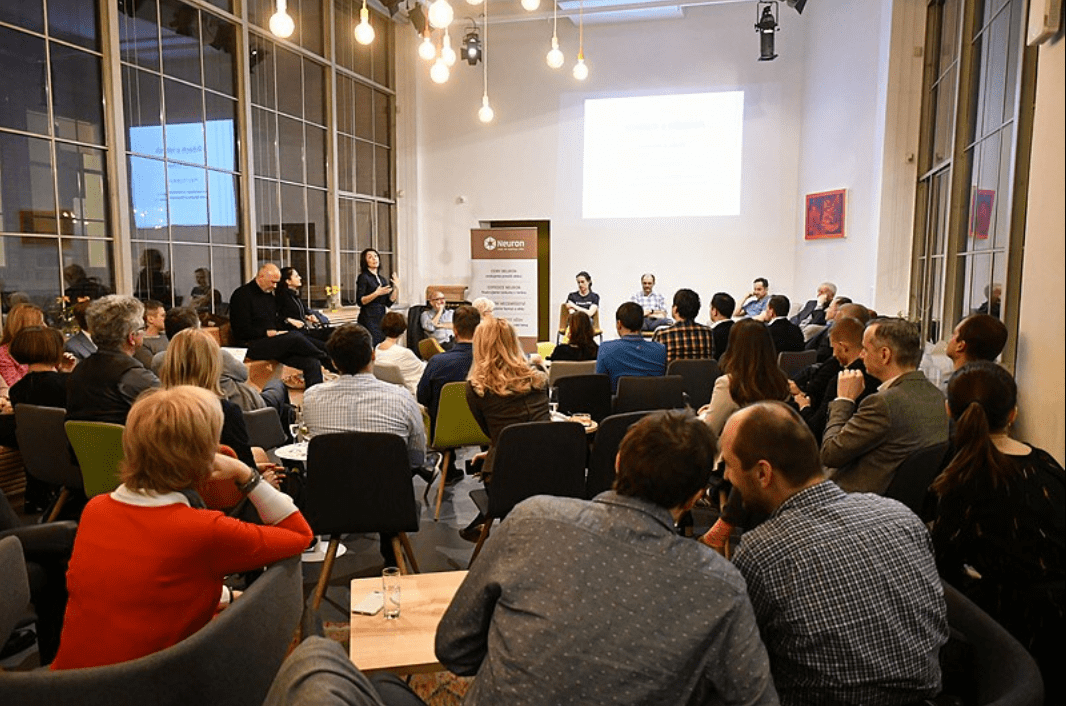
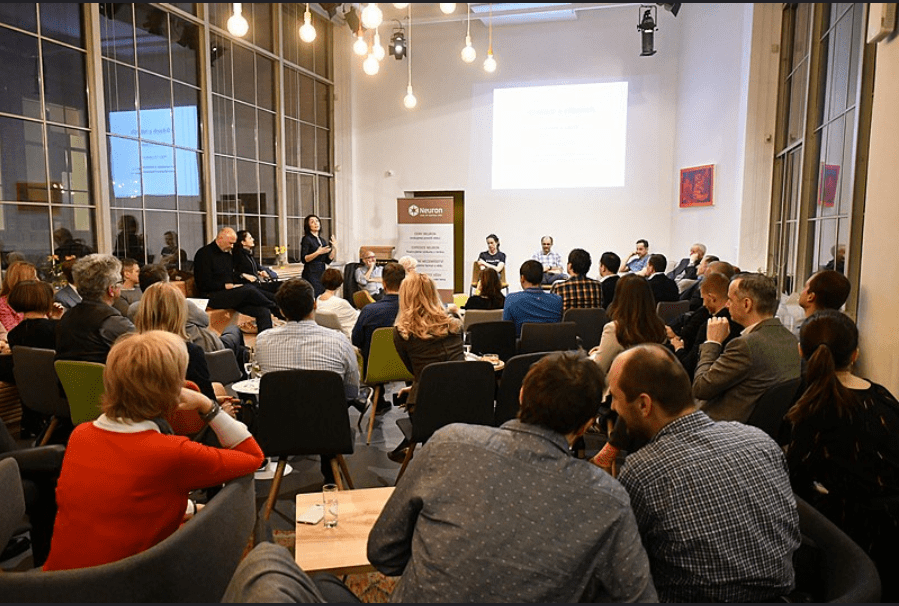
Some robots can now paint a Rembrandt the artist never painted. They can put together realistic speeches by statesmen that were never delivered. People are able to make "robots" adapt to their needs. Whether you cut a robot's finger or a human's, bystanders react the same way in both cases — they feel pain. People who have had amputations retain neural networks that then let them move bionic limbs. Where does the boundary between human and robot lie? In the capacity for a higher degree of self-awareness. Get to know the topics we discussed at another Neuron Club.
Some robots can now paint a Rembrandt the artist never painted. They can put together realistic speeches by statesmen that were never delivered. People are able to make "robots" adapt to their needs. Whether you cut a robot's finger or a human's, bystanders react the same way in both cases — they feel pain. People who have had amputations retain neural networks that then let them move bionic limbs. Where does the boundary between human and robot lie? In the capacity for a higher degree of self-awareness. Get to know the topics we discussed at another Neuron Club.
Artificial intelligence as a buzzword
"At present the term artificial intelligence is applied to all sorts of things. In reality we are talking about machine learning." On the basis of an enormous data set and using a suitable algorithm, an artificial neural network can be taught to generate the right output, or to predict. That is already routinely used in physics (applying solutions to cases where we do not know the answer); speech translators work on the same principle, and so on. But it is still simple applied statistics — on the basis of millions of examples we build mathematical models that use algorithms to produce ideal outputs.
Big brother, big mother, big worker?
Using artificial intelligence carries risks.
Big Brother: results and outputs arise without our understanding exactly how. We are thus gradually giving up understanding of the processes taking place, and therefore control over them. Sophisticated systems can learn more about us than we know about ourselves and our surroundings — machines have long been better than us at recognising faces, and Google's analysts theoretically know when a flu epidemic will break out, because queries about pharmacy opening hours multiply in the search engine.
Big Mother: there is also a risk of paternalism — relying on the outputs of an AI that advises us on everything can imperceptibly deprive us of autonomous decision-making and thinking.
Big Worker: why not, if it helps us analyse data the human brain could never encompass?
Artificial intelligence — humanity's friend
"Finding the answer to the question of whether robots will one day rule us is about as important as worrying about overpopulation on Mars." The current form of AI as a powerful statistical analyser that has to be trained from scratch for each task rules out any process of self-awareness in AI: "AI will therefore never be able to step over the shadow of its programming."
On the contrary, when we synchronise AI with humanity's goals and use applied statistics to the full, AI can be a valuable ally. Especially in personalising medicine, performing robotic operations, creating new materials, optimising processes, and in education too.
The greatest benefit, though, is the ability to process enormous data sets in a short time: even the discovery of the Higgs boson was helped by machine learning making it possible to process the enormous quantity of data from the accelerator.
Epilogue: on robots and people — openly
Creating an artificial intelligence capable of self-awareness is not desirable. It could be misused for power. Nor is it realistic in the foreseeable future. Nevertheless, even artificial intelligence in the sense of machine learning can do a great deal of harm — robots can cause instability on the stock exchange, drones are used as effective killers, it can foster addiction. AI is able to draw a person in so far that they forget their basic needs (sex robots).
On the other hand, artificial intelligence is and will be a useful helper — thanks to robots we can make manual work more efficient, it will simplify and personalise diagnosis and treatment in health care, and so on.
What matters is being sceptical about one's own scientific results and being open: sharing the data set, the algorithm and so on and allowing the scientific community to test and verify the conclusions. "If we develop AI openly so that everyone can share everything, we can assume that even if someone then wants to misuse it, there will be people who know how to prevent it."