Confirmed: the world's deepest flooded abyss lies in the Czech Republic
14 November 2015
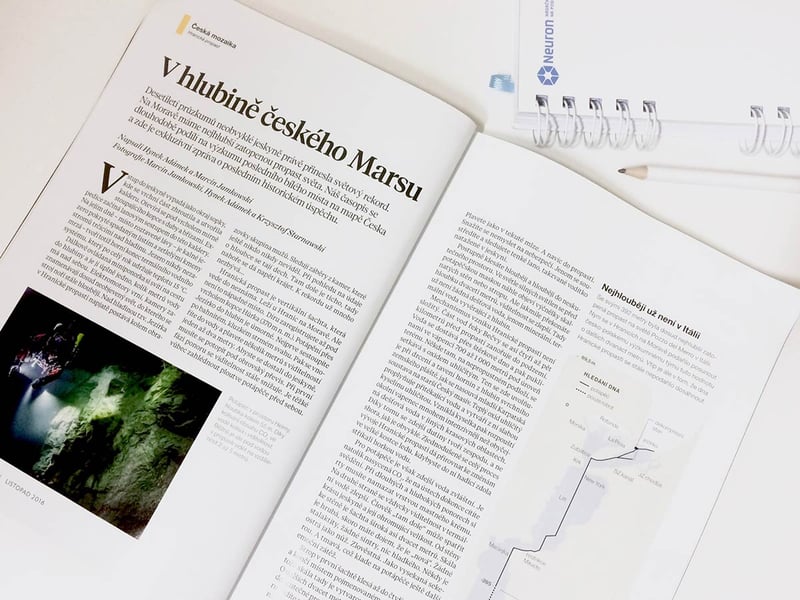
Prague, 30 September 2016 — until recently the Hranice Abyss near Přerov was only a little short of the record. To conquer the magic threshold of 392 metres, the depth of the Italian abyss Pozzo del Merro, which held the world record, only 8 metres were missing. The latest measurement proved what a team of Czech speleologists, members of the Czech Speleological Society, working with the leading Polish cave diver Krzysztof Starnawski, had been attempting for a number of years:
The deepest flooded abyss in the world is the Hranice Abyss, with a measured depth so far of 404 metres
Prague, 30 September 2016 — until recently the Hranice Abyss near Přerov was only a little short of the record. To conquer the magic threshold of 392 metres, the depth of the Italian abyss Pozzo del Merro, which held the world record, only 8 metres were missing. The latest measurement proved what a team of Czech speleologists, members of the Czech Speleological Society, working with the leading Polish cave diver Krzysztof Starnawski, had been attempting for a number of years:
The Hranice Abyss is the deepest flooded abyss in the world.
There are, however, still many secrets connected with this "inaccessible lady", as those who study it often call the abyss. The hydrogeologist and speleologist Helena Vysoká is carrying out scientific research into the abyss, the aim of which is to learn as much as possible about the water in its depths. For her research she received a quarter of a million crowns from the Neuron Endowment Fund and became the very first leader of a Neuron Expedition.
Depths beyond the limits of human capability
In recent years the Czech-Polish team had been trying to approach a depth of 400 metres. Within a project called Hranice Abyss Step beyond 400 m, thanks to cooperation with the Polish speleologist Krzysztof Starnawski, who is one of the few divers in the world capable of such a demanding deep descent, a depth of 404 metres has now been measured. "The key dive on 27 September was one of a long series of dives I have made in the Hranice Abyss over the last 20 years. But they all had the same aim: to explore the abyss further and deeper," Krzysztof Starnawski said in an interview for National Geographic, which partly funds the research. Descending to such depths is not easy for a human, which is why the group also works with the Prague group Brmlab, which is working on developing a mini-submarine that could map those depths beyond the limits of human capability.
The last blank spot on the map of the Czech Republic
One of the many reasons why the discovery took so long is the fact that the character of the abyss makes exploration a far from simple business. The most recent attempts to measure the depth were made by a diver releasing a probe from a depth below 200 m, which unwound from a reel until it reached solid bottom. Each such attempt corresponds to only a single point where the probe settles on solid ground. If, for instance, the bottom of the space being examined is sloping, such a method may not even capture its real situation.
Assaults on the summit 400 metres below the surface
Human descents to such depths, moreover in a specific cave environment, are very demanding, and a diver's time at great depth — and therefore the room they have to work there — is strictly limited. When a robot works, the situation is complicated by the broken profile of the abyss; there is a risk of the guide cable tangling in fallen logs or catching on the edges of the walls. At a point around 180–190 m (at the bottom of Lift I) there used to be a narrow place, the so-called Mikádo restriction, where a diver could weave through a tangle of jammed fallen logs and so penetrate deeper, but a remotely operated robot would have had difficulty getting past such an obstacle. In 2015 part of the rock massif collapsed at this point, creating a large rock window and opening a free path into the lower parts of the abyss, which brought new possibilities for using the robot. In the end success came from cooperation between human and technology: the diver guided the robot to a depth of around 200 m, and it did the work at a depth where no human foot (and not only foot) has yet trodden in the Hranice Abyss.
"But robots will not do the work for us; people are still needed to show them where to go." ~ Krzysztof Starnawski
Not least, the not always favourable conditions "for assaults on the summit", as climbers say, play a role. One of the factors given by the conditions in the abyss is, for instance, the highly variable visibility, which fundamentally determines what can be done underwater. It is not yet precisely clear what influences it depends on. Hydrogeological research into the abyss would like to contribute new findings on this phenomenon too.
Measuring the depth is only 20 % of the work
There are, however, still many secrets connected with this "inaccessible lady", as those who have studied it over the long term often call the cave. Measuring the depth then makes up only about 20 % of the work in the abyss. Besides exploring and mapping its spaces, part of the research into the abyss consists of taking samples of water, rock and biological material and of assisting with various scientific investigations. One of the most recent projects is precisely the Neuron Expedition, which studies the water in the abyss. "The findings so far about the water in the Hranice Abyss are fragmentary and often not archived. Within the Neuron Expedition we managed to take water samples, carry out various measurements and obtain detailed information about how some chemical and physical parameters of the water behave over time and in space," said the hydrogeologist Helena Vysoká, leader of the Neuron Expedition, and added:
"The data show what an incredibly complex and interesting hydrodynamic system the Hranice Abyss is." ~ Helena Vysoká
The Hranice Abyss as the main plot of a detective story
The dive itself is physically very demanding for a diver; they themselves compare it to the experience of climbers at altitudes above eight thousand metres. Asked what he does during decompression, Krzysztof Starnawski answers:
"Usually I read; I have laminated pages of books so that the paper doesn't get soaked. Detective stories and political thrillers are best."
A depth of up to one kilometre
In terms of geological exploration it has not been proven how thick the limestone bedrock in which the Hranice Abyss developed is. Drilling in the wider surroundings of the Hranice Abyss encountered limestone even at a depth of 4.2 km. The theoretical depth of the Hranice Abyss, estimated on the basis of the thickness of the limestone and of models, may thus be enormous, as the diver David Čani, a member of the Hranice Abyss team, aptly says in an interview for iDnes, adding:
"Everything suggests that the depth may approach as much as one kilometre."
We congratulate the whole team, which devoted so much energy and time to the research. We are hugely pleased that, thanks to Helena Vysoká's research, we could be there for this milestone.