A new international publication from Neuron research! Jaroslav Řídký's roundels are conquering the world
1 February 2019
The article appeared in Lidové noviny on 1 February 2019. Published on this website with the kind permission of the author Martin Rychlík.)
Czech scientists are deciphering the mysterious roundels.
The archaeologist Jaroslav Řídký and colleagues have published a book-length monograph in the United Kingdom about mysterious roundels — prehistoric circular structures. The research was supported, among other things, by a Neuron grant. (A 2014 Neuron Impuls — note by the Neuron Endowment Fund.)
Journeys into prehistory. Above is a reconstruction of the roundel at the Moravian site of Těšetice-Kyjovice.
Reconstruction: Institute of Archaeology of the Czech Academy of Sciences — PETR VAVREČKA
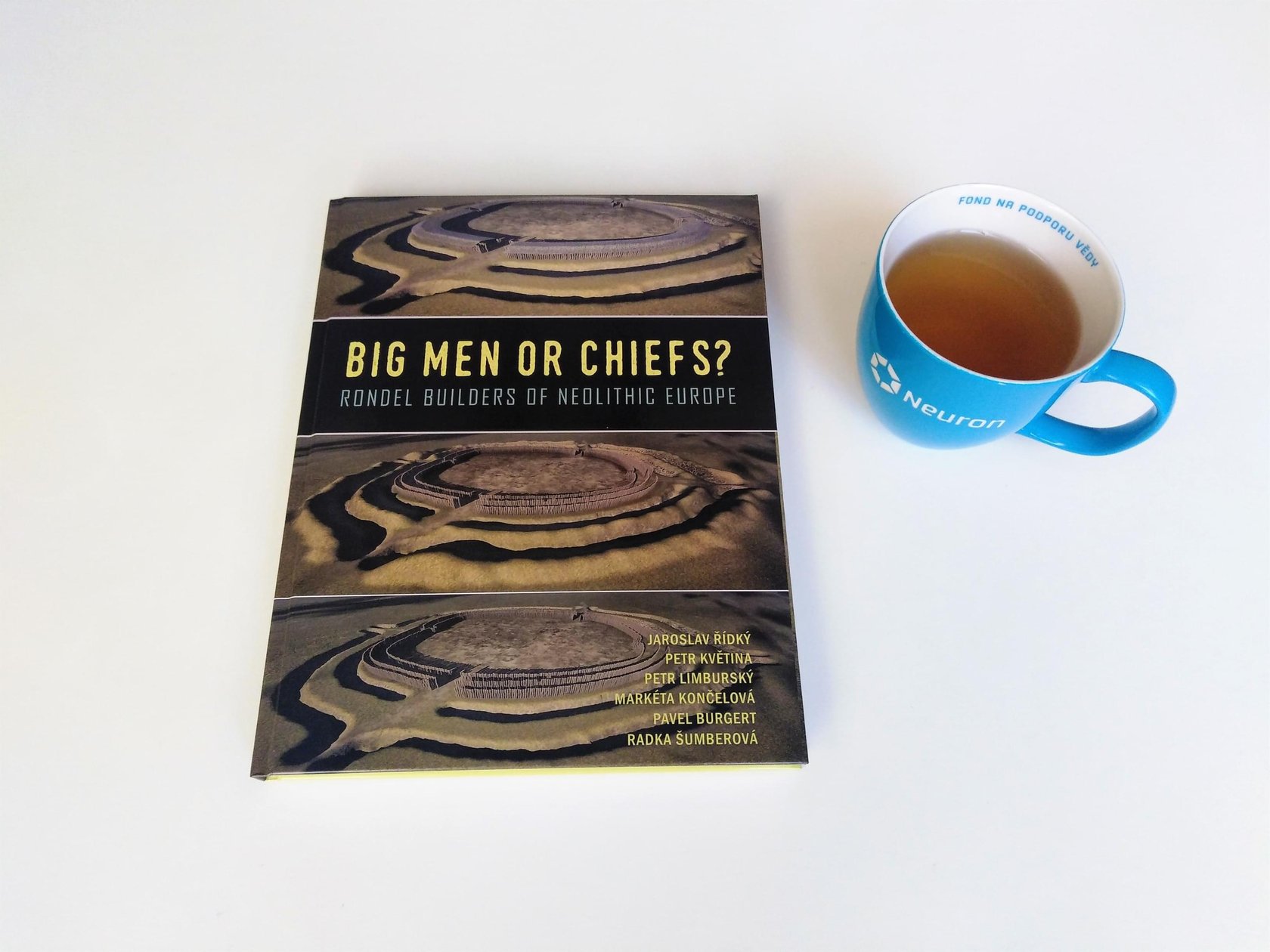
They must indeed have been impressive structures when they began to appear in Central Europe some 6,800 years ago. These are what are called roundels, in German Kreisgrabenanlagen. They tended to be huge: from thirty to 240 metres in diameter, made up of palisades and ditches and most often having two, three or four entrances. For whole decades archaeologists have puzzled over what and whom these huge structures served... Possible answers are now offered by Jaroslav Řídký of the Institute of Archaeology of the Czech Academy of Sciences in Prague, who with colleagues has newly published the monograph Big Men or Chiefs? Rondel Builders of Neolithic Europe (2019) with the leading publisher Oxbow Books in Oxford.
Neolithic roundels have been identified with sanctuaries, observatories, marketplaces, gathering places or ritual arenas. What interests the Czech scientists above all is their sociopolitical significance — in what environment they came about and who built them. The then apparently more or less egalitarian society had to agree on the construction, because building required not only the cooperation of a great many people but above all leadership and planning. And that meant either chiefs with hereditary status or big men, an anthropological term for natural leaders in Melanesia who gain prestige through talent, generosity or eloquence. The descendants of big men, however, have to earn similar prestige by their own efforts.
"It is interesting that across so large an area, from western Germany to Hungary and from Poland and Slovakia south to Austria, the structures within the territory of roughly five archaeological cultures have such a similar, almost unified circular shape. Everywhere roundels appear with two to four entrances — more or less at the cardinal points. Also remarkable is the disappearance of roundels after roughly one hundred to 150 years," Řídký told Lidové noviny. In his view the prehistoric builders of the time of the Stroked Pottery culture must have followed some generally known rules for such construction. Austrian experimenters also found that a roundel of about fifty metres took at least one year to build!
So far the most thorough overview
The new book is based on detailed research into 154 roundels in Central Europe. About forty are known in the Czech Republic; examples are the finds at Bylany in the Kolín region or at Těšetice-Kyjovice in Moravia. Dense concentrations are found along the lower course of the Vltava and in the Elbe basin, and also in Saxony and in the Danube region. The monograph has ten chapters. It works through a summary of various theories, and then Řídký and five colleagues (Petr Květina, Petr Limburský, Markéta Končelová, Pavel Burgert and Radka Šumberová) present specific finds, elements of architecture, radiocarbon dating, links to microregions and the so far most probable explanation of their existence.
"Settlements with roundels at that time may have been centres of whole regions, and the roundels themselves were apparently instruments of power, since some authority, probably a whole group — perhaps by force or by faith — controlled the inhabitants so that they would take part in the construction... We are considering what is called group hierarchy within settlement clans," says Květina, who drew inspiration from non-European ethnology. The authors of course wrote everything directly in English. "Important works about roundels exist in German, but the new book adds examples from Czech sites that were not so easily available to the international community," adds Řídký, whose work is now probably the most thorough study of the subject.
For the centenary of a research institute
Four years ago Řídký won a Neuron Impuls of CZK 683 thousand, which he used for mapping, dating and preparing the publication. "I value Neuron's support and I made full use of it," says the archaeologist, who with his colleagues was influenced by the research of Bohumil Soudský, who studied the world-famous Bylany near Kutná Hora. Over the hundred years of the existence of the Institute of Archaeology (it was founded in November 1919), the study of Neolithic roundels has, thanks to work at Bylany, at Vochov and in the Kolín region, become one of this institution's central subjects.