The dream that was never finished
10 May 2017
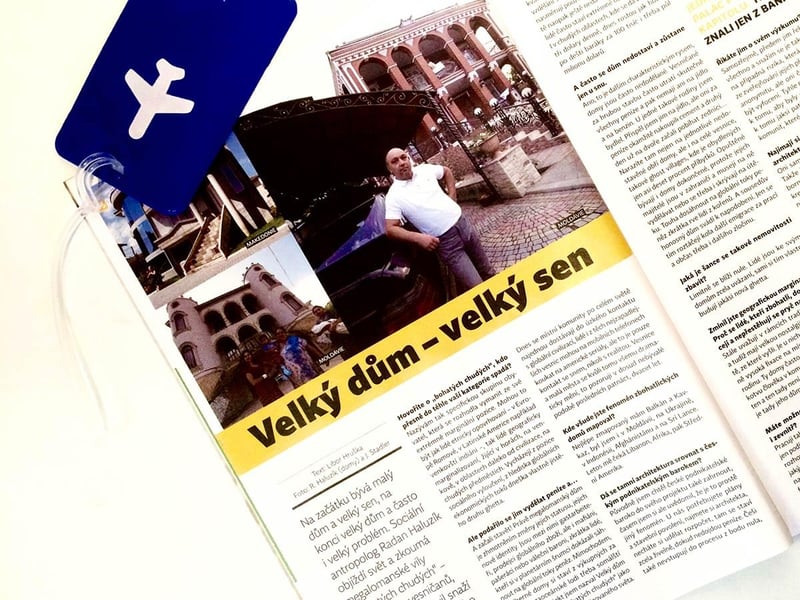
The social anthropologist Radan Haluzík maps the phenomenon of "entrepreneurial baroque" all over the world and tells the stories of people who cross boundaries for their dream. Boundaries of the state, of the law, of health or of their own means. "It is a sign of a certain era and of the identity of people who were poor until recently, who became relatively rich and want to show the world how long a road they have travelled and that they are new, better, modern," he says with great understanding about the idiosyncratically bombastic architecture that also took hold here in the building of family houses in the 1990s. His project succeeded this year in the Neuron Expedition, and so Radan Haluzík will set off to study the villas of the "rich poor" as a global phenomenon that is not so much a product of its place as of its time — a time of worldwide change, of the global flow of labour, goods and capital, but also of ideas and human dreams.
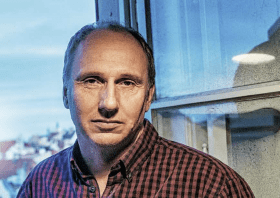
The social anthropologist Radan Haluzík maps the phenomenon of "entrepreneurial baroque" all over the world and tells the stories of people who cross boundaries for their dream. Boundaries of the state, of the law, of health or of their own means. "It is a sign of a certain era and of the identity of people who were poor until recently, who became relatively rich and want to show the world how long a road they have travelled and that they are new, better, modern," he says with great understanding about the idiosyncratically bombastic architecture that also took hold here in the building of family houses in the 1990s. His project succeeded this year in the Neuron Expedition, and so Radan Haluzík will set off to study the villas of the "rich poor" as a global phenomenon that is not so much a product of its place as of its time — a time of worldwide change, of the global flow of labour, goods and capital, but also of ideas and human dreams.
The interview appeared in the magazine TÉMA no. 2/2017.
It is published with the kind permission of the author Lenka Vrtišková Nejezchlebová and the editors.
Photographs of all the houses: Radan Haluzík
You travel the world collecting material — experiences, interviews and photographs — for your project about the houses of the "rich poor", as you call them. You often live in those houses too. Where were you last?
In the summer I was, for instance, in a Moldovan Roma town, in a stunning huge house, almost a small chateau. It was beautiful… but empty. So they lent me the whole of it. The owners, a Roma couple, lived in a smaller house next door; they were wonderful company and storytellers, I fell in love with their tales and above all with their energy for life. Already towards the end of communism they had a cooperative workshop making men's underwear; after the fall of the regime they traded successively in Chinese crockery, bedlinen, curtains and tablecloths all over the former Soviet Union. They grew rich and built three-storey palaces for their four sons. But only one of them more or less works.
"He sketched his dream house on a sandwich bag."
How is that?
They miscalculated the building costs. And who could have guessed that all those economic flows of theirs would gradually dry up? I was there when they called in tradesmen to get one of those palaces with little turrets — under construction for more than twenty years — into working order, to lay on water, finish the electrics, the kitchen and the outdoor paving; but the tradesmen estimated another "two suitcases of money" — that is, 200 thousand dollars! And they no longer have that. Business is not going as it used to, the parents are old, one of the sons is ill. The others are abroad with their families chasing business and trying to earn enough so that one day they can finish their houses. And it works similarly in half the palaces in this villa quarter of dreams. Or rather it looks as if it works, but it does not.
In what sense?
For instance, in the house where I stayed there is a fantastic staircase, put together entirely from tiny wooden pieces, marquetry, like a chessboard — in short, a gem. But the heights are wrong; in some places an opening has to be cut out so that a person can get through without hitting their head. Those stairs are also considerably steeper than they should be, sometimes two or three centimetres higher than the standard — but the joke is in that "sometimes". Every one is different, it really was awkward to walk on.
Forgive me for laughing, but it is funny. It reminds me of Pat and Mat.
These absurdities are a hallmark of many buildings I have seen in various parts of the world. They are thrown together on the spot, without an architect. Sometimes the builder draws up a do-it-yourself plan at home, but far more often it is built without any plan at all. My friend from Chechnya says: "Architects are freeloaders!" He sketched the look of his dream house on a sandwich bag, glanced at it a few times, then threw it away and has been building ever since. Surprisingly, it has not yet fallen on his head. A Macedonian businessman, in turn, says: "The architect isn't going to live in it — you're going to live in it! You know best how you'll live!" He employs a number of designers in his companies, but he thought up and largely designed his own house himself.
Where does that attitude come from?
These people see modernity as release from the straitjacket of tradition and as a chance for freedom. The house is meant to express that. "That house — that's ME, and this is how far I've come!" They want to be the architects of their dream — of their new life, which is positive, though in the case of building somewhat impractical.
"That house, that's me, that's how far I've come."
So what does the building look like?
Most people dig the biggest hole they can, then stand in it, call in the bricklayers and wave their arms about, creating a house. But don't laugh too much — under the same conditions it would turn out similarly here. Most people roughly calculate the cost of the shell, which is only about a quarter of the total cost, so they inevitably run out of money. The reason we do not have so many unfinished and uninhabited buildings here is only that the authorities do not issue a building permit until you have a plan, and where there is a plan there is a budget, which leads to a certain rationality. In the places I have been around the world, most houses were built semi-legally or illegally, because nobody checks.
So let us go back to your Moldovan friends and the house where you stayed. What else there was typical of such buildings?
For instance, the second-to-top floor was a "reception room" with a dining room. A polished table, beautiful furniture, crystal chandeliers, expensive carpets. But where is the food going to be carried from, when those stairs are so steep and the kitchen is in the house next door?! And who is actually going to gather at that table? Moldovan Roma do not eat together at a table; they eat as and when each of them comes along, in the kitchen. So this dining room, which was never used, is absurd. But beautiful. I had that whole gleaming palace to myself; in the bedroom on the first floor I slept in a splendid bed like a lord. But I was probably the dirtiest I have ever been in my life.
How so?
There was no bathroom in the house. It was hot, I was constantly dusty and sweaty. I could go and wash in the parents' little house, but only occasionally; I would have been embarrassed to keep going there. And I had a lovely toilet with a floral pattern, but dry and at the back of the yard, so I kept going up and down those terrible and beautiful stairs.
Do they see their situation as a defeat?
Not at all. The house functions as a prestige object and in their way they are proud of it. I have seen plenty of such houses and talked to many families in a similar position. Sometimes they live a little further off in some summer kitchen; other times guest-worker families stay abroad and come to their houses only for the summer; elsewhere they huddle in one room that they heat and keep habitable — but few people are annoyed that it is not quite as they imagined. The knowledge that they have such a house, a mention of it in front of colleagues, competitors, clients — all of that raises their prestige, the status of their "humanity", it is the meaning of their lives.
And is it not just an illusion?
I don't think so; it has an effect. If you have a cleaner at work from Ukraine, say, and she shows you photographs of such a house, won't you look at her a little differently? Admit that you will. And from photographs, or from a single chance visit to such a house, you cannot tell how things really are; from the point of view of "representation" those houses actually fulfil their expected function.
Potemkin luxury?
Yes. But what in today's consumer society is not Potemkin luxury? People have cottages in the mountains and houses by the sea that they never visit, pedigree dogs they do not even have time to walk... The houses I study know how to impress. And impression is a powerful weapon. In business negotiations, in negotiations over a bride, but also in negotiating respect and social status in general. And they are the tidiest houses I have seen. They smell lovely. The hosts bring you coffee, serve refreshments, everything gleaming. Only if they let you live there, as they did with me, do you understand that things are not as they seem at first sight.
"You're meant to say: bloody hell! What-is-this!!"
How does it happen that people invite you to stay with them?
As a student of anthropology in the 1990s I travelled around the Caucasus and the Balkans doing war reporting and later anthropological research into ethnic conflicts. I was largely dependent on someone inviting me home to sleep, to eat and, above all, to talk to me about what was going on. Gradually I learned to "be a good guest". Without that I could not do my work; I can't stay in a hotel or a guest house, I have to get to know the people and the houses at close quarters.
Do you pay your hosts anything?
Mostly not, and most of them would not take anything anyway. But when I see somewhere that in the palace where I am a guest the fridge is empty and food is short because all the money went into building, I discreetly — so as not to be embarrassing — contribute to the food. A certain reciprocity plays a part too. Just as I am curious about how they live, they are curious about how I live. I have to do a lot of talking myself. They have to "enjoy" it too. And I do it with great pleasure; field work is probably the happiest part of my life altogether. I return to some families even after years; I have friends from them all over the world.
Let us say a little more generally which people and which houses you are mainly interested in, what to imagine under the term "nouveaux riches", or as you sometimes say the "rich poor".
It is a sign of a certain era and of the identity of people who were poor until recently, suddenly became relatively rich and want to show the world how long a road they have travelled and that they are new, better, modern. But they did not know how wealth is "shown", what the houses of rich people look like elsewhere; they had only their dreams, which are inspired more by American television series and historical films about aristocracy than by reality. "Nouveaux riches" of the 1990s really did build houses with turrets all over the world — we know it here too, half a reflection of folk architecture, half the American dream. And those houses remained and remain unfinished.
Where are they to be found?
At first I was convinced that this "entrepreneurial baroque" was exclusively a post-socialist phenomenon, but I found buildings with similar features in Indonesia, in Afghanistan, in Sri Lanka, in Latin America, in Africa — in short, everywhere. They reflect not only the 1990s but later periods too, depending on when the wave of globalisation passed through and brought wealth to a certain part of the until then poor local population. As an anthropologist that is exactly what interests me, as part of today's story of our planet, the story of globalisation. The money is there on this planet, but only if a person can reach the great global flows. And to reach them you have to go where they flow. And so, for their dream of a large house, these people often have to cross boundaries — geographical ones, or at least moral ones. They have to tear themselves either out of their environment, travel far and become guest workers, or out of decent society and set foot on the ground of organised crime, of growing opium, of selling drugs or killing people, and become a mafioso or a corrupt politician. But those who decided to go into business also grow rich, or those who gained contacts with multinational companies — they sell Coca-Cola in the middle of a desert or a rainforest. Or marginalised ethnic minorities such as Roma or Latin American Indians. They may have been born into mud huts, suddenly grew rich and began to build a house. And put all their money into it.
And straight away as big a house as possible! To make up for the inferiority complex of the "mud hut"?
I don't like the word inferiority complex. As someone who went from — as you put it, the "inferiority complex of a prefab block" — to study at Stanford, I know that it is not easy either to meet the expectations and challenges of a new environment or to understand straight away what that new environment is actually about. After all, we all remember it from the 1990s. I see it as an effort by self-made men to come to terms with that change. I call it emancipatory architecture. "I've travelled a long way, look, this is my house — this is who I am now."
Is there any typical shared feature of those buildings, whether they are built by a mafioso, an honest entrepreneur or a guest worker?
Very common, for instance, is the straddling of this emancipatory architecture between tradition and modernity: from outside nothing but traditional ornament, references to the palaces of historical feudal lords and to folk architecture — from inside the luxury of modern Western kitchens, bathrooms, plasma televisions and garages with BMWs and Mercedes. Also typical are the oversized shared spaces of the house, so that as many guests as possible can be invited and shown "how we live here". Conversely, for individual members of the family there are no individual spaces at all, or only shared ones. In the longing for the achievements of the West, the Western "spirit" was forgotten — a spirit that also consists of individualisation, privacy, self-development and room for interests and hobbies.
You are the son of an architect and were formed by good schools at home and abroad. Has your relationship to these houses developed in aesthetic terms?
At first impression they look tasteless, overloaded, oversized... It is bizarre, but breathtaking. And that is how it is meant to be. You are meant to say: "Bloody hell! What-is-this!!" (he laughs) At first I gasped a little, but gradually I began to like it. I test that aesthetic on myself when I live in those houses. As with that family in Moldova. I lay in an enormous bed in that bedlinen with stags and giant tea roses and looked up at a huge chandelier of Czech red crystal. It was like looking into a fire, staring every evening into that blood-red crystal chandelier. Those houses are designed to work on people in this way, to make an impression, to "touch" them, to "take their breath away". I enjoy the aesthetic of those houses; other things bother me.
What?
Their unfinishedness and non-functionality. A supreme effort for a dream that stops halfway. The health risks that go with it. Slaving for thirty years without a day off somewhere far across the sea, saving on food, and then spending your holiday building a house again without a single free day? With houses that came out of illegal activity, further questions arise... someone dealt in drugs, someone robbed someone, or so it is said even killed. It bothers me that in the end these people do not arrive at the contentment offered by an ordinary "town flat" where everything runs and lights up and it is warm and fish swim about in an aquarium, a budgerigar chirps and the children do their homework in their own room. For all their incredible sacrifices, these people will not experience that, and I am sorry about it.
It strikes me as a depressing picture.
But it is more complicated still. You do not know the variant in which there is NO HOUSE AT ALL! Staying in that — as you called it "hut" — is even worse. I have the story of a man from the truly poorest region of Montenegro. In a place with nothing but scrub and stones, somewhere in the middle of the hills, he had a small house and two sons in it. He went to work in Germany and slaved for ten years from morning till night, intending to buy a decent plot and build on it a house for himself, his sons and their future families. In the meantime land prices rose so much that with all his money he could afford only the plot and a tiny bedsit for his old age. And he left his sons that small house in the scrub... The brothers fought and one had to leave. The "winner" has 20 square metres, without water, without a road, for a whole family. And also a great deal of boredom during the long dark winters out there in the solitude of the mountains. Against that, a story crowned with a — for you kitschy and not quite finished — house is a complete fairy tale.
Do you have a favourite house?
The "apple house" in Macedonia comes to mind, for instance; the family that built it makes its living growing and selling apples on global markets. It has a large red apple emblem in the gable, everything in that house refers to its red colour, and before our visit they scented it with apple perfume. Fortunately this family is not among the desperate ones; they have enough money, business is going well so far, the son and daughter commute to the city for university. It does, though, have its "but". Downstairs there is a space prepared for some kind of premises, a café, a small shop, as many such houses have — but it is empty, and that is typical too. Upstairs in the house it is also empty, a whole floor prepared for the boy for when he marries…
Not for the daughter?
She is to marry out of the house. That is what "tradition dictates". The boy will take over the apple business. The house is enormous, but everyone actually lives practically in one room, heated in winter by the only stove in the house. The student siblings do have their shared "children's room", but there is no proper desk in it and it is not heated in winter. And it really is getting on their nerves that they always sleep together. "Brother, because of you I'll probably stay a virgin!" she laughs. The lack of privacy we talked about can be seen here on this plan. No little bedrooms, children's rooms, studies. Just more and more living rooms with sofas! Shared spaces swamp the house; there is no thought at all for space for intimacy, sexuality and individuality, for hobbies. And this is where the whole thing actually starts to be about a culturally sensitive question: what is the "dreamed-of West" the builders look up to, and what is only a formal imitation of it?
"Staying in a hut is far worse."
I thought we would be talking about individual houses, but in your photographs I see whole zones of very similar houses — how is that?
Yes, often whole new rural and suburban landscapes, mostly laid out in an urbanistically nonsensical way. The houses get in each other's way and block each other's light, which sparks conflicts. It is a bit of an arms race; everyone wants their house to be as big as possible, so they push them higher and higher. There tends to be no sewerage; waste water flows between the houses. There are no paved roads, or only paving laid on soil that the first heavy rain washes away. Or they stand in places where there is no room for so many buildings. Here in this picture, for instance, we see an originally small mountain village on the border of Kosovo, Macedonia and Albania, at an altitude like that of Sněžka.
How many inhabitants does the village have today?
Officially ten thousand, but only a few per cent of those people live there all year round. I have been there three times. In the 1990s about half the old original houses were still standing. And today? A few last old cottages of branches and stone huddle there, built around by unplastered palaces. They are essentially steep ski slopes; occasionally an avalanche comes down and sometimes takes one of the houses with it... But building goes on. Without any spatial plan, without roads, without sewerage. The electricity is often only temporarily strung up. As in many other mountain villages in the western Balkans, they have literally built over all the fertile land.
Where are those ten thousand people?
Most of them come here only for a few weeks in summer, when there are company holidays in Germany, Switzerland and Austria. Many have patisseries and bakeries all over the world (I know of one in Prague) and, when they want to go home, have to find someone to stand in for them. At the end of the summer they load everything back into their cars and drive back, because their children go to school in Germany, Switzerland or Austria. Over the winter about five per cent of the inhabitants stay. A ghost village. But you will see the same landscapes in Ukraine, in Moldova, in El Salvador, in Guatemala, in Mexico, in Sri Lanka…
Did you talk to the people there?
Of course. Some are getting really tired of the commuting and the divided life; others are already in spirit out there in the world and come up to the mountains only out of piety or as if "to a cottage". Many would like to return for good, but they know very well that there would be nothing for them to do there.
After the country joined the EU, a wide world opened up for the Romanian nomadic Kalderash Roma.
And with it great wealth, great temptations and expectations."
When someone sees that a neighbour has been attempting his dream for years and the building has no end, why do others still go into it?
They believe for a terribly long time that they really will finish those houses one day and that then the whole family will move in. But when someone already has such good business abroad, it is hard to leave it. And in the meantime they put down roots in a foreign country, gain residence status, citizenship, the children start going to school there. That is the paradox of globalisation. The bigger the house, the more its owner has to be abroad to earn for it, and the emptier the house is. Big house equals empty house. On my wanderings around the world I met only a minority of people who both live in their dream houses and have them finished. Mostly they are those who built a small house and have some reasonable source of livelihood in the place where it stands.
We have covered guest workers and talked about entrepreneurs, but you also know the stories of houses built with money from crime or some illegal activity...
I have seen mafia houses, houses built from petty and long-term crime, from begging or pickpocketing in Western Europe. A chapter in itself are houses built from illegally claiming social benefits in EU countries, which was written about a good deal in the British press, which has documented a number of such cases and houses in Romania. One Romanian street that grew out of them is even nicknamed "Benefit Boulevard". In Chechnya in the 1990s a whole generation of palaces grew out of bank fraud. A specific chapter are then the houses of warlords, often outright war criminals, such as Arkan (the nickname of Željko Ražnatović, commander of the paramilitary Serb Volunteer Guard — ed.). Remarkable are the Afghan so-called Poppy Houses, built with money from heroin, and the houses of Mexican drug barons.
"A massage bath in the bathroom, but no water."
You went in search of entrepreneurial baroque in Indonesia too — what is the situation like there?
I was in Bali and mainly on one island near Bali, where people grow rich thanks to tourism and above all from the production of palm oil and also rubber, whose plantations they go far away to plant — as far as the rainforests of Sumatra. But I also know families who have "seaweed gardens" on the sea coast. On a large scale they grow and dry two special kinds of edible seaweed, which they then sell on the Japanese market.
And what does Indonesian "entrepreneurial baroque" look like?
A little different in each region. In Bali they are little houses-cum-chateaux, half traditional architecture and half the style of a modern Western villa. By the house there is a traditional ornamental pond, they have birds in cages, they keep cockerels for cockfighting. They have a domestic Hindu shrine, but also a modern garage, kitchen and bathroom, which often does not work because the region suffers from a shortage of water.
Have you ever met anyone whose dream really came true? For whom it works as they imagined?
The closest to that is probably my friend from the little island near Bali. He makes his living from various services in tourism and does site supervision on several projects. He had a wild childhood and adolescence, left his family and started living with acquaintances and on the beach. He became a wild man who admires reggae and Bob Marley. He made friends with people from Europe working in Bali, went out with a Japanese woman, educated himself, gathered experience. He is an extremely intelligent lad. He "only" completed secondary school, but secondary education is surprisingly decent even in some developing countries, so he gained very solid foundations in biology and mathematics, writes good English and reads a lot — he has the largest collection of novels on the island, where over 40 thousand people live.
"A proper house should have two faces."
And what did his dream look like?
Some time ago he started working on a project to build nine luxury tourist villas in the shape of a manta ray. The tourist business on the island is based on the fact that you can dive here among mantas, almost within arm's reach. And he knows mantas well, because he worked as a diving instructor; he loves mantas and that was reflected in his dream of his own home. "The manta is like an animal coming from somewhere in space, out of imagination. The manta has two parts, white below, black above, and that is mystical," he says. "When you have a deer, it's still a deer. From the front, from the back, brown — a deer. Not the manta. The manta has two faces: from below welcoming, very personal. And from above — protective. And that is what a proper house should be like too!" And so he longed for his own house in the shape of a manta.
"Many of the houses appearing in Sri Lanka imitate the palaces of the old maharajahs and more recent colonial art deco villas."
From the photograph it looks like a manta with its fins cut off.
Yes, he did not finish those "wings", because he would have had to buy up the neighbouring plots. But he is sensible and will not do it; he would rather invest in the interior fittings so that the house works. He has lived in that house from the start. And when we look at the floor plan, you can see he also thought about individual space: a bedroom, a children's room, a guest room, even a study with a computer. He does have his fears and anxieties that business will not go as well as it has so far, but he has his house, his dream, in which he lives well, even if it is a slightly trimmed manta.
So a little optimism at the end?
Of course, his house "without wings" fills me with it. We live in a time of great global dangers and pitfalls, but also of great challenges and hopes. I see that in the houses too. It may turn out as it did in my native Wallachia, where in the 1970s people suddenly moved from wooden cottages into brick villas: if the generation that built the houses does not fully settle and get them working, their children will see it through to the end.
At first I gasped a little, but gradually I began to like it.
I test that aesthetic on myself when I live in those houses."